


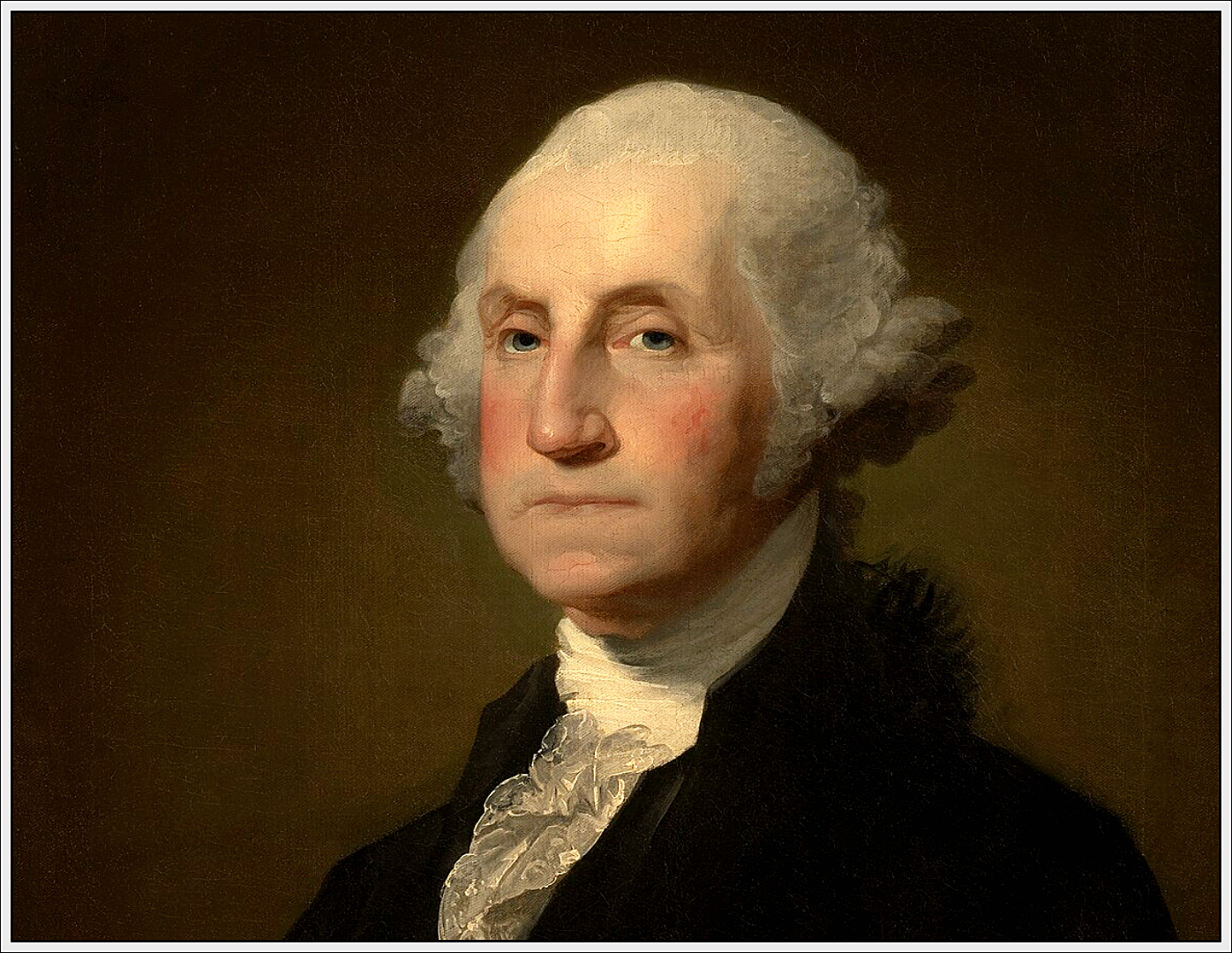

George Washington: February 22, 1732-December 14, 1799
✪ George Washington was a Founding Father and the first President of the United States, serving two terms from 1789 to 1797. As commander of the Continental Army, Washington led Patriot forces to victory in the American Revolutionary War against the British Empire. He is commonly known as the Father of His Country for his role in bringing about American independence.
in 1788, Washington was elected president unanimously by the Electoral College and again in 1792. As the first U.S. President, he implemented a strong, well-financed national government while remaining impartial in the fierce rivalry that emerged within his cabinet between Thomas Jefferson and Alexander Hamilton. During the French Revolution, he proclaimed a policy of neutrality while supporting the Jay Treaty with Britain.
Washington set enduring precedents for the Office of the President, including republicanism, a peaceful transfer of power, the use of the title “Mr. President” and the presidential two-term tradition.
George Washington was born on February 22, 1732, at Popes Creek in Westmoreland County, Virginia. He was the first of six children of Augustine and Mary Ball Washington.
His father Augustine was a Justice of the Peace and a prominent local public figure who had four additional children from his first marriage to Jane Butler. Washington was never close to his father and rarely mentioned him in later years. He also had a fractious relationship with his mother. However, among his siblings, he was particularly close to his older half-brother Lawrence.
Washington was baptized as an infant in April 1732 and was a devoted member his entire life of the Anglican Church. He served for more than 20 years as a vestryman and churchwarden at the Fairfax and Truro parishes in Virginia. He privately prayed and read the Bible daily. He also often publicly encouraged prayer.
In 1735, Washington’s family moved to a plantation on Little Hunting Creek before settling in 1738 at Ferry Farm near Fredericksburg, Virginia. When his father Augustine died in 1743, Washington inherited Ferry Farm and ten slaves. His half brother Lawrence inherited Little Hunting Creek and renamed it Mount Vernon.
Because of his father’s death, Washington did not have the same level of formal education his elder half-brothers received at Appleby Grammar School in England. He instead attended the Lower Church School in Hartfield. There, he studied & learned mathematics and land surveying. He became a talented draftsman and mapmaker.
By early adulthood, hWashington was already writing with what his biographer Ron Chernow described as “considerable force” and “precision.” As a teenager, Washington compiled over a hundred rules for social interaction styled The Rules of Civility, copied from an English translation of a French guidebook.
In 1748, Washington spent a month with a team surveying Fairfax’s Shenandoah Valley property. The following year, he received a surveyor’s license from the College of William & Mary. By 1752, Washington had purchased almost 1,500 acres of land in the Shenandoah Valley.
Lawrence Washington’s service as adjutant general of the Virginia Militia inspired George to seek a militia commission. Virginia’s lieutenant governor, Robert Dinwiddie, appointed Washington as a major and commander of one of the four militia districts. At that time, the British and French were competing for control of the Ohio River Valley. The British were constructing forts along the river; and the French between the river and Lake Erie.
Washington was also directed by Dinwiddie to make peace with the Iroquois Confederacy in order to to gather intelligence about the French forces. Washington personally met with Iroquois leader Tanacharison at Logstown.
In February 1754, Dinwiddie promoted Washington to lieutenant colonel and second-in-command of the 300-strong Virginia Regiment, with orders to confront the French at the Forks of the Ohio.
In May of that same year, after having established a defensive position at Great Meadows, Washington learned the French had made camp seven miles away; and he decided to take offensive action. With a small force of Virginians and Indian allies he killed the French, including their commander Joseph Coulon de Jumonville, who had been carrying a diplomatic message for the British.
The rest of the Virginia Regiment joined Washington the following month with news that he had been promoted to the rank of colonel and given command of the full regiment. Washington was suffering from severe dysentery so did not initially travel with the expedition forces.
The Virginia Regiment was reconstituted in August 1755 and Dinwiddie appointed Washington its commander, again with the rank of colonel. Under Washington, the Virginia Regiment defended 300 miles of frontier against twenty Indian attacks over a period of ten months. Washington developed the professionalism of the regiment as it grew from 300 to 1,000 men. Though he failed to realize a royal commission, which made him hostile towards the British, he gained self-confidence, leadership skills, and knowledge of British military tactics. Destructive competition Washington later witnessed among colonial politicians fostered his future support of a strong central government.
On January 6, 1759 at age 26, Washington married Martha Dandridge Custis, the 27-year-old widow of wealthy plantation owner Daniel Parke Custis. Martha was cultured, educated, intelligent, gracious and experienced in managing a planter’s estate. The couple enjoyed a happy marriage.
The Washingtons lived at Mount Vernon, where George cultivated tobacco and wheat. The marriage gave Washington control over Martha’s one-third dower interest in the 18,000-acre Custis Estate she inherited from her late husband; and he also managed the remaining two-thirds for Martha’s children. As a result, Washington became one of the wealthiest men in Virginia, which increased his social standing.
As a respected military hero and prominent landowner, Washington held local offices and was elected to the Virginia provincial legislature, representing Frederick County in the Virginia House of Burgesses for a seven year period beginning in 1758.
Early in his legislative career, Washington rarely spoke at or even attended legislative sessions, but was more politically active starting in the 1760s. He eventually became a prominent critic of British taxation and mercantilist policies towards the American colonies.
Washington was opposed to the taxes which the British Parliament imposed on the Colonies without proper representation. He believed the Stamp Act 1765 was oppressive and celebrated its repeal the following year. In response to the Townshend Acts, he introduced a proposal in May 1769 which urged Virginians to boycott British goods.
Washington and other colonists were also angered by the Royal Proclamation of 1763 (which banned any American settlements west of the Allegheny Mountains)and British interference in American western land speculation (in which Washington was a participant)
In 1774, Parliament sought to punish Massachusetts colonists for their role in the Boston Tea Party by passing the Coercive Acts, which Washington saw as “an invasion of our rights and privileges.” That July, he and George Mason drafted a list of resolutions for the Fairfax County committee, including a call to end the Atlantic slave trade. The resolutions were adopted. In August, Washington attended the First Virginia Convention and was selected as a delegate to the First Continental Congress. As tensions rose in 1774, he helped train militias in Virginia and organized enforcement of the Continental Association boycott of British goods instituted by the Congress.
On April 19, 1775, the American Revolutionary War broke out and Washington hastily departed Mount Vernon on May 4 to join the Second Continental Congress in Philadelphia. On June 14, Congress officially created the Continental Army and John Adams nominated Washington as its first commander-in-chief, mainly because of his military experience and the belief that a Virginian would better be able to unite the colonies. He was unanimously elected by Congress the next day. On June 16, Washington gave his acceptance speech and declines any salary.
Washington crossed the Delaware River into Pennsylvania, where General John Sullivan joined him with 2,000 more troops. By then, the future of the Continental Army was in doubt due to a lack of supplies, a harsh winter, expiring enlistments, and desertions. At sunrise on December 26, 1776, Washington, aided by Colonel Knox and artillery, led his men in a successful surprise attack on the Hessians in Trenton, New Jersey.
Washington and his army would return again to New Jersey on January 3, 1777, and launch an attack on the British regulars at Princeton. In that battle, 40 Americans were killed or wounded and 273 British killed or captured. Strategically, Washington’s victories at Trenton and Princeton proved to be pivotal in the Revolutionary War. They changed the course of the war by reviving Patriot morale and quashing the British battle strategy of showing overwhelming force followed by offering generous terms.
In December 1777, Washington and his army of 11,000 men went into winter quarters at Valley Forge north of Philadelphia. There they lost between 2,000 and 3,000 men as the result of disease and lack of food, clothing, inadequate shelter, reducing the army to below 9,000 men. By February, Washington was facing low troop morale and increasing numbers of desertions.
An internal revolt by his officers prompted some members of Congress to consider removing Washington from his command. However, Washington’s supporters in Congress resisted, and the matter was ultimately dropped.
Washington also became America’s first spymaster by designing an espionage system against the British. In 1778, Major Benjamin Tallmadge formed the Culper Ring at Washington’s direction to covertly collect information about the British in New York.
When the Treaty of Paris was signed on September 3, 1783, Britain officially recognized American independence. Washington disbanded his army, giving a farewell address to his soldiers on November 2. After he oversaw the evacuation of British forces from New York, he was greeted by parades and celebrations.
In early December 1783, Washington officially bade farewell to his officers at Fraunces Tavern and resigned as commander-in-chief soon after. In a final appearance in uniform, he gave a statement to the Congress:
“I consider it an indispensable duty to close this last solemn act of my official life, by commending the interests of our dearest country to the protection of Almighty God, and those who have the superintendence of them, to his holy keeping.”
Washington’s resignation and Farewell Address was acclaimed at home and abroad, “extolled by later historians as a signal event that set the country’s political course”
After spending just ten days at Mount Vernon after eight and a half years at war, Washington was eager to return home. He arrived in Mount Vernon on Christmas Eve. Historian professor John E. Ferling wrote that he was delighted to be “free of the bustle of a camp and the busy scenes of public life.” Washington received a constant stream of visitors at Mount Vernon who arrived to pay their respects.
To make his estate profitable again, Washington undertook a new landscaping plan and succeeded in cultivating a range of fast-growing trees and native shrubs. He also began professionally breeding mules after being gifted a stud by King Charles III of Spain in 1785. He believed mules would revolutionize agriculture.
Before returning to private life in June 1783, Washington called for a strong union. Though he was concerned that he might be criticized for meddling in civil matters, he sent a circular letter to the states, maintaining that the Articles of Confederation were no more than “a rope of sand.” He believed the nation was on the verge of “anarchy and confusion” and was vulnerable to foreign intervention He believed a national constitution was necessary to unify the states under a strong central government. Congress agreed to a Constitutional Convention to be held in Philadelphia in 1787, with each state sending delegates to attend.
Washington arrived in Philadelphia on May 9, 1787, and the convention began on May 25. Benjamin Franklin nominated Washington to preside over the meeting, and he was unanimously elected.
On July 10, in a letter to Alexander Hamilton, Washington wrote: “I almost despair of seeing a favorable issue to the proceedings of our convention and do therefore repent having had any agency in the business.” Nevertheless, Washington lent his prestige to the work of the other delegates and lobbied to many of them to support the ratification of the Constitution. The final version adopted the Connecticut Compromise between the two plans; and was signed by 39 of 55 delegates on September 17, 1787.
Washington was inaugurated to his first term as President on April 30, 1789; taking the oath of office at Federal Hall in New York City. His inaugural coach was led by militia and a marching band, followed by statesmen and foreign dignitaries in an parade attended by a crowd of 10,000. Robert R. Livingston administered the oath, using a Bible provided by the Masons.
Afterwards, Washington read a speech in the Senate Chamber, asking “that Almighty Being … consecrate the liberties and happiness of the people of the United States”
His executive precedents included the inaugural address, messages to Congress, and the cabinet form of the Executive Branch. He also personally selected the first justices of the Supreme Court.
Congress created executive departments in 1789; including the State Department, the War Department and the Treasury Department. Washington appointed Edmund Randolph as Attorney General, Samuel Osgood as Postmaster General, Thomas Jefferson as Secretary of State, Henry Knox as Secretary of War, and Alexander Hamilton as Secretary of the Treasury.
Washington exercised restraint in using his veto power, writing that “I give my Signature to many Bills with which my Judgment is at variance.” He was most sympathetic to a Federalist form of government.
Other domestic issues during Washington’s first term included the planning of a permanent capital, the passage of several constitutional amendments including the Bill of Rights, and continuing debates concerning slavery and expansions into Native American territory. Washington proclaimed November 26, 1789, as a day of Thanksgiving to promote & encourage national unity.
Washington initially planned to retire after his first presidential term, weary of office and in poor health. However, many urged him to run for a second term.
As the election of 1792 drew near, Washington agreed to run again On February 13, 1793, the Electoral College unanimously re-elected Washington president for a second time, while John Adams was re-elected as vice president by a vote of 77 to 50. Washington was sworn into office by Associate Justice William Cushing on March 4, 1793, in Congress Hall in Philadelphia.
At the end of his second term, Washington retired. He was dismayed by personal political attacks against him and wanted to ensure that a truly contested presidential election could be held. He did not feel bound to a two-term limit, but his retirement set a significant precedent. On September 19, 1796, David Claypoole’s American Daily Advertiser published his now famous Farewell Address.
In this addess, Washington stressed national identity was paramount, and said that the “name of AMERICAN… must always exalt the just pride of patriotism. Washington also warned against the dangers of political parties and entangling foreign alliances with domestic affairs. He counseled friendship and commerce with all nations, but warned against involvement in European wars. He stressed the importance of religion, asserting that “religion and morality are indispensable supports” in a republic.
He closed his address by reflecting on his legacy:
“I fervently beseech the Almighty to avert or mitigate the evils to which my unintentioned errors may tend. I shall also carry with me the hope that my country will never cease to view them with indulgence, and that, after forty-five years of my life dedicated to its service with an upright zeal, the faults of incompetent abilities will be consigned to oblivion, as myself must soon be to the mansions of rest.”
Washington’s “Farewell Address” is considered one of the most influential statements on republicanism.
In March 1797,Washington retired to Mount Vernon to devote time to his business interests. There, he became an even more committed Federalist.
Washington was known to be rich because of what historical biographer Chernow calls the “glorified façade of wealth and grandeur” at Mount Vernon. However, nearly all of his wealth was in the form of land and slaves rather than ready cash. To supplement his income, Washington erected a distillery for whiskey production. He also bought land parcels to spur development around the new Federal City (named in his honor in 1791).
At the time of his death in 1799, Washington’s estate was worth an estimated $780,000 and he held title to more than 58,000 acres of land across Virginia, Ohio, Maryland, Pennsylvania, New York, Kentucky, and the Northwest Territory. Washington’s peak net worth was estimated to be $587 million in 2020 dollars.
On December 12, 1799, Washington inspected his farms on horseback in inclement weather for five hours. He then dined with guests without first changing into dry clothes. The next day, he awoke with a sore throat but was well enough to go out again to mark trees for cutting. Early the following morning, he awoke to an inflamed throat and difficulty breathing.
He ordered his estate overseer, George Rawlins, to remove nearly a pint of his blood (bloodletting was a common practice of the time). They continued the bloodletting until approximately five pints were removed and Washington’s condition further deteriorated.
Washington instructed his doctors to leave the room saying, “I die hard, but I am not afraid to go.”
On his deathbed, and afraid of being entombed alive, Washington instructed his private secretary Tobias Lear to wait three days before his burial. According to Lear, Washington died between 10 p.m. and 11 p.m. on December 14, 1799, with Martha seated at the foot of his bed. His last words were “‘Tis well.”
Modern medical authors have largely concluded that he likely died from severe severe epiglottitis complicated by the treatments he was given, which included multiple doses of calomel (a purgative) and extensive bloodletting.
Washington’s funeral was held on December 18, 1799, four days after his death, at Mount Vernon. Cavalry and foot soldiers led the procession, and six colonels served as the pallbearers. The Mount Vernon funeral service was restricted mostly to family and close friends. Reverend Thomas Davis read a brief funeral service, followed by a ceremony performed by members of Washington’s Masonic Lodge; Washington had been a Freemason since 1752. Word of his death spread slowly, but as it reached other regions, church bells rang and many businesses closed.
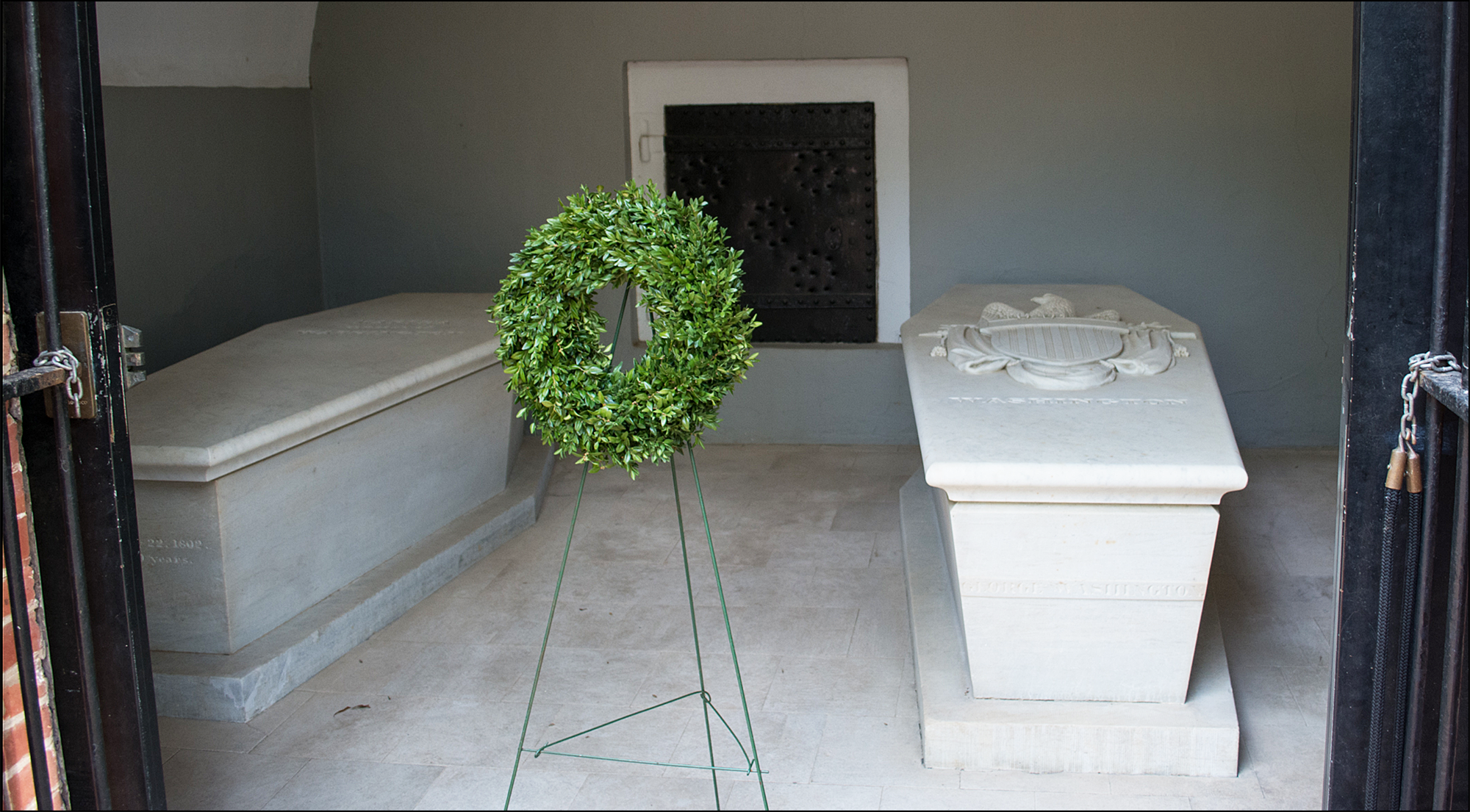
Washington was buried in the Washington family vault at Mount Vernon on December 18, 1799. In 1832, a joint Congressional committee debated moving his body from Mount Vernon to a crypt in the United States Capitol.
Washington was somewhat reserved in personality, although he was known for having a strong presence. He made speeches and announcements when required, but he was not a noted orator nor debater. He drank alcohol in moderation but was morally opposed to excessive drinking, smoking tobacco, gambling, and profanity. Washington’s 1751 bout with smallpox may have rendered him sterile.
Washington did not wear a powdered wig. Instead, he wore his hair curled, powdered and tied in a queue in the fashion of the day. Washington suffered from severe tooth decay and ultimately lost all of his teeth except one. He had several sets of false teeth during his presidency. Contrary to common lore, these were not made of wood, but of metal, ivory, bone, animal teeth and other human teeth.
His dental problems left him in constant pain, which he treated with laudanum. He also experienced a painful growth in his thigh early in his first presidential term, followed by a life-threatening bout of pneumonia in 1790 from which he never fully recovered.
Washington was a talented and accomplished equestrian. Jefferson described him as “the best horseman of his age.”
Washington is one of the most influential figures in American history. He became an international symbol for liberation and nationalism as the leader of the first successful revolution against a colonial empire. In 1879, Congress proclaimed proclaimed Washington’s Birthday as a federal holiday. In 1976, he was posthumously appointed General of the Armies of the United States during the American Bicentennial. President Gerald Ford stated that Washington would “rank first among all officers of the Army, past and present.“
Washington appears on contemporary United States currency, including the one-dollar bill, the Presidential one-dollar coin and the quarter-dollar coin (Washington quarter). Washington was pictured on the nation’s first postage stamp in 1847; and has since appeared on more United States postage stamps than anyone else.
Washington’s presidential library is housed at Mount Vernon, which is now designated as a National Historic Landmark. His papers are held in the Library of Congress. ✪













▶️ DONATE VIA PAYPAL (DEBIT & CREDIT CARD)
ALL PayPal Transactions Are Encrypted For Card Holder Privacy & Security
▶️ DONATE VIA ZELLE (DIRECT BANK CASH TRANSFER)
ZELLE is the perfect online alternative to PayPal. It’s an incredibly simple, secure, easy, fast and FREE way to send or receive money to recipients directly from your online banking account without a middleman. Best of all, there’s NO fees.
ZELLE is a service provided by your bank and is already built in to your online banking account. You only need to activate it first before using. If you’ve already activated ZELLE in your online bank or credit union account, you can donate to The New Americanist by using our ZELLE address:
vip@thenewamericanist.com
To activate your ZELLE, follow these easy instructions (a simple two minute process):

▶️ DONATE VIA SNAIL MAIL






▶️ CLICK HERE TO VIEW
▶️ 1 Hour 5 Minutes 3 Seconds
▶️ 48 Minutes 25 Seconds
▶️ 20 Minutes 1 Second
▶️ 9 Minutes 37 Seconds
▶️ 6 Minutes 13 Seconds
▶️ 6 Minutes 42 Seconds
▶️ 6 Minutes 35 Seconds
▶️ 11 Minutes 17 Seconds
▶️ 10 Minutes 33 Seconds
▶️ 11 Minutes 13 Seconds
▶️ 8 Minutes 51 Seconds
▶️ 11 Minutes 43 Seconds
▶️ 14 Minutes 24 Seconds
▶️ 5 Minutes 53 Seconds
▶️ 5 Minutes 31 Seconds
▶️ 5 Minutes 52 Seconds
▶️ 15 Minutes 40 Seconds ⭐️ Deplorables Know Libs Suck
▶️ 32 Minutes 11 Seconds ⭐️ TokaiseBlessedPatriot
▶️ 4 Minutes 38 Seconds
▶️ 16 Minutes 55 Seconds ⭐️ The New Logical Show
A NEW video podcast produced by TNA’s very own bet125. Make certain you SUBSCRIBE & LIKE.
Let’s all support new Conservative Media. 😎
