
Leopold Anthony Stokowski: April 18, 1882 – September 13, 1977
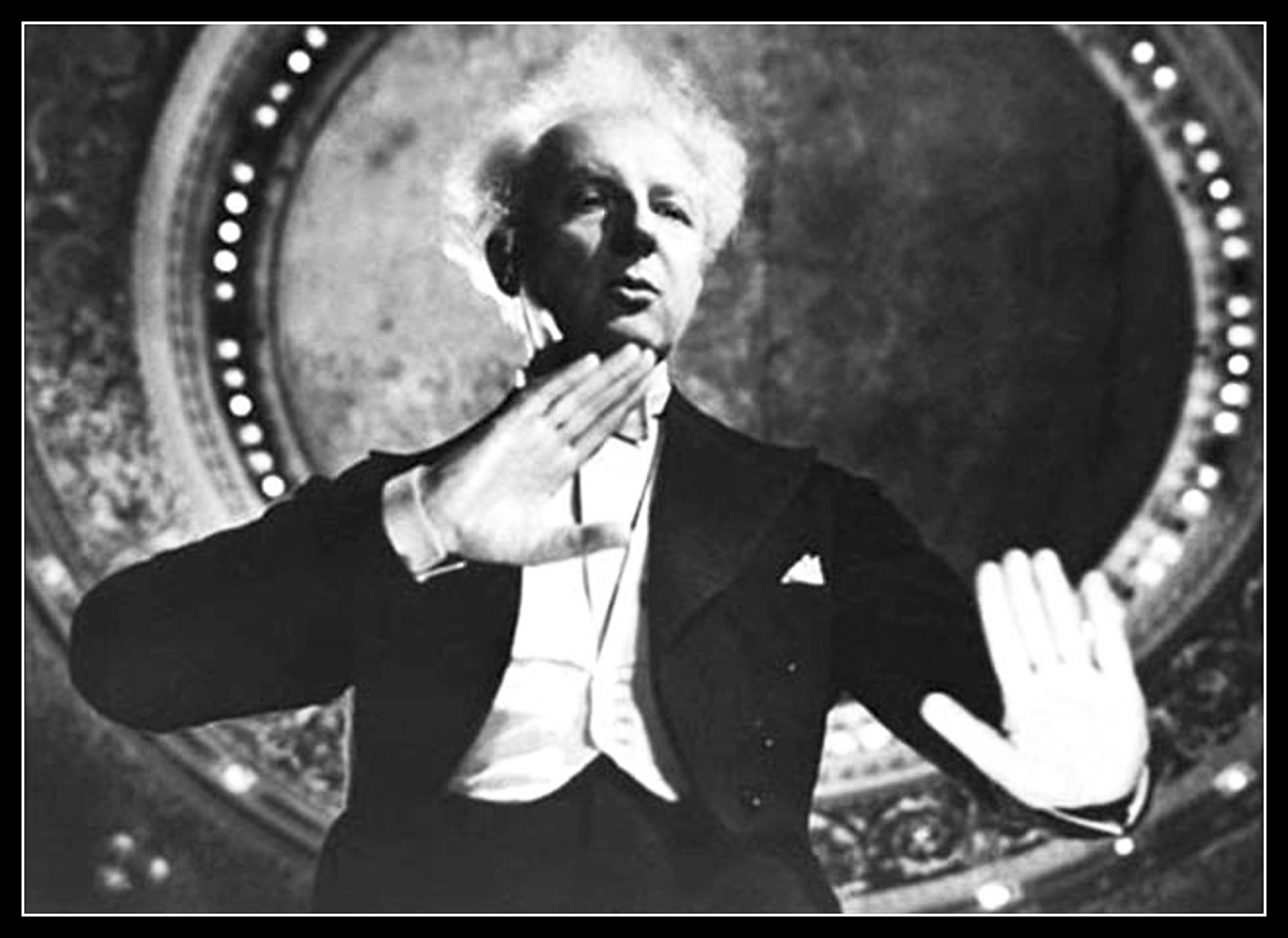
✪ Leopold Anthony Stokowski was one of the leading conductors of the early and mid-20th Century, who is best known for his long association with the Philadelphia Orchestra. He is particularly distinguished by his free-handed conducting style which spurned the traditional use of the baton; and, for obtaining unique & characteristic sounds from the orchestras he directed.
Stokowski served as the music director of the Cincinnati Symphony Orchestra, the Philadelphia Orchestra, the NBC Symphony Orchestra, the New York Philharmonic Orchestra, the Houston Symphony Orchestra, the Symphony of the Air and many others. He was also the founder of the All-American Youth Orchestra, the New York City Symphony, the Hollywood Bowl Symphony Orchestra and the American Symphony Orchestra.
Stokowski also conducted the music for and appeared in several Hollywood films, most notably Disney’s Fantasia; and was a lifelong champion of contemporary composers, giving many premieres of new music during his 60 year conducting career. Stokowski made his official conducting debut in 1909 and appeared in public for the last time in 1975, but continued to make recordings until June 1977, only a few months before his death at the age of 95.
Leopold Anthony Stokowski was the son of an English born cabinet maker of Polish heritage, Kopernik Joseph Boleslaw Stokowski, and his Irish-born wife Annie-Marion (née Moore). Stokowski’s birth certificate notes his birth on April 18, 1882 at 13 Upper Marylebone Street (now New Cavendish Street), in the Marylebone District of London. Stokowski was named after his Polish-born grandfather Leopold, who died in the Bethlem Hospital, Southwark, London, on 13 January 1879, at the age of 49. Later in life, Stokowski altered his middle name to Antoni, using the Polish spelling.
Not much is known about Stokowski’s youth or early life which has led to much historical speculation. Although he was born and raised in London, he spoke with an unusual, decidedly non-British accent. On occasion, he gave his year of birth as being 1887 instead of 1882; as in a letter to the Hugo Riemann Musiklexicon in 1950, in which he also incorrectly gave his birthplace as Kraków. Nicolas Slonimsky, editor of Baker’s Biographical Dictionary of Musicians, received a letter from a Finnish encyclopaedia editor that said: “The Maestro himself told me that he was born in Pomerania, Germany, in 1889.”
Stokowski studied at the Royal College of Music, where he first enrolled in 1896 at the age of thirtee;, making him one of the youngest students ever to do so. In his later life in the United States, Stokowski would conduct six of the nine symphonies composed by his fellow organ student Ralph Vaughan Williams.
Stokowski also sang in the choir of the St Marylebone Parish Church; and later, became assistant organist to Sir Walford Davies at the Temple Church. By the age of sixteen, Stokowski was elected as a member of the Royal College of Organists. In 1900, he formed the choir of St Mary’s Church, Charing Cross Road, where he trained the choirboys and played the organ. In 1902 he was appointed organist and choir director of St James’s Church, Piccadilly. He also attended The Queen’s College, Oxford, where he received the degree of Bachelor of Music in 1903.
In 1905, Stokowski began work in New York City as the organist and choir director of St. Bartholomew’s Church. He was very popular among the church parishioners, who included members of the Vanderbilt family. However, in the course of time he resigned this position to pursue a career as an orchestra conductor. Stokowski then moved to Paris for additional studies in conducting. There he learned the Cincinnati Symphony Orchestra would be needing a new conductor when it returned from a long sabbatical. In 1908 Stokowski began a campaign to win this position by writing letters to Mrs. Christian R. Holmes, the orchestra’s president, and traveling to Cincinnati, Ohio, for a personal interview.
Stokowski was selected over all the other applicants and took up his conducting duties in Cincinnati in late 1909; which was also the year of his official conducting debut in Paris with the Colonne Orchestra, on 12 May 1909 as he accompanied his future wife, the pianist Olga Samaroff, in Tchaikovsky’s Piano Concerto No. 1. Stokowski’s conducting debut in London took place the following week, on 18 May, with the New Symphony Orchestra at the Queen’s Hall.
Stokowski’s engagement as new permanent conductor in Cincinnati becames a great success. There, he introduced the concept of “pops concerts” and starting with his first season, he began to champion the works of living composers. He would maintain his advocacy of contemporary music until the end of his career. However in early 1912 Stokowski, became frustrated with the policies of the orchestra’s board of directors, and submitted his resignation.
Two months later, Stokowski was appointed the director of the Philadelphia Orchestra and he made his conducting debut in Philadelphia on 11 October 1912. This position would bring him some of his greatest accomplishments and professional recognition. However, before Stokowski moved into his conducting position in Philadelphia, he returned to England to conduct two more concerts at the Queen’s Hall in London. On 22 May 1912, Stokowski conducted the London Symphony Orchestra in a concert that he was to repeat again in its entirety sixty years later at the age of 90.
Stokowski rapidly gained a reputation as a musical showman. His flair for the theatrical included grand gestures, such as throwing the sheet music on the floor to show he did not need to conduct from a score. He also experimented with new lighting arrangements in the concert hall; at one point conducting in a dark hall with only his head and hands lighted, at other times arranging the lights so they would cast theatrical shadows of his head and hands.
Late in the 1929–1930 symphony season, Stokowski started conducting without a baton. His free-hand manner of conducting soon became one of his trademarks. On the musical side, Stokowski nurtured the orchestra and shaped the “Stokowski” sound; or what became known as the “Philadelphia Sound.” He encouraged “free bowing“ from the string section, “free breathing” from the brass section, and continually altered the seating arrangements of the orchestra’s sections, as well as the acoustics of the hall, in response to his urge to create a better sound. Stokowski is credited as the first conductor to adopt the seating plan that is used by most orchestras today.
Stokowski also became known for modifying the orchestrations of some of the works he conducted; as was a standard practice for conductors prior to the second half of the 20th Century. Many music critics have taken exception to the liberties Stokowski took; liberties which were commonplace in the Nineteenth Century, but had mostly fallen out of favor in the twentieth, when faithful adherence to the composer’s scores became more common.
Stokowski appeared as himself in the motion picture The Big Broadcast of 1937, conducting two of his Bach transcriptions. That same year he also conducted and acted in One Hundred Men and a Girl, with Deanna Durbin and Adolphe Menjou. In 1939, Stokowski collaborated with Walt Disney to create the motion picture for which he is best known: Fantasia. He conducted all the music (with the exception of a “jam session” in the middle of the film) and included his own orchestrations for Bach’s Toccata and Fugue in D minor and Mussorgsky’s/Schubert’s Night on Bald Mountain/Ave Maria. Stokowski even got to talk to (and shake hands with) Mickey Mouse on screen, in a famous silhouette cameo; though, he would later say with a smile that Mickey Mouse got to shake hands with him.
▶️ 26 Seconds
A lifelong and ardent fan of the newest and most experimental techniques in recording, Stokowski saw to it that most of the music for Fantasia was recorded over Class A telephone lines laid down between the Academy of Music in Philadelphia and Bell Laboratories in Camden NJ, using an early, highly complex version of multi-track stereophonic sound, dubbed Fantasound. Recorded on photographic film, the only suitable medium then available, the results were considered technically astounding for the late 1930s.
With his Philadelphia Orchestra contract having expired in 1940, Stokowski immediately formed the All-American Youth Orchestra, its players’ ages ranging from 18 to 25. It toured South America in 1940 and North America in 1941 and was met with rave reviews. However, the AAYO was disbanded when America entered the Second World War; and plans for another extensive tour in 1942 were abandoned.
Upon his return in 1960, Stokowski appeared with the Philadelphia Orchestra as a guest conductor. He also made two LP recordings with them for Columbia Records. He would continue to appear as guest conductor on several more occasions. His final Philadelphia Orchestra concert took place in 1969.
During this time, Stokowski also became chief conductor of the NBC Symphony Orchestra on a three-year contract (1941–1944). Stokowski conducted a great deal of contemporary music with the NBC Symphony, including the US premiere of Prokofiev’s Alexander Nevsky in 1943. When Toscanini returned to the NBC Symphony in 1942; he and Stokowski shared conducting duties for the remaining two years of Stokowski’s contract.
In 1944, on the recommendation of Mayor Fiorello La Guardia, Stokowski helped form the New York City Symphony Orchestra, which they intended would make music accessible for middle-class workers. Ticket prices were set low, and performances took place at convenient, after-work hours. Many early concerts were standing room only; however, a year later in 1945, Stokowski was at odds with the board (who wanted to trim expenses even further) and he resigned. Stokowski made three 78 pm sets with the New York City Symphony for RCA Victor: Beethoven’s 6th Symphony, Richard Strauss’s Death and Transfiguration, and a selection of orchestral music from Georges Bizet’s Carmen.
In 1945, Stokowski founded the Hollywood Bowl Symphony Orchestra. The orchestra lasted for two years before it was disbanded for live concerts, but not for recordings, which continued well into the 1960s. Some of Stokowski’s open-air HBSO concerts were broadcast and recorded, and have since been issued on CD. There was a 1949 cartoon spoof of Stokowski at the Bowl with Bugs Bunny playing the conductor in “Long-Haired Hare” by Chuck Jones.
Stokowski continued to appear frequently with the Los Angeles Philharmonic, both at the Hollywood Bowl and other venues. Then in 1946 Stokowski became a chief Guest Conductor of the New York Philharmonic. Stokowski returned to the NBC Symphony Orchestra in 1954 for a series of recording sessions for RCA Victor. In 1960, Stokowski made one of his infrequent appearances in the opera house, when he conducted Giacomo Puccini’s Turandot at the New York Metropolitan, in memorable performances.
In 1962, at the age of 80, Stokowski founded the American Symphony Orchestra (ASO) where his championship of 20th-Century composers remained undiminished; and perhaps, his most celebrated premiere with the American Symphony Orchestra was of Charles Ives’s 4th Symphony in 1965, which CBS also recorded.
Stokowski served as music director for the ASO until May 1972 when, at the age of 90, he returned to live in England. On 3 January 1962, still showing his interest in using technological innovation, he was featured in a telecast for WGN-TV conducting the Chicago Symphony Orchestra, which has since also been made available on DVD.
Stokowski continued to conduct for a few more years, but failing health eventually forced him to conduct only for recording sessions. An eyewitness said Stokowski often conducted sitting down in his later years; sometimes, as he became involved in the performance, he would stand up and conduct with remarkable energy. His last public appearance in the UK took place at the Royal Albert Hall, London, on 14 May 1974.
Stokowski gave his last world premiere in 1973 when, at the age of 91, he conducted Havergal Brian’s 28th Symphony in a BBC radio broadcast with the New Philharmonia Orchestra. In August 1973, Stokowski conducted the International Festival Youth Orchestra at Royal Albert Hall in London, performing Tchaikovsky’s Fifth Symphony. In 1976, he signed a recording contract with Columbia Records that would have kept him active until he was 100 years old.
Stokowski married three times. His first wife was American concert pianist Olga Samaroff, to whom he was married from 24 April 1911 until their divorce on 30 July 1923.
His second wife was Johnson & Johnson heiress Evangeline Love Brewster Johnson, an artist and aviator, to whom he was married from 11 January 1926 until their divorce on 2 December 1937.
In March 1938, Stokowski began a highly publicised relationship with film actress Greta Garbo after the two vacationed together in Italy, on the island of Capri.
On 21 April 1945, Stokowski married heiress and actress Gloria Vanderbilt. They had two sons, Leopold Stanislaus Stokowski (born 1950) and Christopher Stokowski (born 1952). They divorced on 29 October 1955.
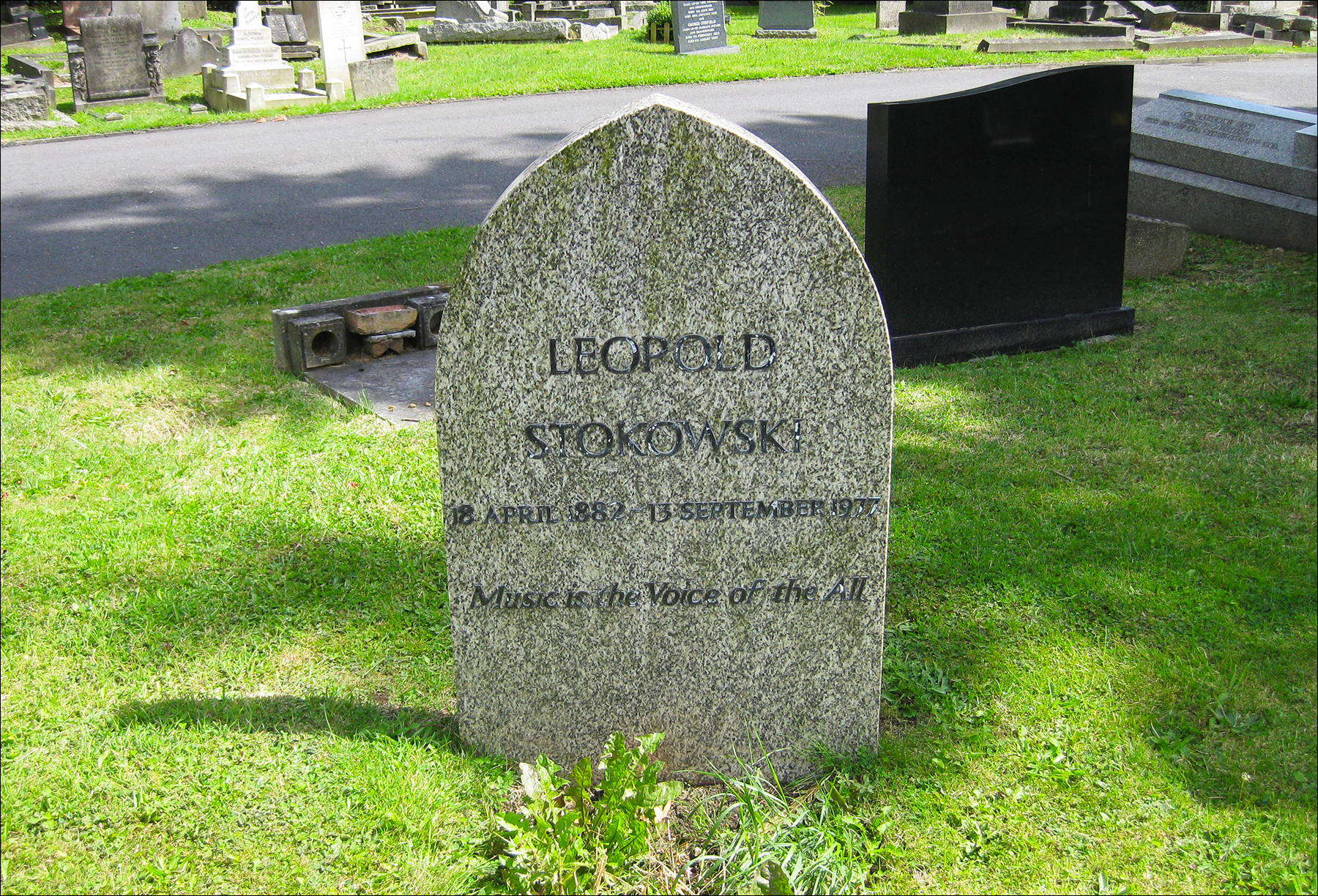
Stokowski died of a heart attack on 13 September 1977 at his Nether Wallop, Hampshire, residence at the age of 95. His very last recordings, made shortly before his death, for Columbia, include performances of the youthful Symphony in C by Georges Bizet and Felix Mendelssohn’s 4th Symphony, “Italian,” with the National Philharmonic Orchestra in London. He is interred at East Finchley Cemetery.
In 1999, for Gramophone magazine, the noted music commentator David Mellor wrote:
“One of the great joys of recent years for me has been the reassessment of Leopold Stokowski. When I was growing up there was a tendency to disparage the old man as a charlatan. Today it is all very different. Stokowski is now recognized as the father of modern orchestral standards. He possessed a truly magical gift of extracting a burnished sound from both great and second-rank ensembles. He also loved the process of recording and his gramophone career was a constant quest for better recorded sound. But the greatest pleasure of all for me is his acceptance now as an outstanding conductor of nineteenth- and twentieth-century music, including a lot that was at the cutting edge of contemporary achievement.”
Stokowski’s collection of 935 orchestral scores and 215 orchestral transcriptions are now archived in the libraries of the University of Pennsylvania. ✪

















▶️ ◼️◼️◼️◼️◼️◼️◼️◼️◼️ ✪✪✪ DONATE ✪✪✪ ◼️◼️◼️◼️◼️◼️◼️◼️◼️◼️

▶️ DONATE VIA PAYPAL (DEBIT & CREDIT CARD)
ALL PayPal Transactions Are Encrypted For Card Holder Privacy & Security
▶️ DONATE VIA ZELLE (DIRECT BANK CASH TRANSFER)
ZELLE is the perfect online alternative to PayPal. It’s an incredibly simple, secure, easy, fast and FREE way to send or receive money to recipients directly from your online banking account without a middleman. Best of all, there are NO fees.
ZELLE is a service provided by your bank and is already built in to your online banking account. You only need to activate it first before using. If you’ve already activated ZELLE in your online bank or credit union account, you can donate to The New Americanist by using our ZELLE address:
vip@thenewamericanist.com
To activate your ZELLE, follow these easy instructions (a simple two minute process):

▶️ DONATE VIA SNAIL MAIL