


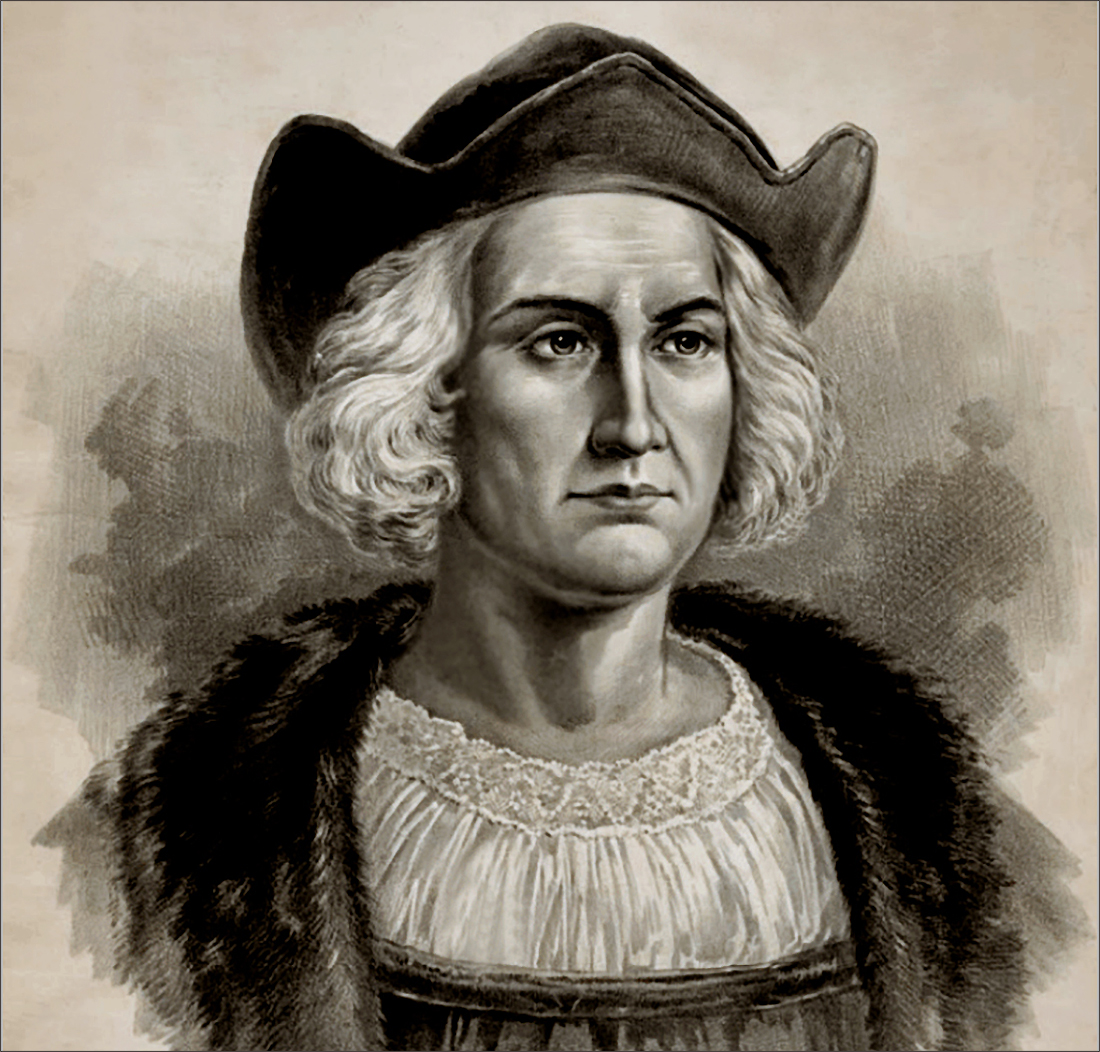

Christopher Columbus: between 25 August & 31 October 1451–20 May 1506)
✪ Christopher Columbus was an Italian explorer and navigator from the Republic of Genoa who completed four Spanish-based voyages across the Atlantic Ocean sponsored by the Spanish Catholic Monarchy, opening the way for the widespread European exploration and colonization of the Americas. His expeditions were the first known European contact with the Caribbean, Central and South America.
The name Christopher Columbus is the anglicized form of his name in Latin, Christophorus Columbus. Largely self-educated, Columbus was knowledgeable in geography, astronomy and history. He developed a plan to discover a western sea passage to the East Indies; hoping to profit from the lucrative spice trade. After the Granada War and Columbus’s persistent lobbying to the monach courts in multiple European kingdoms, the Catholic Monarchy of Queen Isabella I and King Ferdinand II, agreed to sponsor a journey west.
In August 1492, Columbus left Castile with three ships and made landfall in the Americas on 12 October. This historical event ended the period of human habitation in the Americas now referred to as the Pre-Columbian Era. His initial landing place was an island in the Bahamas, known by its native inhabitants as Guanahani. He would then go on to visit the islands now known as Cuba and Hispaniola; and establish a colony in what is now Haiti. After Columbus returned to Castile in early 1493, word of his voyage quickly spread throughout Europe.
Columbus would make three additional voyages to the Americas, exploring the Lesser Antilles in 1493, Trinidad and the northern coast of South America in 1498 and the east coast of Central America in 1502. Many of the names he gave to geographical areas & features, particularly islands, are still in use today.
The voyages of Columbus are considered a turning point in human history, marking the beginning of globalization accompanied by profound demographic, commercial, economic, social and political changes. However, in the first century after his endeavors, Columbus’s figure largely languished in the backwaters of history
The extent to which Columbus himself was aware the Americas were a wholly separate landmass is uncertain; as he never clearly renounced his belief he had reached the Far East. Columbus’s expeditions inaugurated a period of exploration, conquest and colonization which lasted for centuries, thus bringing the Americas into the European sphere of influence.
The transfer of plants, animals, precious metals, culture, human populations, technology, diseases and ideas between the Old World and New World that followed his first voyage are known as the Columbian Exchange. These events and the effects which persist to the present are often cited as the beginning of the Modern Era.
Columbus’s early life is obscure, but scholars believe he was born in the Republic of Genoa sometime between 25 August and 31 October 1451. His father was Domenico Colombo, a wool weaver who worked in Genoa and Savona, and owned a cheese stand at which young Christopher worked. His mother was Susanna Fontanarossa. Columbus had three brothers as well as a sister.
His native language is presumed to have been a Genoese dialect (Ligurian) as his first language, though Columbus probably never learned to write in it. .His name in 15th-century Genoese was Cristoffa Corombo. In Italian, Cristoforo Colombo, and Cristóbal Colón in Spanish.
In one of his writings, he says he went to sea at 14. In 1473, Columbus began his apprenticeship as business agent for the wealthy Spinola, Centurione and Di Negro families of Genoa. Later, he made a trip to the Greek island Chios in the Aegean Sea, which was then then ruled by Genoa. In May 1476, Columbus took part in an armed convoy sent by Genoa to carry valuable cargo to northern Europe. During this time, he probably visited Bristol, England and Galway, Ireland.
Columbus based himself in Lisbon from 1477 to 1485. In 1478, the Centuriones sent Columbus on a sugar-buying trip to Madeira. There he met and married Felipa Perestrello e Moniz, daughter of Bartolomeu Perestrello, a Portuguese nobleman of Lombard origin.
Through his marriage to his first wife, Felipa Perestrello, Columbus gained access to the nautical charts and logs that had belonged to her deceased father, Bartolomeu Perestrello, who served as a captain in the Portuguese navy under Prince Henry the Navigator. In the mapmaking shop where he worked with his brother Bartholomew, Columbus also had ample opportunity to hear the stories of old seamen about their voyages to the western seas, but his knowledge of the Atlantic wind patterns was still imperfect at the time of his first voyage.
In 1479 or 1480, Columbus’s son Diego was born. Between 1482 and 1485, Columbus traded along the coasts of West Africa, reaching the Portuguese trading post of Elmina at the Guinea coast in present-day Ghana. In 1484, Columbus returned to Porto Santo to find that his wife had died. He returned to Portugal to settle her estate and take Diego with him.
Columbus learned Latin, Portuguese and Castilian. He read widely about astronomy, geography, and history, including the works of Ptolemy, Pierre d’Ailly’s Imago Mundi, the travels of Marco Polo and Sir John Mandeville, Pliny’s Natural History, and Pope Pius II’s Historia rerum ubique gestarum. According to the historian Edmund Morgan:
Columbus was not a particularly scholarly man. Yet he studied these books, made hundreds of marginal notations in them and came out with ideas about the world that were characteristically simple and strong and sometimes wrong …
Under the Mongol Empire’s hegemony over Asia and the Pax Mongolica, Europeans had long enjoyed a safe land passage on the Silk Road to India, parts of East Asia, including China and Maritime Southeast Asia, which were sources of valuable goods. With the fall of Constantinople to the Ottoman Empire in 1453, the Silk Road was closed to Christian traders.
In 1474, the Florentine astronomer Paolo dal Pozzo Toscanelli suggested to King Afonso V of Portugal that sailing west across the Atlantic would be a quicker way to reach the Maluku (Spice) Islands, China, Japan and India than the route around Africa, however Afonso rejected his proposal.
In the 1480s, Columbus and his brother proposed a plan to reach the East Indies by sailing west. Columbus supposedly wrote to Toscanelli in 1481 and received encouragement, along with a copy of a map the astronomer had sent Afonso implying that a westward route to Asia was possible.
Columbus would have to wait until 1492 before King Ferdinand and Queen Isabella of Spain would support his voyage across the Atlantic to find gold, spices, a safer route to the East.
Historians have argued that Columbus was a Christian millennialist and apocalypticist and these beliefs were what motivated his quest for Asia in a variety of ways. Columbus often wrote about seeking gold in the log books of his voyages and writes about acquiring it “in such quantity that the sovereigns… will undertake and prepare to go conquer the Holy Sepulcher” in a fulfillment of Biblical prophecy. Columbus also often wrote about converting all races to Christianity. Abbas Hamandi argues that Columbus was motivated by the hope of “delivering Jerusalem from Muslim hands” by “using the resources of newly discovered lands.”
Nearly all educated Westerners of Columbus’s time knew that the Earth is spherical, a concept that had been understood since antiquity. The techniques of celestial navigation, which uses the position of the Sun and the stars in the sky, had long been in use by astronomers and were beginning to be implemented by mariners. However Columbus made several substantial errors in intially calculating the size of the Earth; the distance the continent extended to the east: and therefore, the distance to the west to reach his goal.
Based on his sources, Columbus estimated a distance of 2,400 nmi (2,800 mi) from the Canary Islands west to Japan. The actual distance is 10,600 nmi (12,200 mi). No ship in the 15th century could have carried enough food and fresh water for such a long voyage and the dangers involved in navigating through the uncharted ocean would have been formidable. Most European navigators reasonably concluded that a westward voyage from Europe to Asia was unfeasible.
Though Columbus was wrong about the number of degrees of longitude that separated Europe from the Far East and about the distance that each degree represented, he did take advantage of the trade winds, which would prove to be the key to his successful navigation of the Atlantic Ocean. He planned to first sail to the Canary Islands before continuing west with the northeast trade wind. Part of the return to Spain would require traveling against the wind using an arduous sailing technique called beating, during which progress is made very slowly.
By about 1484, Columbus proposed his planned voyage to King John II of Portugal.The king submitted Columbus’s proposal to his advisors, who rejected it.
Columbus then sought an audience with the monarchs Ferdinand II of Aragon and Isabella I of Castile, who had united several kingdoms in the Iberian Peninsula by marrying and now ruled together.
On 1 May 1486, permission having been granted, Columbus presented his plans to Queen Isabella, who, in turn, referred it to a committee. The learned men of Spain, like their counterparts in Portugal, replied that Columbus had grossly underestimated the distance to Asia. They pronounced the idea impractical and advised the Catholic Monarchs to pass on the proposed venture.
To keep Columbus from taking his ideas elsewhere, and perhaps to keep their options open, the sovereigns gave him an allowance, totaling about 14,000 maravedis for the year, equivalent to the annual salary of a sailor. In May 1489, the queen sent him another 10,000 maravedis, and the same year the monarchs furnished him with a letter ordering all cities and towns under their dominion to provide him food and lodging at no cost.
In the April 1492 “Capitulations of Santa Fe,” King Ferdinand and Queen Isabella promised Columbus that if he succeeded he would be given the rank of Admiral of the Ocean Sea and appointed Viceroy and Governor of all the new lands he might claim for Spain.
He would also be entitled to 10% (diezmo) of all the revenues from the new lands in perpetuity. He also would have the option of buying one-eighth interest in any commercial venture in the new lands, and receive one-eighth (ochavo) of the profits.
Between 1492 and 1504, Columbus completed four round-trip voyages between Spain and the Americas, each voyage being sponsored by the Crown of Castile. On his first voyage he reached the Americas, initiating the European exploration and colonization of the continent, as well as the Columbian Exchange. His role in history is thus important to the Age of Discovery, Western history, and human history writ large.
In Columbus’s letter on the first voyage, published following his first return to Spain, he claimed that he had reached Asia, as previously described by Marco Polo and other Europeans. Over his subsequent voyages, Columbus refused to acknowledge that the lands he visited and claimed for Spain were not part of Asia, in the face of mounting evidence to the contrary. This might explain, in part, why the American continent was named after the Florentine explorer Amerigo Vespucci—who received credit for recognizing it as a “New World”—and not after Columbus.
On the evening of 3 August 1492, Columbus departed from Palos de la Frontera with three ships. The largest was a carrack, the Santa María, owned and captained by Juan de la Cosa, and under Columbus’s direct command. The other two were smaller caravels, the Pinta and the Niña.
On 7 October, the crew spotted “immense flocks of birds.” On 11 October, Columbus changed the fleet’s course to due west, and sailed through the night, believing land was soon to be found. At around 02:00 the following morning, a lookout on the Pinta, Rodrigo de Triana, spotted land. The captain of the Pinta, Martín Alonso Pinzón, verified the sight of land and alerted Columbus. Columbus later maintained that he had already seen a light on the land a few hours earlier, thereby claiming for himself the lifetime pension promised by Ferdinand and Isabella to the first person to sight land. Columbus called this island (in what is now the Bahamas) San Salvador (meaning “Holy Savior”).
Columbus called the inhabitants of the lands that he visited Los Indios (Spanish for “Indians”) Christopher Columbus’s journal entry of 12 October 1492 states:
“I saw some who had marks of wounds on their bodies and I made signs to them asking what they were; and they showed me how people from other islands nearby came there and tried to take them, and how they defended themselves; and I believed and believe that they come here from tierra firme to take them captive. They should be good and intelligent servants, for I see that they say very quickly everything that is said to them; and I believe they would become Christians very easily, for it seemed to me that they had no religion. Our Lord pleasing, at the time of my departure I will take six of them from here to Your Highnesses in order that they may learn to speak.“
Columbus also explored the northeast coast of Cuba, where he landed on 28 October. Columbus, for his part, continued to the northern coast of Hispaniola, where he landed on 6 December.There, the Santa María ran aground on 25 December 1492 and had to be abandoned. The wreck was used as a target for cannon fire to impress the native peoples.
On 13 January 1493, Columbus made his last stop of this voyage in the Americas, in the Bay of Rincón in northeast Hispaniola.
Columbus’s letter on the first voyage, probably dispatched to the Spanish court upon arrival in Lisbon, was instrumental in spreading the news throughout Europe about his voyage. Almost immediately after his arrival in Spain, printed versions began to appear, and word of his voyage spread rapidly. Most people in Europe initially believed that he had reached Asia.
On 24 September 1493, Columbus sailed from Cádiz with 17 ships, and supplies to establish permanent colonies in the Americas. This time hee sailed with nearly 1,500 men, including sailors, soldiers, priests, carpenters, stonemasons, metalworkers, and farmers. Among the expedition members were Alvarez Chanca, a physician who wrote a detailed account of the second voyage; Juan Ponce de León, the first governor of Puerto Rico and Florida. Also on this voyage was Juan de la Cosa, a cartographer who is credited with making the first world map depicting the New World; and Columbus’ youngest brother Diego.
On 17 November, Columbus first sighted the eastern coast of the island of Puerto Rico. Upon landing, Columbus christened the island San Juan Bautista after John the Baptist, and remained anchored there for two days from 20 to 21 November, filling the water casks of the ships in his fleet. From April to August 1494, Columbus explored Cuba and Jamaica.
On 30 May 1498, Columbus left with six ships from Sanlúcar, Spain. On July 31 they sighted Trinidad, the most southerly of the Caribbean islands. On 5 August, Columbus sent several small boats ashore on the southern side of the Paria Peninsula in what is now Venezuela, near the mouth of the Orinoco river. This was the first recorded landing of Europeans on the mainland of South America,
On 9 May 1502, Columbus departed Cádiz with his flagship Santa María and three other vessels. The ships were crewed by 140 men, including his brother Bartholomew as second in command and his son Fernando.
On 15 June, the fleet arrived at Martinique, where it lingered for several days. A hurricane was forming, so Columbus continued westward. While Columbus’s ships sheltered at the mouth of the Rio Jaina, the first Spanish treasure fleet sailed into the hurricane. Columbus’ ships survived with only minor damage, while 20 of the 30 ships in the governor’s fleet were lost along with 500 lives.
After a brief stop at Jamaica, Columbus sailed to Central America, arriving at the coast of Honduras on July 30. He spent two months exploring the coasts of Honduras, Nicaragua, and Costa Rica, seeking a strait in the western Caribbean through which he could sail to the Indian Ocean.
On 10 May Columbus sighted the Cayman Islands, naming them “Las Tortugas” after the numerous sea turtles there. His ships sustained substantial damage in a storm off the coast of Cuba. Unable to travel farther, on 25 June 1503 they were beached in Saint Ann Parish, Jamaica. For six months Columbus and 230 of his men remained stranded on Jamaica and were rescued on 28 June 1504, arriving back in Sanlúcar, Spain, on November 7.
Columbus had always claimed that the conversion of non-believers was one reason for his explorations, and he grew increasingly religious in his later years.
Columbus produced two books during his later years: a Book of Privileges (1502), detailing and documenting the rewards from the Spanish Crown to which he believed he and his heirs were entitled, and a Book of Prophecies (1505), in which passages from the Bible were used to place his achievements as an explorer in the context of Christian eschatology
During a violent storm on his first return voyage, Columbus, then 41, suffered an attack of what was believed at the time to be gout. In subsequent years, he was often plagued with what was thought to be influenza and other fevers, bleeding from the eyes, temporary blindness and prolonged attacks of gout. The attacks increased in duration and severity, sometimes leaving Columbus bedridden for months at a time, and finally culminated in his death 14 years later.
After his arrival to Sanlúcar from his fourth voyage (and Queen Isabella’s death), an ill Columbus settled in Seville in April 1505. On 20 May 1506, aged 54, Columbus died in Valladolid.

Columbus’s remains were first buried at the Chapel of Wonders at the Convent of St. Francis in Valladolid, but were then moved to the monastery of La Cartuja in Seville (southern Spain) by the will of his son Diego. They may have been exhumed in 1513 and interred at the Seville Cathedral. In about 1536, the remains of both Columbus and his son Diego were moved to a cathedral in Colonial Santo Domingo, in the present-day Dominican Republic. Columbus had requested to be buried on the island. By some accounts, in 1793, when France took over the entire island of Hispaniola, Columbus’s remains were moved to Havana, Cuba. After Cuba became independent following the Spanish–American War in 1898, at least some of these remains were moved back to the Seville Cathedral.
The figure of Columbus was not ignored in the British colonies during the colonial era: Columbus became a unifying symbol early in the history of the colonies that became the United States when Puritan preachers began to use his life story as a model for a “developing American spirit.”
Columbus’ name was given to the newly born Republic of Colombia in the early 19th century. In many countries of the Americas, as well as Spain and Italy, Columbus Day is still celebrates the anniversary of Columbus’ arrival in the Americas on Oct 13, 1492. ✪

















▶️ CLICK HERE TO VIEW


▶️ CLICK HERE TO VIEW
▶️ 1 Hour 24 Minutes 53 Seconds
▶️ 23 Minutes 33 Seconds
▶️ 1 Hour 57 Minutes 5 Seconds
▶️ 1 Hour 21 Minutes 17 Seconds
▶️ 1 Hour 13 Minutes 22 Seconds
▶️ 12 Minutes 44 Seconds
▶️ 5 Minutes 50 Seconds
▶️ 2 Minutes 50 Seconds
▶️ 11 Minute 55 Seconds
▶️ Premiere ⭐️ Bet1125
▶️ 12 Minutes 49 Seconds
▶️ 22 Minutes 58 Seconds
▶️ 12 Minutes 7 Seconds
▶️ 35 Minute 49 Seconds
▶️ 19 Minutes 10 Seconds
▶️ 9 Minutes 13 Seconds
▶️ 3 Minutes 2 Seconds
