
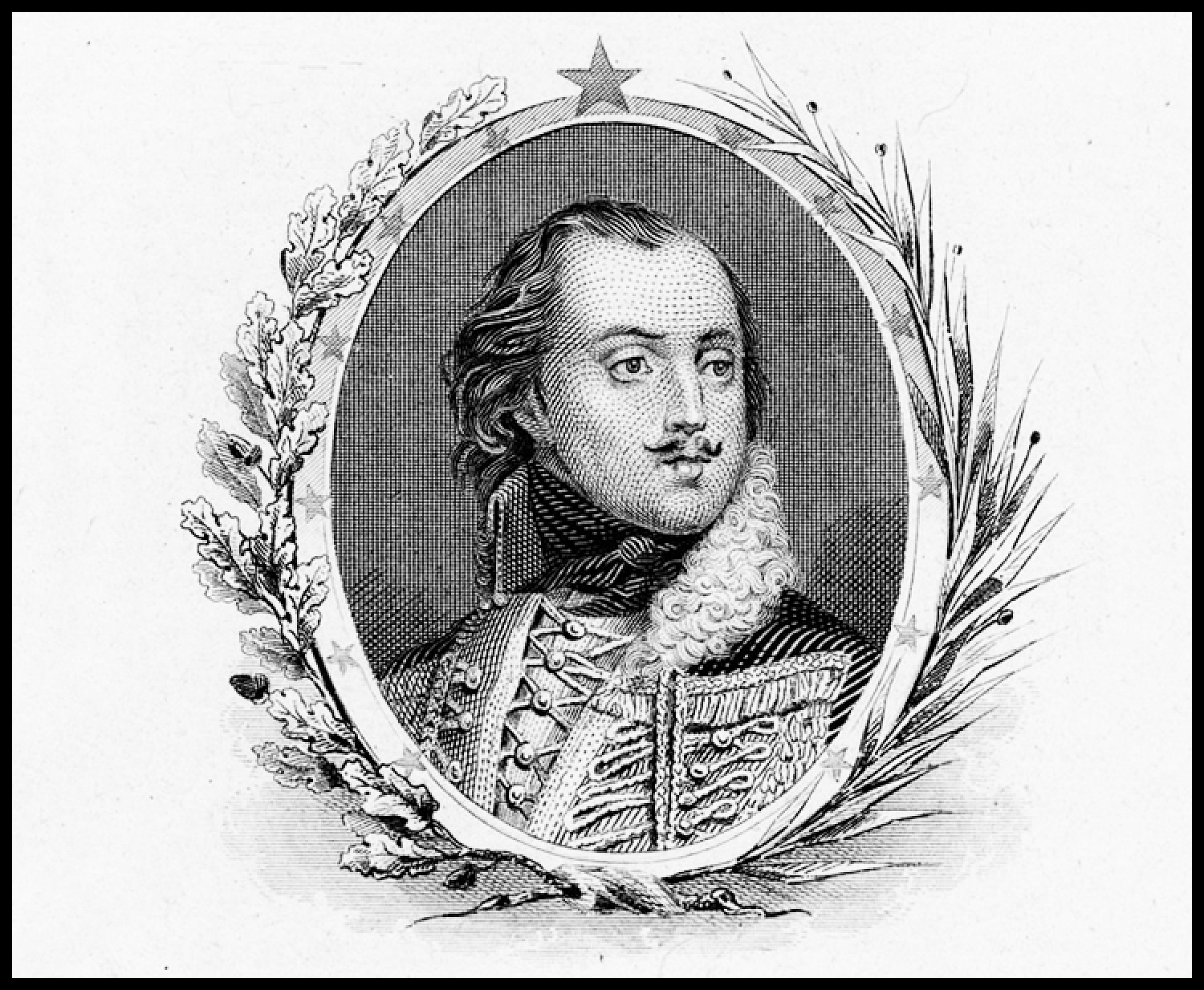

Kazimierz Pułaski: March 4 or 6, 1745 – October 11, 1779
✪ Kazimierz Michał Władysław Wiktor Pułaski, anglicized as Casimir Pulaski, was a Polish nobleman, soldier, and military commander who has been called “The Father of American Cavalry” or “The Soldier of Liberty.” Pulaski was born in Warsaw and following in his father’s footsteps, became interested in politics at an early age. He soon became involved in the military and in revolutionary affairs in the Polish–Lithuanian Commonwealth. Pulaski was one of the leading military commanders in the Bar Confederation and fought against the Commonwealth’s foreign domination by Russia. When this uprising of the Confederation ultimately failed, he was driven into exile.
Following a recommendation by Benjamin Franklin, Pulaski traveled to North America to help in the American Revolutionary War. There, he distinguished himself throughout the revolution, most notably when he saved the life of George Washington. Pulaski became a general in the Continental Army: and he and his friend, the Hungary-born colonel commandant Michael Kovats, raised Pulaski’s Legion and completely reformed the American Cavalry as a whole. At the siege of Savannah, while leading a cavalry charge against British forces, he was fatally wounded by grapeshot and died shortly after.
Pulaski is remembered as a hero who fought for independence and freedom in both Poland and the United States. Numerous places and events in both countries are named in his honor; and he is commemorated in many works of art. Pulaski is one of only eight people to be awarded an honorary United States citizenship.
Pulaski was born on March 6, 1745, in the manor house of the Pułaski Family in Warsaw, Poland. Casimir was the second eldest son of Marianna Zielińska and Józef Pułaski, who was an advocatus at the Crown Tribunal, the Starost of Warka, and one of the town’s most notable inhabitants.
The Pułaski family was Catholic. Early in his youth, Casimir Pulaski attended an elite college run by Theatines, a male religious order of the Catholic Church in Warsaw, but dropped out and did not finish his education.
There is some circumstantial evidence Pulaski was a Freemason. When Gilbert du Motier, Marquis de Lafayette laid the cornerstone of the monument erected in Pulaski’s honour in Monterey Square in Savannah in 1824, a full Masonic ceremony took place. Other sources claim Pulaski was a member of the Masonic Army Lodge in Maryland. A Masonic Lodge in Chicago is named Casimir Pulaski Lodge, No.1167, and a brochure issued by the lodge claims he obtained the degree of Master Mason on June 19, 1779, and was buried with full Masonic honors. To date, no surviving documents of Pulaski’s actual Masonic membership or affiliation have been recovered.
Pulaski began his military career in 1762 as a page of Carl Christian Joseph of Saxony, Duke of Courland and the Polish king’s vassal. He spent six months at the ducal court in Mitau, during which the court was interned in the palaces by the Russian forces occupying the area. He then returned to Warsaw. From that time forward, Pulaski used the title of Starost of Zezulińce.
In December 1767, Pulaski and his father became involved with the Bar Confederation, which considered King Stanisław to be a Russian puppet. The Confederation sought to curtail Russian hegemony over the Commonwealth. The Confederation was actively opposed by the Russian forces stationed in Poland. Pulaski recruited a unit: and on February 29, 1768, signed the Act of the Confederation, thus declaring himself an official supporter of the movement.
In March and April, Pulaski agitated among the Polish military, successfully convincing some of those forces to join the Confederates. He fought his first battle on April 20 near Pohorełe. It was a victory, as was another on April 23 near Starokostiantyniv. However, an engagement at Kaczanówka on April 28 resulted in defeat.
Pulaski retreated to a monastery in Berdyczów, which he defended during a siege by royalist forces for over two weeks until June 16. Eventually, he was forced to surrender and was taken prisoner by the Russians. On June 28, he was released in exchange for a pledge that he would never again take up arms with the Confederates; and he would lobby the Confederates to end hostilities. However, Pulaski considered the assurance to be non-binding and made a public declaration to that effect upon reaching a camp of the Confederates at the end of July.
In 1769, Pulaski’s unit was again besieged by numerically superior forces. After a staunch defense, he was able to break the Russian siege. Criticized by some of his fellow Confederates, Pulaski departed on June 3 to Lithuania with his allies and a force of about 600 men. There, Pulaski attempted to incite a larger revolt against Russia.
Despite no decisive military successes, Pulaski was nonetheless able to assemble a 4,000-strong army and deliver it back to a fortified Confederate staging point. This excursion gained him international notice and a reputation as an extremely effective military leader.
Historically, Pulaski is seen as one of the most famous and accomplished leaders of the Polish Confederation. At the same time, he was also known for often acting independently by disobeying orders from Confederate command. He had a reputation of being a “loose cannon.” Pulaski eventually sought refuge in France, where he unsuccessfully attempted to join the French Army..
Next, Pulaski attempted to recreate a Confederate force in the Ottoman Empire during the Russo-Turkish War; however, before he could make any progress, the Turks were defeated and he barely escaped by sea to Marseille France. In France, he found himself in debt and unable to find an army which would enlist him. He spent the entire year of 1775 in France; imprisoned at times for debts, until his allies gathered enough funds to arrange for his release.
Around that time, he was recruited by the Marquis de Lafayette and Benjamin Franklin, who he met in spring 1777, for service commission in the American Revolutionary War. Franklin was greatly impressed by Pulaski, and wrote of him:
“Count Pulaski of Poland, an officer famous throughout Europe for his bravery and conduct in defense of the liberties of his country against the three great invading powers of Russia, Austria and Prussia … may be highly useful to our service.”
Franklin subsequently recommended General George Washington accept Pulaski as a volunteer in the Continental Army cavalry. Pulaski departed from France in June, 1777 and arrived in Marblehead, Massachusetts, near Boston. After his arrival, Pulaski wrote to Washington, “I came here, where freedom is being defended, to serve it, and to live or die for it.”
On August 20, Pulaski met Washington in his headquarters at Neshaminy Falls, outside Philadelphia. He showed off riding stunts, and argued for the superiority of cavalry over infantry. Because Washington was unable to grant him an officer rank, Pulaski spent the next few months traveling between Washington and the United States Congress in Philadelphia, awaiting his appointment. His first military engagement against the British occurred before he received it, on September 11, 1777, at the Battle of Brandywine.
Pulaski is credited with saving Washington’s life at this battle when the British launched a surprise flanking maneuver, catching the Continental Army off guard and nearly routing them. Washington and his troops were in danger of being surrounded and destroyed.
Alhough he did not yet have an official commission in the Continental Army, Pulaski immediately recognized the danger and rode to Washington after requesting the command of a cavalry unit to delay the British advance.
With Washington’s approval, Pulaski quickly gathered a group of about 30 mounted guards. He led a daring charge directly into the enemy lines, buying precious time for the main American force to retreat and regroup. Pulaski’s decisive actions averted a disastrous defeat and likely saved Washington from enemy capture or death.
As a result, on September 15, 1777, on the orders of Congress, Washington commissioned Pulaski asa brigadier general in the Continental Army Cavalry. At that time, the cavalry was only a few hundred men strong organized into four small regiments. Pulaski immediately began work on reforming the cavalry; and personally wrote the first regulations for the formation. On October 4, Pulaski took part in the Battle of Germantown; he spent the winter of 1777 to 1778 with most of the army at Valley Forge.
Many American officers serving under Pulaski had difficulty taking orders from a foreigner who could scarcely speak English and whose ideas of discipline and tactics differed enormously from those to which they were accustomed. This resulted in friction between the Americans, Pulaski and his fellow Polish officers. There was also discontent in the unit over delays in pay and Pulaski’s imperious personality was a regular source of discontent among his peers, superiors, and subordinates. Pulaski was also unhappy his suggestion to create a lancer unit had been denied. The combination of these circumstances prompted Pulaski to resign his general command in March 1778, and return to Valley Forge.
Pulaski later went to Yorktown, where he met with General Horatio Gates and suggested the creation of a new unit. At Gates’ recommendation, Congress confirmed his previous appointment to the rank of a brigadier general, with a special title of “Commander of the Horse,” and authorized the formation of a corps of 68 lancers and 200 light infantry. This corps, which became known as the Pulaski’s Legion, was recruited mainly in Baltimore, where it was headquartered. By August 1778, the Pulaski’s Legion numbered about 330 men, both Americans and foreigners. American Major-General Charles Lee commented on the high standards of the Legion’s training.
The “father of the American cavalry” demanded much of his men and trained them in tested cavalry tactics. Pulaski is often referred to as the founder of the U.S. Cavalry, and made great efforts to turn the cavalry into an effective force. The improvement of the Legion’s mounted arm even drew high praise form the British. Pulaski used his own personal finances when money from Congress was scarce, in order to assure his forces of the finest equipment and personal safety.
In the autumn Pulaski was ordered to Little Egg Harbor on the coast of southeast New Jersey, where in the engagement on October 15, known as the affair at Little Egg Harbor, the legion suffered heavy losses. Ordered to take part in the punitive Sullivan Expedition against the Iroquois, he was dissatisfied with this command, and intended to leave the service and return to Europe, but instead asked to be reassigned to the Southern front. On February 2, 1779, Washington instead ordered Pulaski to South Carolina.
▶️ 2 Minutes 2 Seconds
Pulaski arrived in Charleston on May 8, 1779 to find the city in crisis. When the British advanced on May 11, Pulaski’s Legion engaged forward elements of the British force, and was badly mauled in the encounter. The Legion infantry, numbering only about 60 men before the skirmish, was virtually wiped out, and Pulaski was forced to retreat to the safety of the city’s guns.
At the beginning of September, an attempt to retake Savannah was launched with French assistance. Pulaski was ordered to Augusta, where he was to join forces with General Lachlan McIntosh. He rendered great services during the Siege of Savannah, and in the assault of October 9 commanded the whole cavalry, both French and American.
While attempting to rally fleeing French forces during a cavalry charge, Pulaski was mortally wounded by grapeshot. The reported grapeshot is now on display at the Georgia Historical Society in Savannah, Georgia. The Charleston Museum also has a grapeshot reported to be from Pulaski’s wound. Pulaski was carried from the field of battle and taken aboard the South Carolina merchant brig privateerWasp, under the command of Captain Samuel Bulfinch, where he died two days later, having never regained consciousness. His heroic death, admired by American Patriot supporters, further boosted his reputation in America.
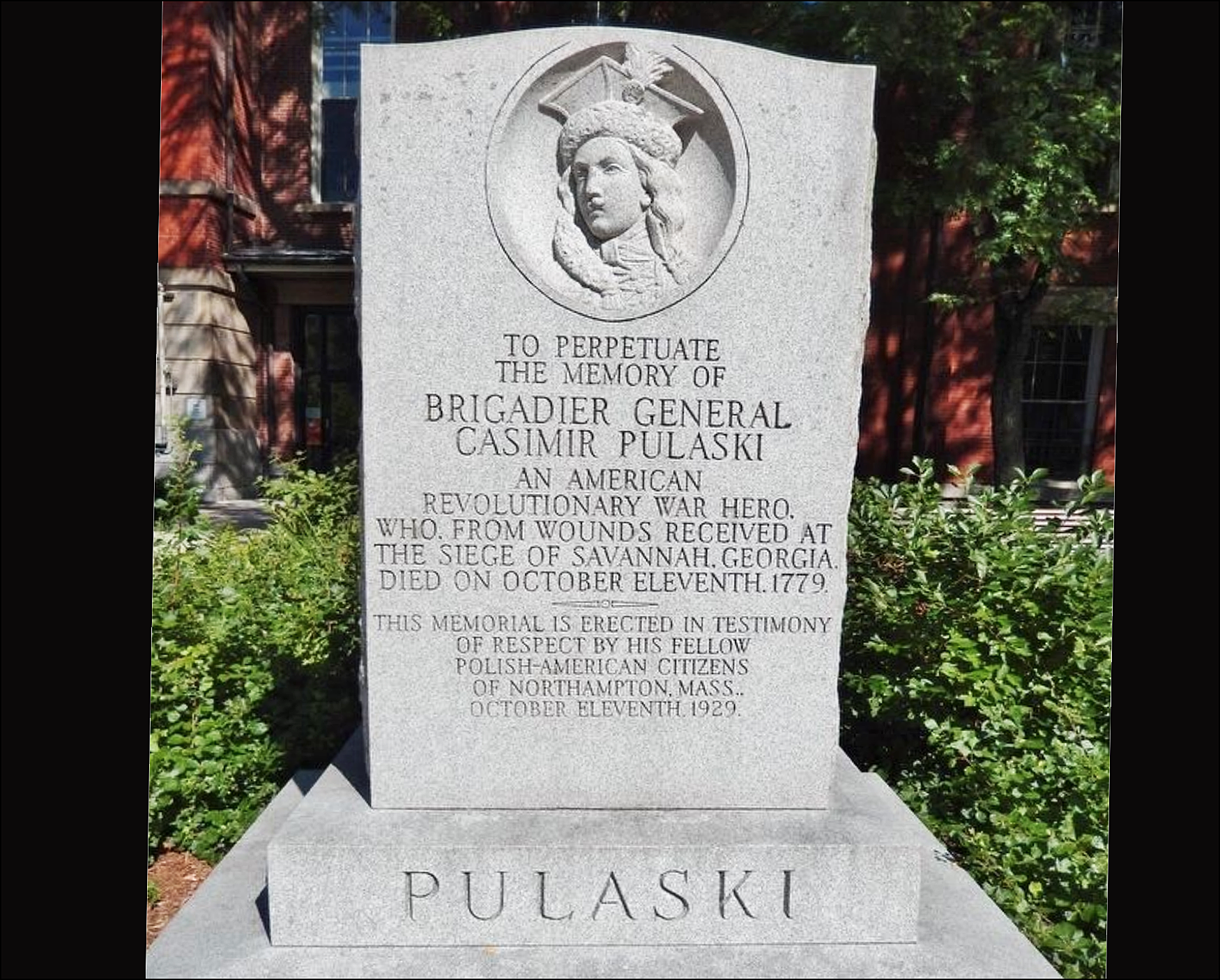
Pulaski never married and had no descendants. Despite his fame, there have long been uncertainties and controversies surrounding both his place and date of birth, and his burial. Many primary sources record a burial at sea. The historical accounts for Pulaski’s time and place of burial vary considerably. According to several contemporary accounts there were witnesses, including Pulaski’s aide-de-camp, that Pulaski received a symbolic burial in Charleston on October 21; sometime after he was buried at sea. Other witnesses, including Captain Samuel Bulfinch of the Wasp, claimed that the wounded Pulaski was actually later removed from the ship and taken to the Greenwich Plantation in the town of Thunderbolt, near Savannah, where he died and was buried.
In March 1825, during his grand tour of the United States, Lafayette personally laid the cornerstone for the Casimir Pulaski Monument in Savannah, Georgia. In 1853, remains found on a bluff above Augustine Creek on Greenwich Plantation were believed to be the Pulaski’s. These bones were reinterred at the Casimir Pulaski Monument in Savannah, Georgia. They were exhumed in 1996 and examined during a forensic study. The eight-year examination, including DNA analysis, ended inconclusively, although the skeleton was consistent with Pulaski’s age and occupation. A healed wound on the skull’s forehead was consistent with historical records of an injury Pulaski sustained in battle, as was a bone defect on the left cheekbone, believed to have been caused by a benign tumor. In 2005, his remains were reinterred in a public ceremony with full military honors, including Pulaski’s induction into the Georgia Military Hall of Fame.✪


















▶️ DONATE VIA PAYPAL (DEBIT & CREDIT CARD)
ALL PayPal Transactions Are Encrypted For Card Holder Privacy & Security
▶️ DONATE VIA ZELLE (DIRECT BANK CASH TRANSFER)
ZELLE is the perfect online alternative to PayPal. It’s an incredibly simple, secure, easy, fast and FREE way to send or receive money to recipients directly from your online banking account without a middleman. Best of all, there’s NO fees.
ZELLE is a service provided by your bank and is already built in to your online banking account. You only need to activate it first before using. If you’ve already activated ZELLE in your online bank or credit union account, you can donate to The New Americanist by using our ZELLE address:
vip@thenewamericanist.com
To activate your ZELLE, follow these easy instructions (a simple two minute process):

▶️ DONATE VIA SNAIL MAIL