


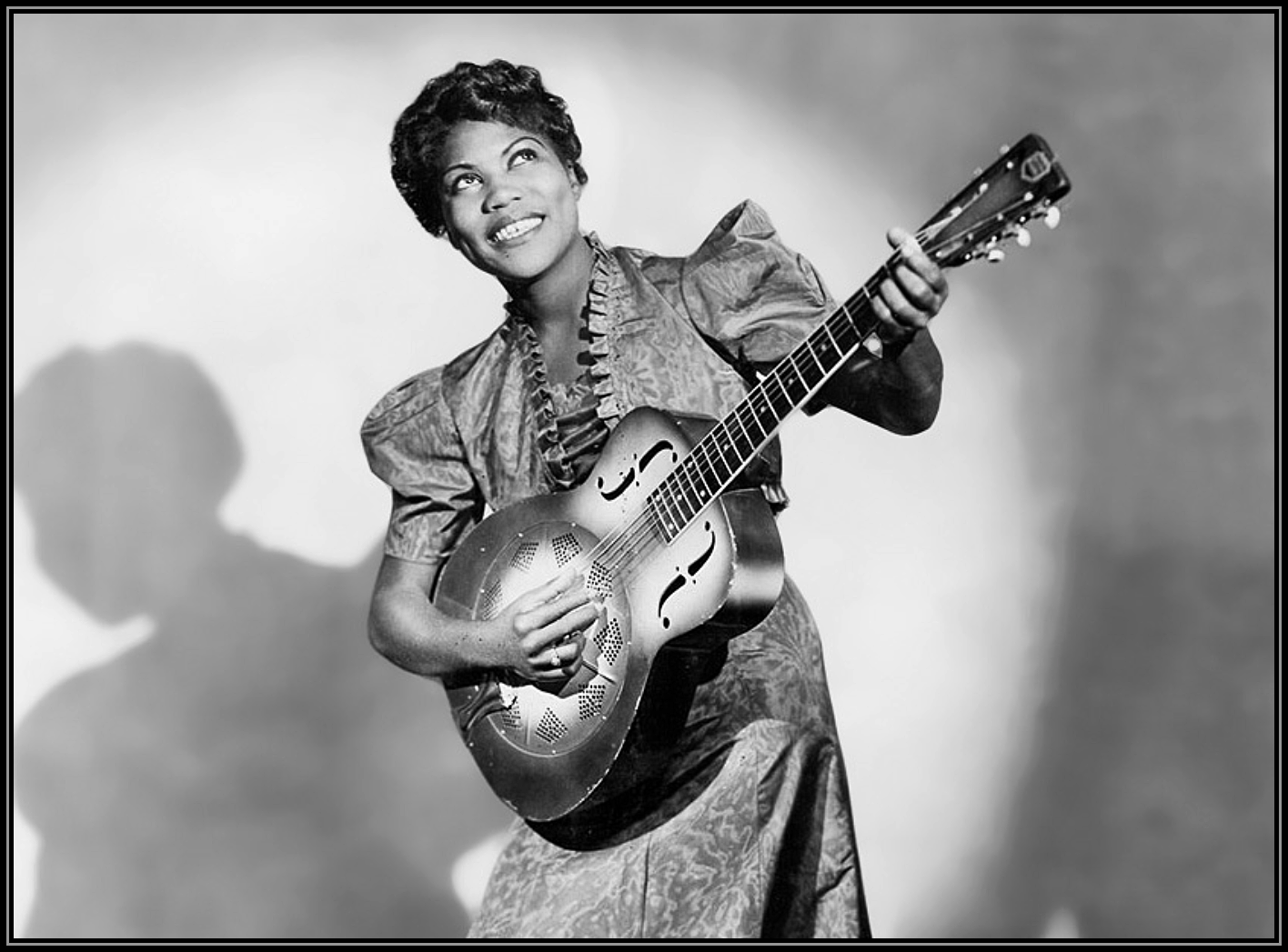

Sister Rosetta Tharpe: March 20, 1915–October 9, 1973
✪ Sister Rosetta Tharpe (born Rosetta Nubin) was an American singer, songwriter, performer and guitarist. She gained popularity during the 1930s and 1940s with her gospel recordings, characterized by a unique mixture of spiritual lyrics and electric guitar. She was the first great gospel music recording star; and among the first gospel musicians to appeal to Rhythm and Blues and Rock and Roll audiences. She has been referred to as “the original soul sister” and earned the title of “the Godmother of Rock and Roll.”
Tharpe was a pioneer in her own unique guitar technique. She was among the first popular recording artists to use heavy distortion on her electric guitar, opening the way to the rise of Electric Blues. Her guitar-playing technique had a profound influence on the development of British blues in the 1960s. Her European tour with Muddy Waters in 1964, with a stop in Manchester on May 7, is cited by British guitarists such as Eric Clapton, Jeff Beck, and Keith Richards.
Tharpe’s guitar style blended melody-driven urban blues with traditional folk arrangements and incorporated a pulsating swing that was a precursor of Rock and Roll. She was a prominent influence on early rock-and-roll musicians including Little Richard, Johnny Cash, Carl Perkins, Chuck Berry, Elvis Presley, Jerry Lee Lewis, and also later guitarists, such as Eric Clapton.
When asked about her music and about Rock and Roll, Tharpe is reported to have said, “Oh, these kids and rock and roll — this is just sped up rhythm and blues. I’ve been doing that forever.” A National Public Radio article commented in 2017 that “Rock ‘n’ Roll was bred between the church and the nightclubs in the soul of a black woman in the 1940s named Sister Rosetta Tharpe.”
▶️ 2 Minutes 36 Seconds
Willing to cross the line between sacred and secular by performing her music of “light” in the “darkness” of nightclubs and concert halls with big bands behind her, Tharpe pushed spiritual music into the mainstream and helped pioneer the rise of pop-gospel, beginning in 1938 with the recording “Rock Me” and with her 1939 hit “This Train.” Her unique music left a lasting mark on more conventional gospel artists. While controversial among conservative religious groups due to her forays into the pop world, she never abandoned her gospel musical roots.
Tharpe was born on March 20, 1915, as Rosetta Nubin in Cotton Plant, Arkansas, to Katie Bell Nubin and Willis Atkins, who were both cotton pickers. Little is known of her childhood and father except that he was a singer. Tharpe’s mother Katie was also a singer and a mandolin player, deaconess-missionary, and women’s speaker for the Church of God in Christ (COGIC), which was founded in 1897 by Charles Harrison Mason, a black Pentecostal bishop, who encouraged rhythmic musical expression, dancing in praise and allowing women to sing and teach in church. Encouraged by her mother, Tharpe began singing and playing the guitar as Little Rosetta Nubin at the age of six and was cited as a musical prodigy.
About 1921, at age six, Tharpe had joined her mother as a regular performer in a traveling evangelical troupe. Billed as a “singing and guitar playing miracle,” she accompanied her mother in performances that were part sermon and part gospel concert before audiences across the American South. In the mid-1920s, Tharpe and her mother settled in Chicago, Illinois, where they performed religious concerts at the Roberts Temple COGIC on 40th Street, occasionally traveling to perform at church conventions throughout the country. Tharpe developed considerable fame as a musical prodigy, standing out in an era when prominent black female guitarists were rare. In 1934, at age 19, she married Thomas Thorpe, a COGIC preacher, who accompanied her and her mother on many of their tours. The marriage lasted only a few years, but she decided to adopt a version of her husband’s surname as her stage name, Sister Rosetta Tharpe. See would perform under this stage name for the rest of her life.
On October 31, 1938, aged 23, Tharpe recorded for the first time – four sides for Decca Records. The first gospel songs recorded by Decca, “Rock Me, That’s All, My Man and I” and “The Lonesome Road” were instant hits, establishing Tharpe as an overnight sensation and one of the first commercially successful gospel recording artists.
Tharpe officially joined Lucky Millinder’s swing band in 1941 after signing a ten year contract and continued touring with the band throughout the 1940s. Her records caused an immediate furor: many churchgoers were shocked by the mixture of gospel-based lyrics and secular-sounding music. However, secular audiences loved them. Tharpe performed on several occasions backed up by the white singing group the Jordanaires.
Tharpe’s appearances with Cab Calloway at Harlem’s Cotton Club in October 1938 and in John Hammond’s “Spirituals to Swing” concert at Carnegie Hall on December 23, 1938 gained her more fame and notoriety. Performing gospel music for secular nightclub audiences and alongside blues and jazz musicians and dancers was unusual, and in conservative religious circles a woman playing the guitar in such settings was frowned upon.
Her nightclub performances, in which she would sometimes sing gospel songs amid scantily clad showgirls, caused her to be shunned by some in the gospel community. Tharpe soon fell out of favor with traditional segments of the gospel community.
Tharpe continued recording during World War II, one of only two gospel artists able to record V-discs for troops overseas. Her song “Strange Things Happening Every Day,” recorded in 1944 with Sammy Price, Decca’s house boogie woogie pianist, showcased her virtuosity as a guitarist as well as her witty lyrics and delivery. It was the first gospel song to appear on the Billboard magazine Harlem Hit Parade. This 1944 recording has also been called the first Rock and Roll record.
In 1946, Tharpe saw Marie Knight perform at a Mahalia Jackson concert in New York. Tharpe recognized a special talent in Knight. Two weeks later, Tharpe showed up at Knight’s doorstep, inviting her to go on the road. They toured the gospel circuit for a number of years, during which they recorded hits such as “Up Above My Head” and “Gospel Train.”
▶️ 3 Minutes 22 Seconds
Tharpe attracted 25,000 paying customers to her wedding to her manager, Russell Morrison (her third marriage), followed by a vocal performance at Griffith Stadium in Washington, D.C., in 1951. In 1952, Tharpe and Red Foley recorded the B-side “Have a Little Talk with Jesus,” which is likely the first interracial duet ever recorded in the US. It was not until 1968 that Billy Vera and Judy Clay would once again have a hit with an interracial duet, “Storybook Children.”
▶️ 3 Minutes 56 Seconds
In April and May 1964, Tharpe toured Europe as part of the Blues and Gospel Caravan, alongside Muddy Waters and Otis Spann, Ransom Knowling and Little Willie Smith. A concert, in the rain, was recorded by Granada Television at the disused railway station at Wilbraham Road, Manchester, in May 1964. The band performed on one platform while the audience was seated on the opposite platform. Notable concert attendees were Eric Clapton, Jeff Beck, Keith Richards and Brian Jones. According to Chris Lee of University of Salford, the 1964 Manchester show “influenced nearly everyone who saw it.”

Tharpe’s performances were curtailed by a stroke in 1970, after which one of her legs was amputated as a result of complications from diabetes. On October 9, 1973, the eve of a scheduled recording session, she died in Philadelphia, Pennsylvania, as a result of another stroke. She was buried at Northwood Cemetery in Philadelphia.
On December 13, 2017, she was inducted into the Rock and Roll Hall of Fame as an Early Influence. In 2023, Rolling Stone Magazine named Tharpe the sixth greatest guitarist of all time.✪



















▶️ CLICK HERE TO VIEW
NOTE: Please contact the administrator @ vip@thenewamericanist.com to report any broken or nonfunctioning links,


▶️ CLICK HERE TO VIEW
▶️ 1 Hour 30 Minutes 18 Seconds
▶️ 17 Minutes 30 Seconds ⭐️ Gary Brown
▶️ 8 Minutes 20 Seconds ⭐️ GypsySoul
Tom Klingenstein is the President of the Conservative Claremont Institute
▶️ 5 Minutes 48 Seconds
▶️ 15 Minutes 56 Seconds
▶️ 38 Minutes 24 Seconds
▶️ 11 Minutes 53 Seconds
▶️ 8 Minutes 33 Seconds
⭐️ Jorline
▶️ 4 Minutes 23 Seconds
