


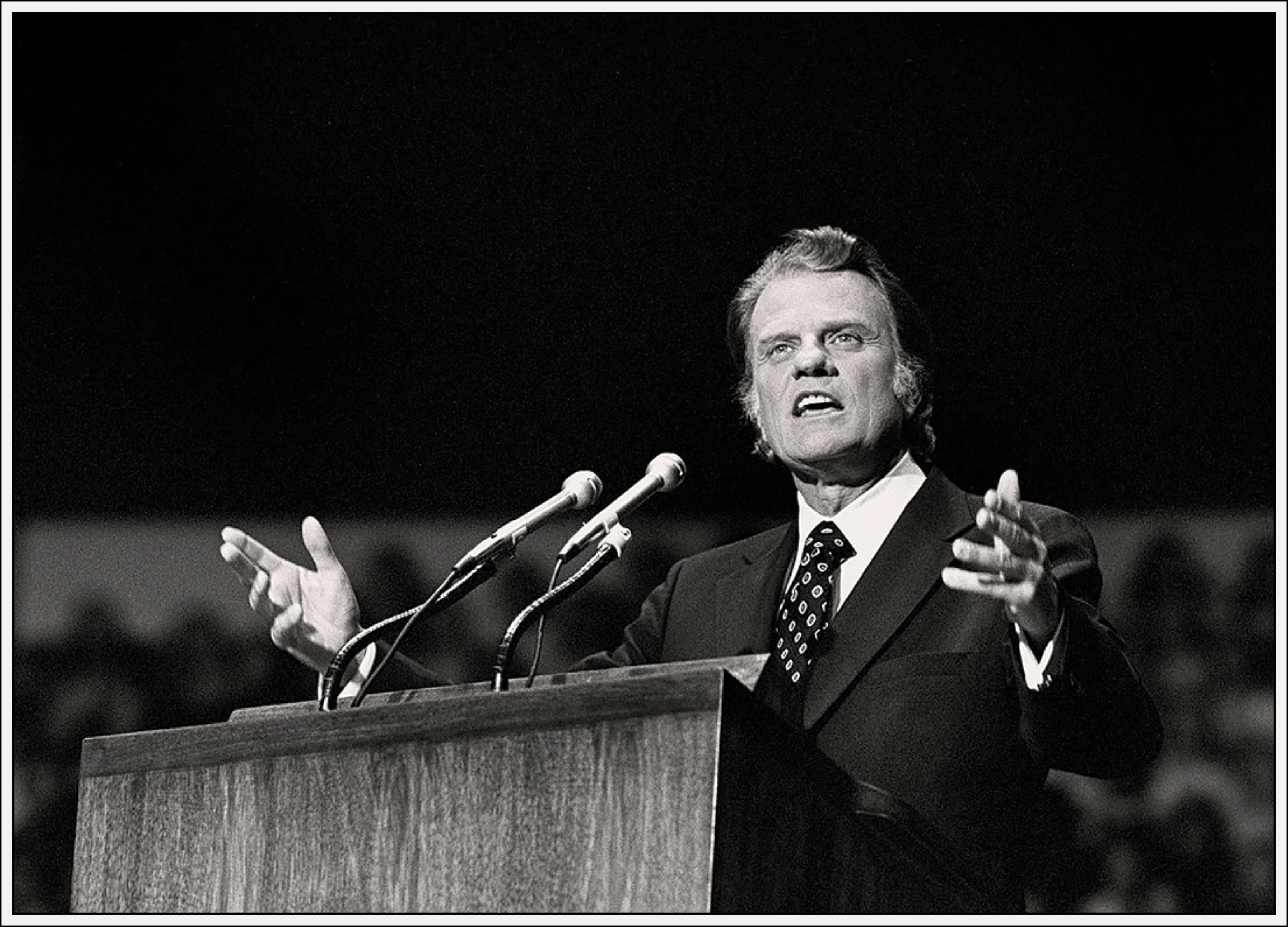

William Franklin Graham Jr. (November 7, 1918 – February 21, 2018)
✪ William Franklin Graham Jr. was an American evangelist, ordained Southern Baptist minister, and civil rights advocate whose broadcasts and world tours featuring live sermons became well known in the mid- to late 20th Century. Throughout his career, spanning over six decades, Graham rose to prominence as an evangelical Christian figure in the United States and abroad.
According to a biographer, Graham was considered “among the most influential Christian leaders” of the 20th Century. Beginning in the late 1940s and early 1950s, Graham became well known for filling stadiums and other massive venues around the world where he preached live sermons. These sermons were often broadcast via radio and/or television, with some continuing to be seen into the 21st Century. During his six decades on television, Graham hosted his annual “crusades,” evangelistic live-campaigns, from 1947 until his retirement in 2005.
Graham also later invited Martin Luther King Jr. to preach jointly at a revival in New York City in 1957. In addition to his religious aims, Graham helped to shape the worldview of a large number of people from various different backgrounds; leading them to find a relationship between the Bible and contemporary secular viewpoints. According to his website, Graham spoke to live audiences consisting of at least 210 million people, in more than 185 countries and territories, through various meetings, including BMS World Mission and his Global Mission event.
Graham’s evangelism was appreciated by mainline Protestant denominations, as he encouraged Protestants, whom were converted by his evangelical message, to remain within or return to their mainline churches. Despite early suspicions and apprehension on his part towards Catholicism; common among contemporaneous evangelical Protestants, Graham eventually warmed and developed amicable ties with many prominent American Catholic Church figures to encourage unity between Catholics and Protestants.
Graham operated a variety of media and publishing outlets. According to his staff, more than 3.2 million people responded to the invitation at Billy Graham Crusades to “accept Jesus Christ as their personal savior.” Graham’s lifetime audience, including those of radio and television broadcasts, likely surpassed billions of people worldwide. As a result of his crusades, Graham preached the Gospel to more people, live and in-person, than anyone else in the history of Christianity.
William Franklin Graham Jr. was born on November 7, 1918, in the downstairs bedroom of a farmhouse near Charlotte, North Carolina. Of Scots-Irish descent, he was the eldest of four children born to Morrow (née Coffey) and dairy farmer William Franklin Graham Sr.
Graham was raised by his parents in the Associate Reformed Presbyterian Church. Graham attended Sharon Grammar School. He started reading books from an early age and loved to read novels for boys, especially Tarzan. Like Tarzan, he would hang on the trees and gave the popular Tarzan yell. According to his father, that yelling led him to become a minister. Graham was 15 years old when Prohibition ended in December 1933, and his father forced him and his sister Catherine to drink beer until they became sick. This created such an unpleasant aversion that the two siblings would avoid alcohol and drugs for the rest of their lives.
Graham was turned down for membership in a local youth group for being “too worldly.” Albert McMakin, who worked on the Graham farm, persuaded him to go see evangelist Mordecai Ham. According to his autobiography, Graham was 16 when he was converted during a series of revival meetings that Ham led in Charlotte in 1934.
After graduating from Sharon High School in May 1936, Graham attended Bob Jones College. After one semester, he found that the coursework and rules were too legalistic. He was almost expelled, but Bob Jones Sr. warned him not to throw his life away: “At best, all you could amount to would be a poor country Baptist preacher somewhere out in the sticks… You have a voice that pulls. God can use that voice of yours. He can use it mightily.”
In 1937, Graham transferred to the Florida Bible Institute in Temple Terrace, Florida. While still a student there, Graham preached his first sermon at Bostwick Baptist Church near Palatka, Florida. In his autobiography, Graham wrote of receiving his calling on the 18th green of the Temple Terrace Golf and Country Club, which was adjacent to the institute’s campus.
In 1939, Graham was ordained by a group of Southern Baptist clergy at Peniel Baptist Church in Palatka, Florida. In 1940, he graduated with a Bachelor of Theology degree.
Graham then enrolled in Wheaton College in Wheaton, Illinois. During his time there, he decided to accept the Bible as the infallible word of God. While attending Wheaton, Graham was invited to preach one Sunday in 1941 at the United Gospel Tabernacle church. After that, the congregation repeatedly asked Graham to preach at their church and later asked him to become their pastor.
On August 13, 1943, Graham married Wheaton classmate Ruth Bell, whose parents were Presbyterian missionaries in China. Her father, L. Nelson Bell, was also a general surgeon. The couple had five children together. Ruth died on June 14, 2007, at age 87. The couple were married for almost 64 years.
In 1948, in a Modesto, California hotel room, Graham and his evangelistic team established the Modesto Manifesto: a code of ethics for life and work to protect against accusations of financial, sexual, and power abuse, The code includes rules for collecting offerings in churches, working only with churches supportive of cooperative evangelism, using official crowd estimates at outdoor events, and a commitment to never be alone with a woman other than his wife (which become known as the “Billy Graham rule”).
Graham was only 29 years old when he became president of Northwestern Bible College in Minneapolis in 1948. He was the youngest president of a college or university in the country, and held the position for four years before resigning in 1952. Graham initially intended to become a chaplain in the Armed Forces, but he contracted mumps shortly after applying for a commission.
The first Billy Graham Crusade was held on September 13–21, 1947, at the Civic Auditorium in Grand Rapids, Michigan, and was attended by 6,000 people. Graham was 28 years old then, and would rent large venues (such as a stadium, park, or even a street); as the crowds became larger, he arranged for a group of up to 5,000 people to sing in a choir.
In 1949, Graham scheduled a series of revival meetings in Los Angeles, for which he erected several circus tents in a parking lot. He attracted national media coverage, especially in the conservative Hearst chain of newspapers, although Hearst and Graham never met. The crusade event ran for eight weeks–five weeks longer than originally planned and Graham became a national figure, with heavy coverage from the wire services and national magazines.
In 1953, Graham was offered a five-year, $1 million contract from NBC to appear on television opposite Arthur Godfrey, but he had prior commitments and turned-down the offer to continue his live touring revivals. Graham held crusades in London which lasted 12 weeks. In 1957, his New York City crusade at Madison Square Garden ran nightly for 16 weeks. At a 1973 rally, his crusade in Durban, South Africa was attended by more than 100,000 people, the first, large mixed-race event in apartheid South Africa.
In Moscow, Russia, in 1992, one-quarter of the 155,000 people in Graham’s audience came forward at his call. During his crusades, he frequently used the altar call song, “Just As I Am.” In 1995, during the Global Mission event, he preached a sermon at Estadio Hiram Bithorn in San Juan, Puerto Rico which was transmitted by satellite to 185 countries and translated into 116 languages. By the time of his last crusade in 2005 in New York City, Graham had preached in 417 live crusades, including 226 in the US and 195 abroad.
Graham also held evangelistic meetings on a number of college campuses: at the University of Minnesota during InterVarsity’s “Year of Evangelism” in 1950, A 4 day mission at Yale University in 1957: and a week-long series of meetings at the University of North Carolina’s Carmichael Auditorium in September 1982.
In 1950, Graham founded the Billy Graham Evangelistic Association (BGEA) with its headquarters in Minneapolis. The association relocated to Charlotte, North Carolina, in 2003 and continues to maintain a number of international offices, such as in Hong Kong, Tokyo and Buenos Aires.
Graham’s earliest crusades were originally racially segregated, but he began to modify his approach in the 1950s. During a 1953 rally in Chattanooga, Tennessee, Graham tore down the ropes that organizers had erected to segregate the audience into racial sections. In his memoirs, he recounted that he told two ushers to leave the barriers down “or you can go on and have the revival without me.“
In 1957, Graham’s stance towards integration became more public when he allowed black ministers Thomas Kilgore and Gardner C. Taylor to serve as members of his New York Crusade’s executive committee. He also invited Martin Luther King Jr., whom he first met during the Montgomery bus boycott in 1955, to join him in the pulpit at his 16-week revival in New York City. 2.3 million gathered at crusades at Madison Square Garden, Yankee Stadium and Times Square to hear them speak.
In 1960, King and Graham traveled together to the Tenth Baptist World Congress of the Baptist World Alliance. In 1963, Graham posted bail for King to be released from jail during the Birmingham (Alabama) campaign.
Graham often played multiple roles which reinforced each other. Grant Wacker identified eight major roles that he played: preacher, icon, Southerner, entrepreneur, architect (bridge builder), pilgrim, pastor and his widely recognized status as America’s Protestant patriarch, which was on a par with Martin Luther King and Pope John Paul II.
Graham deliberately reached into the secular world as a bridge builder. For example, as an entrepreneur he built his own pavilion for the 1964 New York World’s Fair. He appeared as a guest on a 1969 Woody Allen television special, in which he joined the comedian in a witty exchange on theological matters. During the Cold War, Graham became the first evangelist of note to speak behind the Iron Curtain, addressing large crowds in countries throughout Eastern Europe and in the Soviet Union, calling for peace.
In 1984, he led a series of summer meetings, Mission England—in the United Kingdom. He often used outdoor football (soccer) fields for his venues.
Graham was interested in fostering evangelism around the world. In 1983, 1986 and 2000 he sponsored, organized and paid for massive training conferences for Christian evangelists. At the time, the largest representation of nations ever held. Over 157 nations gathered in 2000 at the RAI Convention Center in Amsterdam, the Netherlands. At one revival in Seoul, South Korea, Graham attracted more than one million people to a single service. He also appeared in North Korea in 1992.
On October 15, 1989, Graham received his own star on the Hollywood Walk of Fame. He is the only person functioning as a minister who has received such a star in that capacity.
On September 22, 1991, Graham held his largest event in North America on the Great Lawn of Manhattan’s Central Park. City officials estimated that more than 250,000 attended.
▶️ 28 Minutes
Graham prepared one last sermon, “My Hope America,” which was released on DVD and played around America and possibly worldwide between November 7–10, 2013. November 7 was Graham’s 95th birthday and he hoped to spark a revival with this message.
Graham said that his planned retirement was a result of his failing health, He suffered from hydrocephalus from 1992 on. In April 2010, Graham was 91 and experiencing substantial vision, hearing and balance loss when he made a rare public appearance at the re-dedication of the renovated Billy Graham Library.
In 2011, when asked if he would have done things differently, he said he would have spent more time at home with his family, studied more and preached less. Additionally, he said he would have participated in fewer conferences.
Graham was a lifelong registered member of the Democrat Party. However in 1960, he opposed the candidacy of John F. Kennedy, fearing that Kennedy, as a Catholic, would be bound to follow the Pope. Graham worked “behind the scenes” to encourage influential Protestant ministers to speak out against Kennedy.
After his election, Kennedy invited Graham to play golf in Palm Beach, Florida, after which Graham acknowledged Kennedy’s election as an opportunity for Catholics and Protestants to come closer together.
Graham opposed all abortion except in a very narrow range of circumstances: rape, incest, and medical situations which threatened the life of the mother. The charter of the Billy Graham Evangelistic Association states, “Life is sacred, and we must seek to protect all human life: the unborn, the child, the adult and the aged.”
Graham leaned toward the Republicans during the presidency of Richard Nixon, whom he had met and befriended as vice president under Dwight D. Eisenhower. He gave his support to various political candidates over the years.
In 2011, although grateful to have met politicians who have spiritual needs like everyone else, he said he sometimes crossed the line and would have preferred to avoid politics.
Graham had a personal audience with many sitting US presidents, from Harry S. Truman to Barack Obama. Twelve consecutive presidents. After meeting with Truman in 1950, Graham told the press he had urged the president to counter communism in North Korea. Truman disliked him and did not speak with him for years after that meeting. Later he always treated his conversations with presidents as confidential. Graham became a regular visitor to the White House during the tenure of Dwight D. Eisenhower.
In 1970, Nixon appeared at a Graham revival in East Tennessee, which they thought safe politically. It drew one of the largest crowds in Tennessee of protesters against the Vietnam War. Nixon was the first president to give a speech from an evangelist’s platform. Their friendship became strained in 1973 when Graham rebuked Nixon for his post-Watergate behavior and the profanity heard on the Watergate tapes.They eventually reconciled after Nixon’s resignation.
Graham was extremely outspoken against communism and supported the American Cold War policy, including the Vietnam War. In a secret letter from April 15, 1969, made public twenty years later, Graham encouraged Nixon to bomb the dikes in North Vietnam if the peace talks in Paris should fail. This action would “destroy the economy of North Vietnam” and, by Nixon’s estimate, would have killed a million people.
In 1982, Graham preached in the Soviet Union and attended a wreath-laying ceremony to honor the war dead of World War II, when the Soviets were American allies in the fight against Nazism.
In 1970, Graham stated that feminism was “an echo of our overall philosophy of permissiveness” and that women did not want to be “competitive juggernauts pitted against male chauvinists.” He further stated that the role of wife, mother, and homemaker was the destiny of “real womanhood” according to the Judeo-Christian ethic.
Graham regarded homosexuality as a sin, and in 1974 described it as “a sinister form of perversion.” In 1993, he said that he thought AIDS might be a “judgment” from God.
Graham also opposed same-sex marriage, stating that “I believe the home and marriage is the foundation of our society and must be protected.” Graham’s obituary noted that his stated position was that he did not want to talk about homosexuality as a political issue.
In 2012, Graham and his son, Franklin, publicly endorsed North Carolina Amendment 1, a measure to ban same-sex marriage in the state. They both condemned President Obama’s public declaration of support for same-sex marriage later that year.
Graham was frequently honored by surveys, including “Greatest Living American,” and consistently ranked among the most admired persons in the United States and the world. He has appeared most frequently on Gallup’s list of most admired people. On the day of his death, Graham had been on Gallup’s Top 10 “Most Admired Man” list a total of 61 times, and held the highest rank of any person since the list began in 1948.
In 1983, he was awarded the Presidential Medal of Freedom by US President Ronald Reagan.
In 2001, Queen Elizabeth II awarded him an honorary knighthood. The honor was presented to him by Sir Christopher Meyer, British Ambassador to the US at the British Embassy in Washington DC on December 6, 2001. On May 31, 2007, the $27 million Billy Graham Library was officially dedicated in Charlotte.
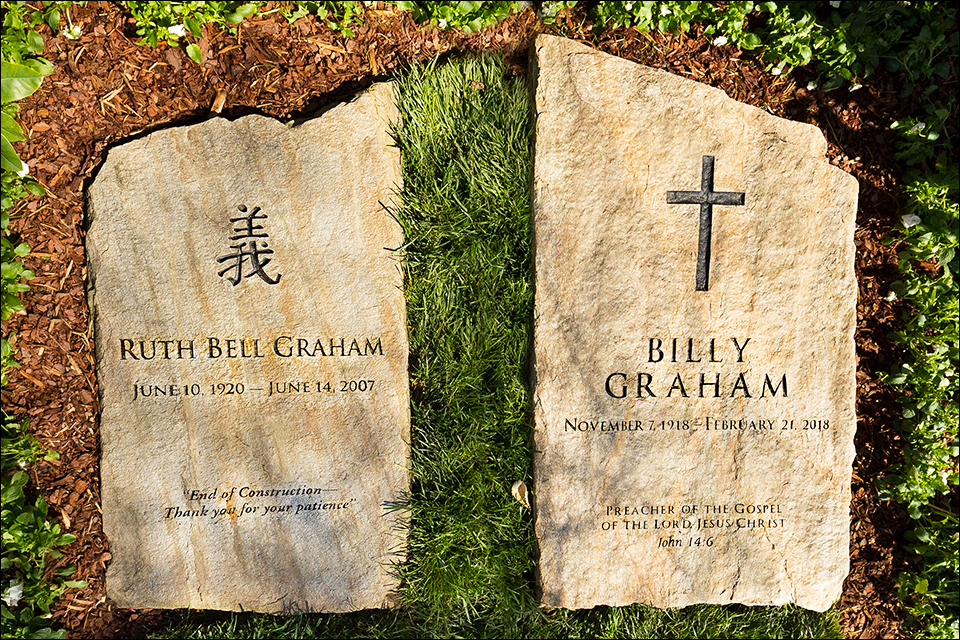
Graham died of natural causes on February 21, 2018, at his home in Montreat, North Carolina, at the age of 99. Between February 28 and March 1, 2018, Graham became the fourth private citizen in United States history to lie in honor at the United States Capitol rotunda in Washington, D.C.
A private funeral service was held on March 2, 2018. Graham was buried beside his wife at the foot of the cross-shaped brick walkway in the Prayer Garden, on the northeast side of the Billy Graham Library in Charlotte, North Carolina. Graham’s pine plywood casket was handcrafted in 2006 by convicted murderers at the Louisiana State Penitentiary.
On May 16, 2024, a bronze statue of Graham was unveiled in his honor in the United States Capitol. ✪


















▶️ CLICK HERE TO VIEW


▶️ CLICK HERE TO VIEW
▶️ 37 Minutes 39 Seconds
▶️ 1 Hour 44 Minutes 29 Seconds
▶️ 22 Minutes 48 Seconds
▶️ 12 Minutes 41 Seconds
▶️ 17 Minutes 57 Seconds ⭐️ RailBoss
▶️ 22 Minutes 20 Seconds
▶️ 16 Minutes 19 Seconds
▶️ 40 Minutes 45 Seconds
▶️ 3 Minutes 45 Seconds
▶️ 3 Minute 2 Seconds
▶️ 2 Minutes 24 Seconds
