


Hi Folks…And Welcome Again To FLAT OUT!
Across the English Channel From Last Month, It’s…
The Sunbeam Tiger: 1964-1967
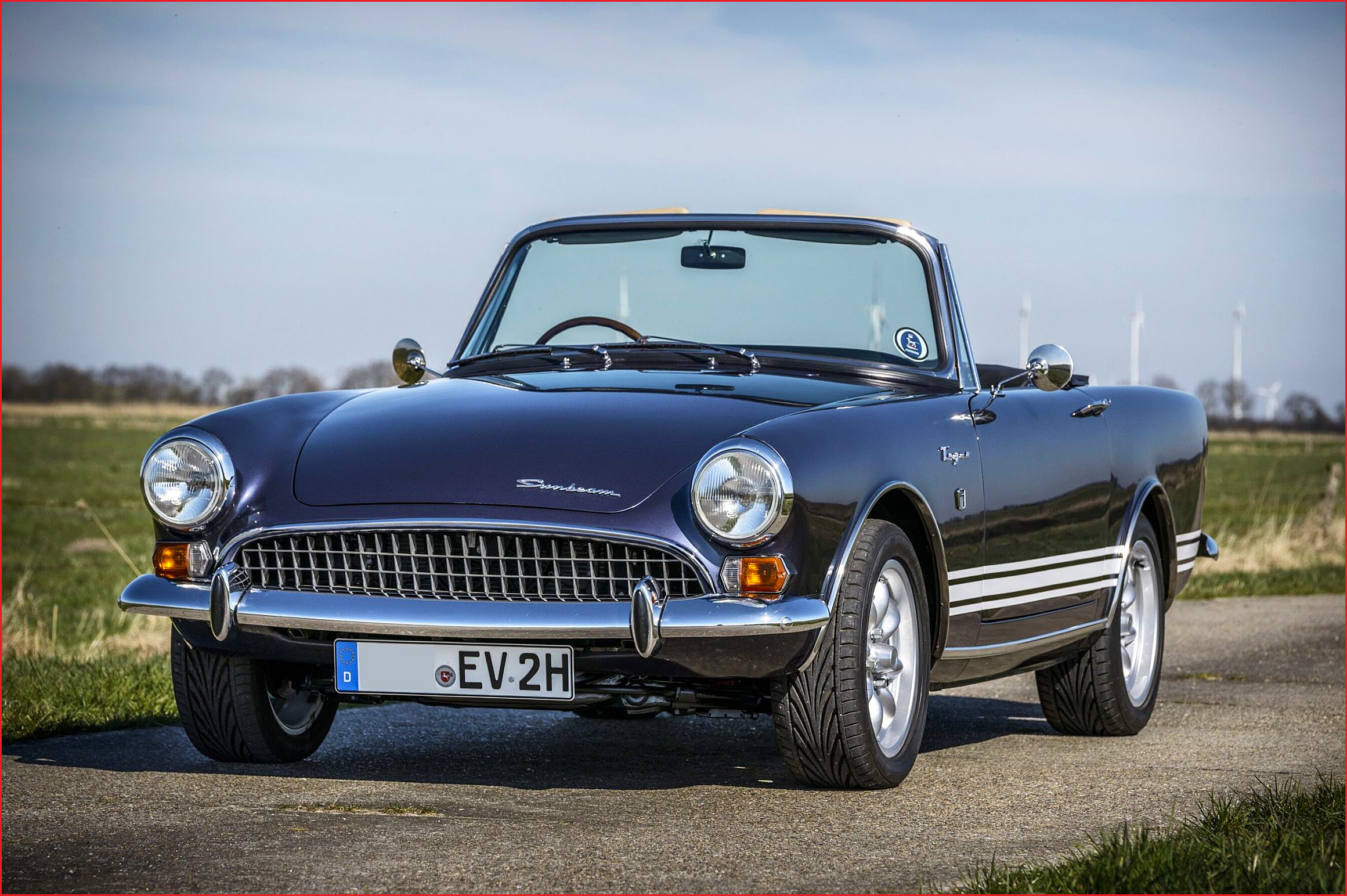
✪ This is the third car I’ve featured that was driven by bumbling CONTROL Agent 86, Maxwell Smart, and the one he is most associated with as he drove it in the first two seasons of Get Smart. The Sunbeam Tiger started life as the British Rootes Group‘s 2-seat Sunbeam Alpine Series II roadster, upgraded with a Ford 260 V-8. American racer-turned-performance car builder Carroll Shelby had performed a similar V-8 transplant on the AC Ace, turning it into the famous AC Cobra first with a Ford 289, then a 427. Rootes Group realized that the Sunbeam Alpine needed more power if it was to compete successfully in the world market, but they lacked a suitable engine or the resources to build one on their own. They approached Ferrari to redesign the Alpine‘s 1.6 liter four-cylinder engine, realizing that “Powered by Ferrari” would be a huge selling point. After some initial negotiations Ferrari turned down the offer. In 1962 racing driver and Formula One champion Jack Brabham approached Rootes competition manager Norman Garrad with the idea of putting a Ford V-8 in the Alpine. Garrad’s son Ian was West Coast Sales Manager of Rootes American Motors in Los Angeles and lived near Carroll Shelby. He was also familiar with Shelby’s transformation of the AC Ace into the AC Cobra with just such an engine swap. The Alpine was already ahead of competition from the likes of Triumph and MG by virtue of its roll-up windows, floor carpeting along with rubber mats, padded dashboard, ample instrumentation and well-fitting integrated soft convertible top. It also had simple, clean side panels and muscular front and rear fenders, perfect for the American market. The small rear fins also hearkened back to American cars of the 1950s and were kept throughout the production run.
Mark I 1964-1966
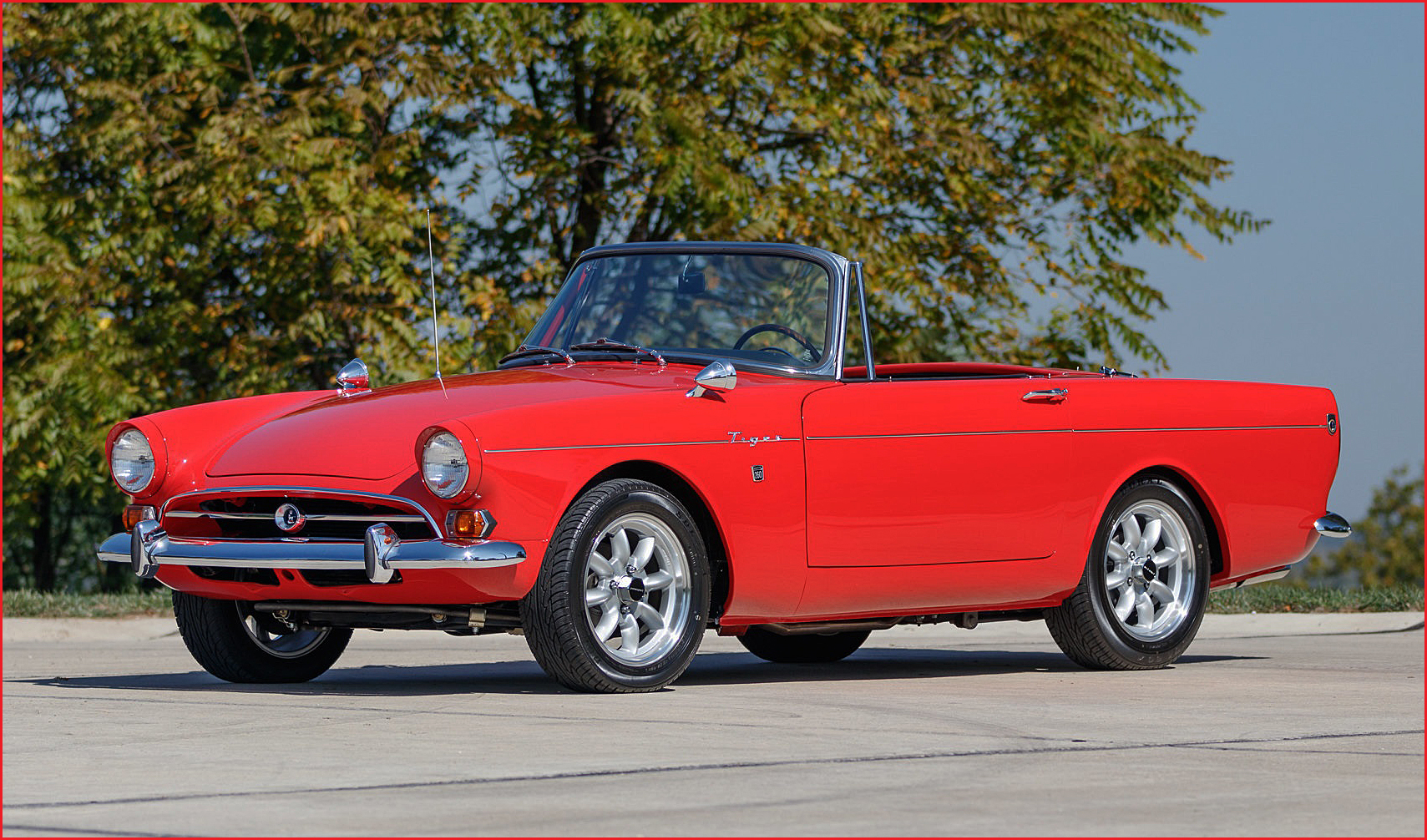
According to journalist William Carroll, after measuring the Alpine‘s engine bay with “a ‘precision’ instrument of questionable antecedents” – a wooden yardstick – Ian Garrad sent his service manager Walter McKenzie to various car dealerships to find a Ford V-8 that would fit. He returned with the happy news that the 260 cubic inch engine would fill the bill, and was also lightweight, weighing in at a mere 440 lbs. It was also only 3 1/2 inches longer than the Alpine‘s four-cylinder, so the primary concern was its width. At 164 HP and 258 lb. ft. of torque it was nearly twice as powerful as the 84 HP four-cylinder and would be a formidable engine in the sub-2200 lb. Alpine. Shelby estimated an eight week timeline and a $10,000 budget to produce a prototype, and Rootes Group agreed. Ian Garrad, impatient to see if the concept was feasible, commissioned racing driver Ken Miles to quickly build a prototype. Miles was given a Series II Alpine, a Ford 260 V-8, a 2-speed automatic transmission and $800. He had a running version in a week, proving the concept. Shelby began work on his prototype in April 1963 and was making trial runs around Los Angeles by the end of the month.
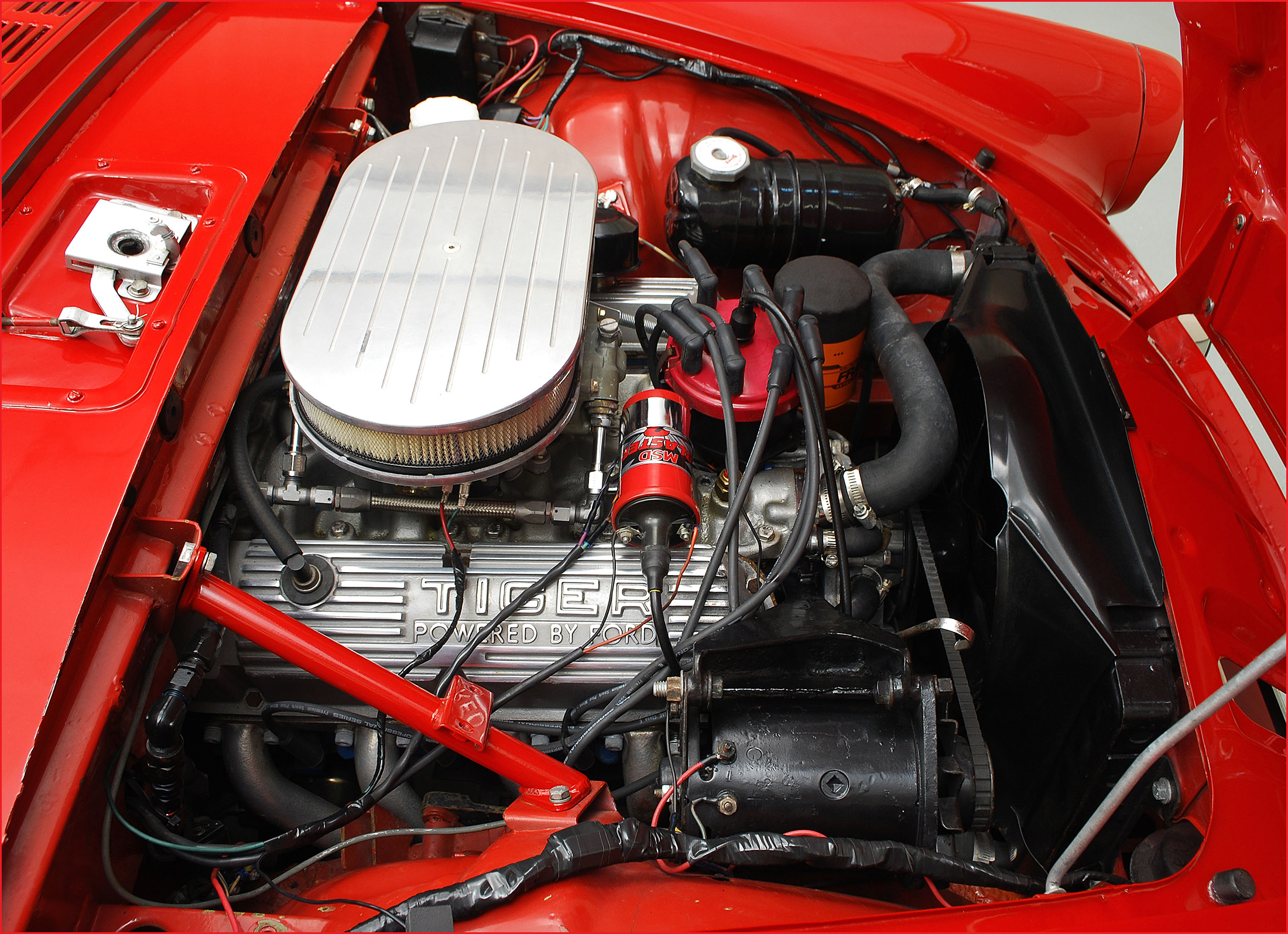
Miles and Shelby both found that the 260 V-8 would just fit into the Alpine‘s engine bay, without an inch to spare. The figure of speech about “shoehorning” an engine into a car that wasn’t designed for it was quite appropriate for the Tiger prototype. Ian Garrad and John Panks, director of Rootes American Motors, tested an early version. They were so impressed that Panks sent a report to Brian Rootes back in England, stating that “we have a tremendously exciting sports car which handles extremely well and has a performance equivalent to an XX-K Jaguar…it is quite apparent that we have a most successful experiment that can now be developed into a production car.” Shelby’s prototype was considerably more refined than Miles’ crude version and used a Ford 4-speed manual transmission instead of the 2-speed automatic. Installing such a large engine into a small vehicle required some modifications, from fabricating motor mounts to upgrading the suspension to replacing the Alpine‘s recirculating-ball steering with a smaller rack-and-pinion unit. This had the added benefit of a more precise steering response. The Alpine‘s existing monocoque chassis with X-bracing was already well -suited to handle the upgraded horsepower of the new Ford Powerplant. The near-doubling of power output compared to the Alpine only came at a 20 percent weight penalty thanks to the 260’s light weight, and its 51.7/48.3 front/rear weight ratio was still similar to the Alpine. The finished Tiger only weighed 2,653 lbs.
All Rootes Group products had to be approved by Lord Rootes, who was reportedly “very grumpy” that the Tiger had been built without his knowledge. He agreed to have Shelby’s prototype shipped to England for him and his team to assess. He insisted on driving the car himself, and was so impressed that he contacted Henry Ford II directly to negotiate a deal for 3,000 Ford 260 V-8s, the number he expected to sell the first year. This was the largest order for Ford engines from an automobile manufacturer at the time. Lord Rootes decided that the car should debut at the 1964 New York Motor Show a mere eight months away. Rootes Group‘s normal development cycle from idea to finished product was three to four years. The working name for the car, Thunderbolt, was changed to Tiger by the time of the auto show, inspired by Sunbeam‘s 1925 land speed record holder of the same name.
Shelby had hoped to get the contract to build the Tiger in the US, but Rootes Group was uneasy about his cozy relationship with Ford and decided to build the car in England instead. The Rootes factory in Ryton did not have the capacity to build the car in the numbers that Rootes wanted to produce, so Jensen‘s West Bromwich plant was tapped to produce it. Readers may be familiar with the Jensen-Healey sports car of the 1970s. Jensen was only able to produce the Tiger because its assembly contract for the Volvo P1800 had been canceled, thus it had an unused assembly line and the production capacity. Jensen‘s chief engineer Kevin Beattie and assistant Mike Jones had also worked for Rootes and understood the company operations. The first 14 Jensen-built prototypes were based upon the Series IV Alpine body shell, available at the end of 1963, and production began in June 1964, less than a year after Shelby completed his prototype. Any disappointment that Shelby may have felt in not being able to produce the car was offset by an offer from Rootes to pay him an undisclosed royalty on every Tiger built.
Installing the 260 in the tight Alpine engine bay required some unusual manufacturing methods such as bashing in the the already painted and primed firewall with a sledgehammer to allow the engine to be slid into place. The Ford 260 engine was fitted with a stock Ford two-barrel carb. The first few Tigers were fitted with Borg-Warner four-speed transmissions until Ford resolved its supply problems and was able to ship its own four-speeds that were also being installed in the new Mustang. The Girling manufactured brakes featured front discs, unusual for the time. An independent front suspension was fitted with stiffer springs to accommodate the additional weight of the V-8. Jensen was soon producing 300 Tigers a month, all but 56 in the first year slated for North America.
“Powered by Ford 260” badges were attached beneath the Tiger logo to better market the car to American buyers. Lighter alloy wheels, a revised grill and bumpers, new turn signals, chrome trim and a dual exhaust system made it distinct from the Alpine on the outside. From the inside a few visual clues indicated the car was different like sportier bucket seats, a larger speedometer and tach and shorter shifter atop a much wider transmission tunnel. The wood-grained dashboard and wood steering wheel were carried over from the Alpine and offered a distinctly British touch. British sports cars of the period were not very roomy, but moving the battery box from behind the driver’s seat to the trunk left a little more legroom, plus room behind the seat to stow small items. Dealers offered several performance modifications that upped the mildly tuned 164 HP 260 engine to a more potent 245 HP for an additional $250 over the $3,499 sticker price. This proved problematic for the suspension and tires, which had been tuned for the stock engine. In 1965 the British Motor Sport magazine concluded that “No combination of an American V-8 and British chassis could be happier.” The stock 260 propelled the Tiger from 0-60 in 8.5 seconds with a top speed of 118 MPH, a considerable gain over the Mark IV Alpine‘s 14 second 0-60 and 96 MPH numbers.
The later Mark I cars post-1965 were made with the Mark V Alpine body and are generally designated “Mark IA” by enthusiasts to differentiate them from the earlier Mark IV-bodied cars.
Mark II 1967
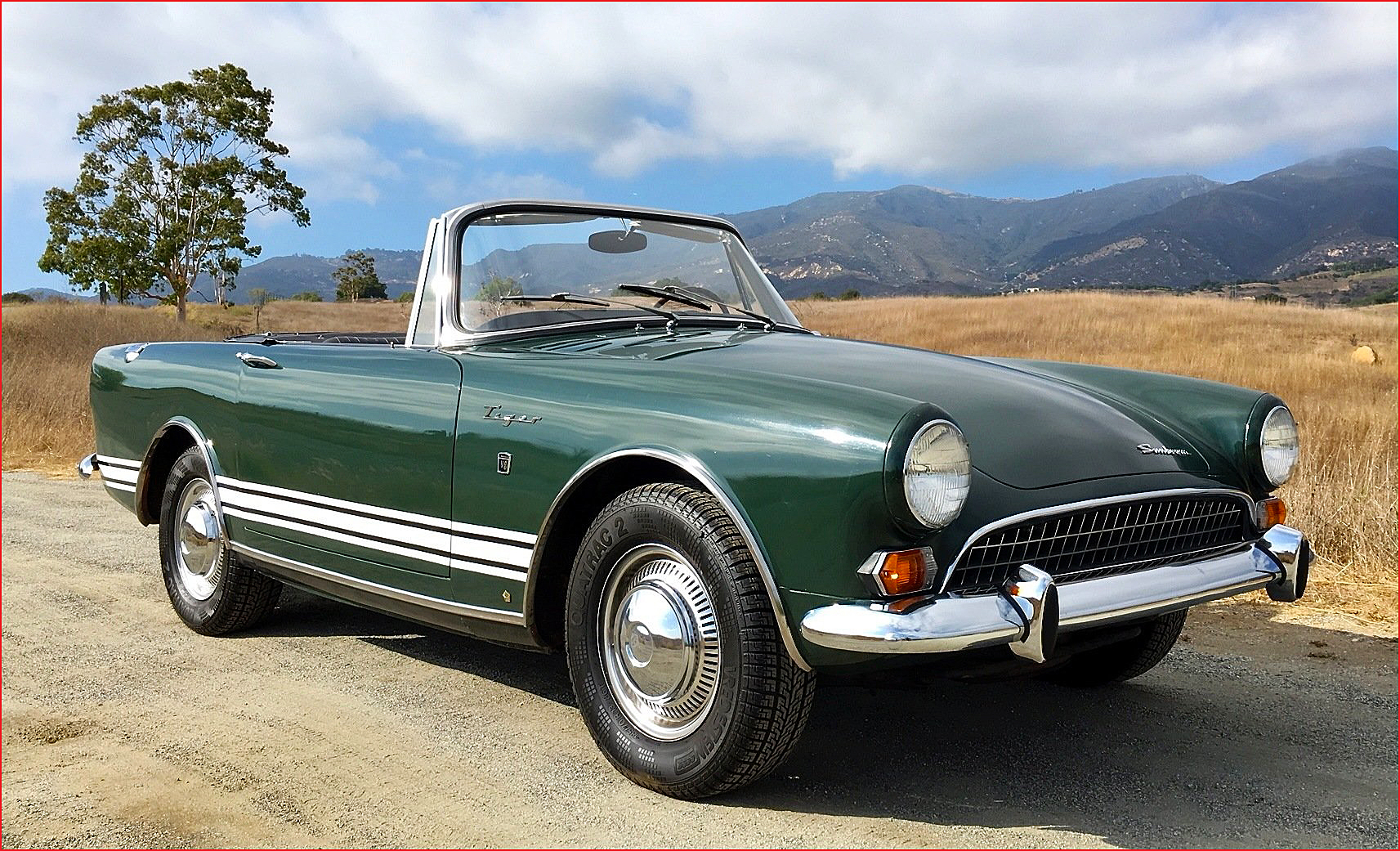
The Tiger Mark II arrived in 1967, with a 200 HP Ford 289 V-8 replacing the 164 HP 260, still in the Mark V Alpine body. This dropped the already impressive, for a British sports car of the period, 8.5 second 0-60 time down a full second to 7.5 and increased the top speed to 122 MPH. A new egg-crate grill graced the front as well as non-hooded headlight surrounds and stainless-steel rocker and wheel arch moldings. The Mark II was officially only available in the US, where it was called Tiger II and priced at $3,842. Ford‘s 1967 Mustang was priced at $2,898, nearly a thousand dollars less, and would best the little Sunbeam by over half a second to 60 MPH and 1 MPH in top speed with the same 289 V-8 despite being 363 lbs. heavier than the 2,560 lb. Mark II.
Rootes Group had always been under-funded, and by 1967 the company was in serious financial difficulty. A thirteen-week strike at one of its subsidiaries further put a strain on finances. At the same time Chrysler was looking to increase its presence in Europe and bought a large share of of Rootes, but not a controlling one. As part of the agreement Chrysler agreed not to acquire a controlling stake in the company without the approval of the British Government, who did not want to see any further American ownership of the UK car industry. in 1967 the government approached BMH and Leyland to see if they would buy out Chrysler and keep the company British, but neither had the resources. Later that year the British Government allowed Chrysler to acquire a controlling interest in Rootes. By the time the Mark II went into production, Chrysler was in full control of Rootes Group. Manufacturing a car powered by a competitor’s engine was unacceptable to Chrysler, but the car was already in production and their 273 small-block V-8 engine was too large to fit into the Tiger‘s engine bay without major modifications, and their big-block offerings would not fit at all. Rather than give Ford any recognition for their new acquisition the “Powered By Ford” badging was changed to “Sunbeam V-8” and Chrysler‘s Pentastar logo was added. The marketing literature simply described the car as having an “American V-8 powertrain.” Chrysler was not interested in producing it, concentrating more on Rootes Group‘s family cars, and the Tiger vanished after the 1967 model year when the existing supply of Ford 289s ran out. The last Mark II Tiger was produced by Jensen on June 27, 1967 after a run of 7,128.
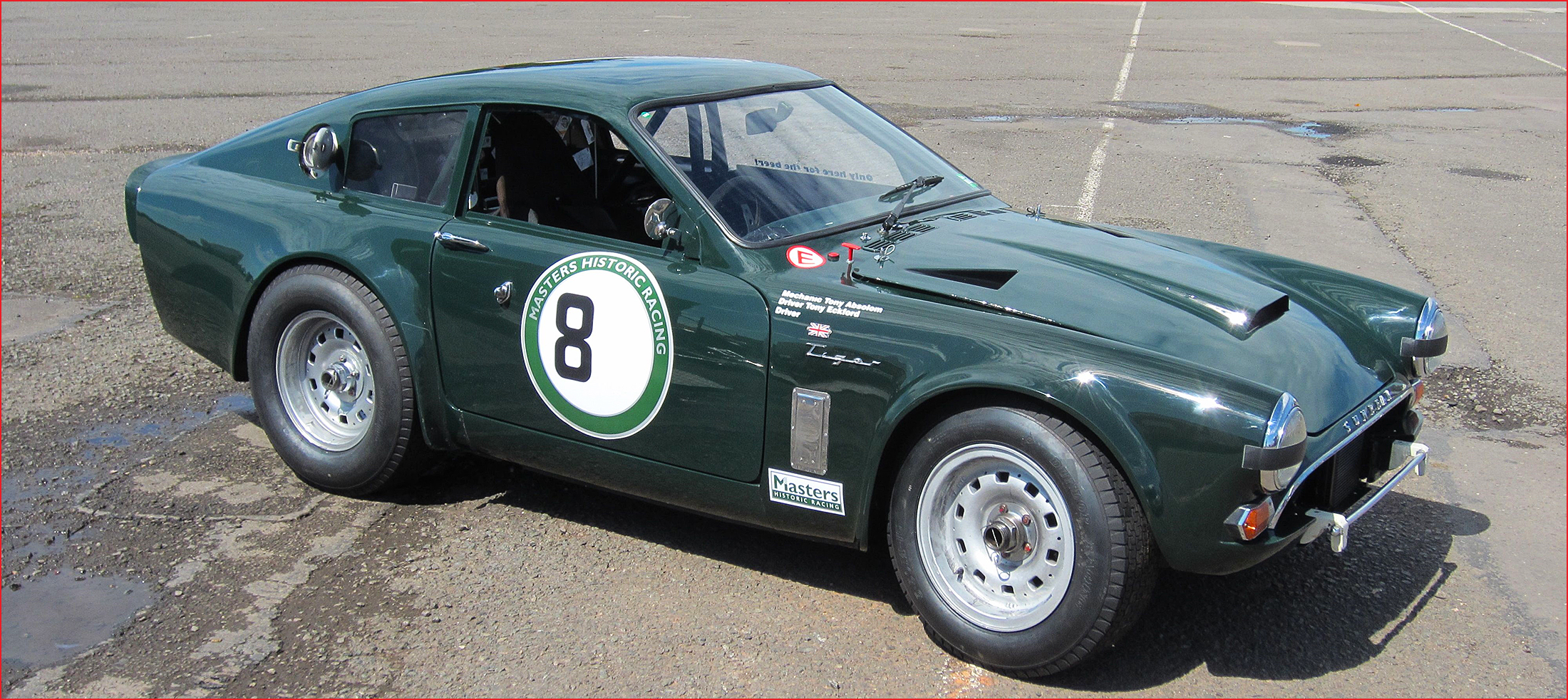
Racing versions of the Tiger with heavily modified engines and fastback coupe bodies competed in SCCA events and the 1964 LeMans race, where both entries failed to finish due to mechanical issues. Later that year Ken Miles drove a Tiger to a second-place finish at the 200-mile Road America race. 1965 was more successful for the little Sunbeam, scoring two wins and seven podium finishes. Another win would come in 1967. The Tiger also went rally racing, racking up wins in the 1964 Geneva Rally, the 1965 Alpine Rally (where it was later disqualified) and a fourth-place finish in the 1965 Monte Carlo Rally.
Don Adams, who played Maxwell Smart, gained control of the Sunbeam Tiger used on the show after the series ended. He later gave it to his daughters and it is now reportedly on display at the Playboy Mansion.
Once again, I have a personal connection to this month’s featured car. A neighbor down the street when I was in elementary school, a friend of my parents, owned a red Sunbeam Tiger. I often heard he and my father discussing the car and cars in general. My father owned and was interested in sports cars and I think that I inherited my passion for oddball sports cars from him. Thanks, Dad. I wish you were here to see me put my passion into words for my friends to read.✪
Got a Great Car Story? Share it! Reminisce About Your Other Favorite Cars, Too!
Seeyas Again Next Time On FLAT OUT!


