


Hi Folks…And Welcome Again To FLAT OUT!
Different & Inventive But Ultimately Doomed, It’s…
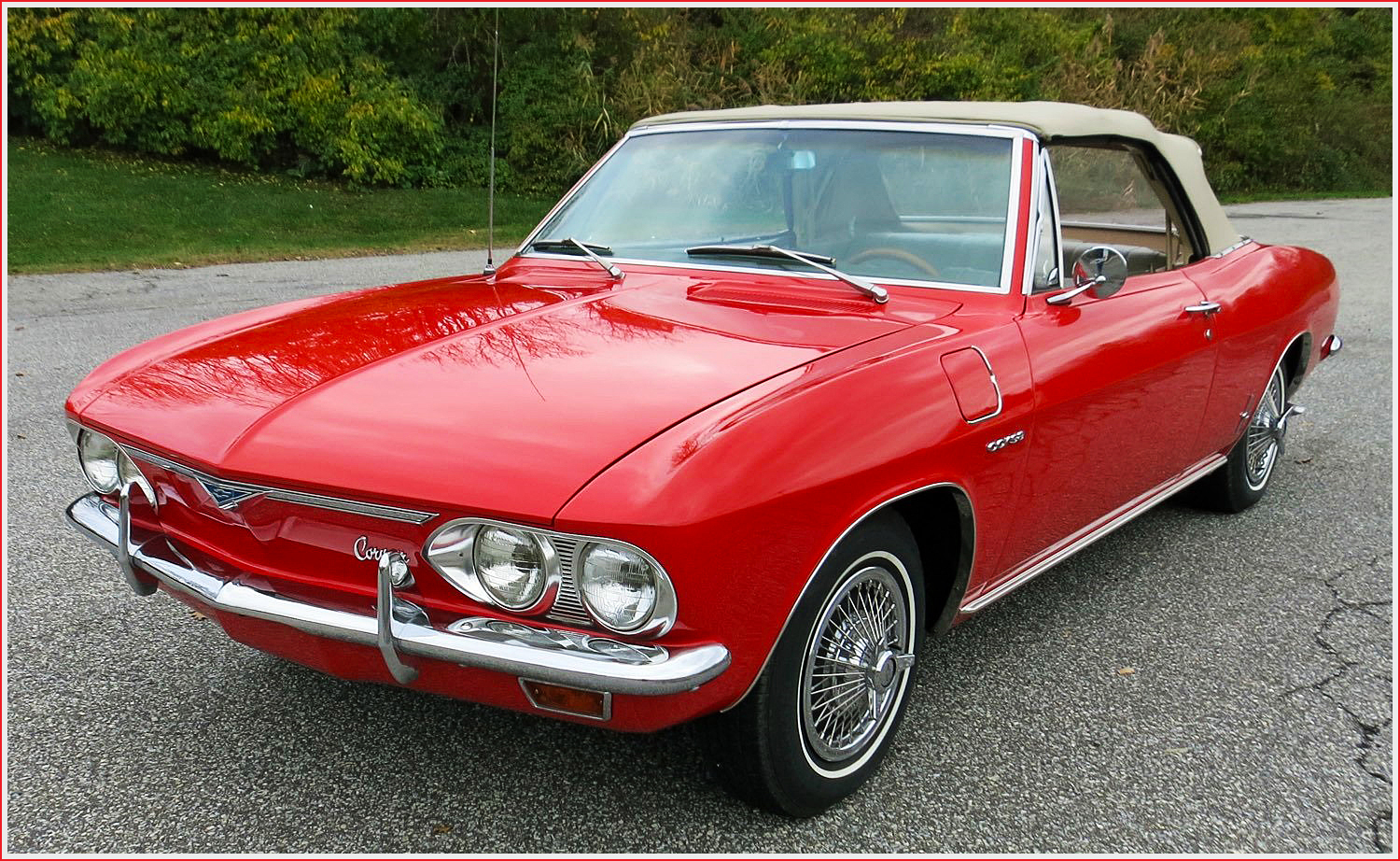
The Chevrolet Corvair- 1960-1969
Time-travel with me back to the fall of 1959. Cars still had fins and an engine in the front driving the rear wheels, save for a few foreign exceptions. The following year a happy, prosperous post-war America would trade in the weary war hero Eisenhower for a vibrant young President who would fall to an assassin’s bullet well before his first term was up. The post-war Baby Boom was winding down and the Space Race was not yet in full swing. The “counterculture” still consisted of aloof, mostly black-clad Beatniks who dug jazz and eschewed the new rock & roll birthed some half a decade earlier, preferring Miles Davis and Dave Brubeck to Elvis and Chuck Berry. The Beatles were still three guitarists in search of a drummer, the world had yet to hear of The Rolling Stones, The Who or The Kinks; the British Invasion would be nearly five years away, and Bob Dylan was two and a half years from releasing his first album. This is the era the innovative Corvair faced, one whose monumental changes, unlike the Corvair‘s, were still in the future.
First Generation 1960-1964
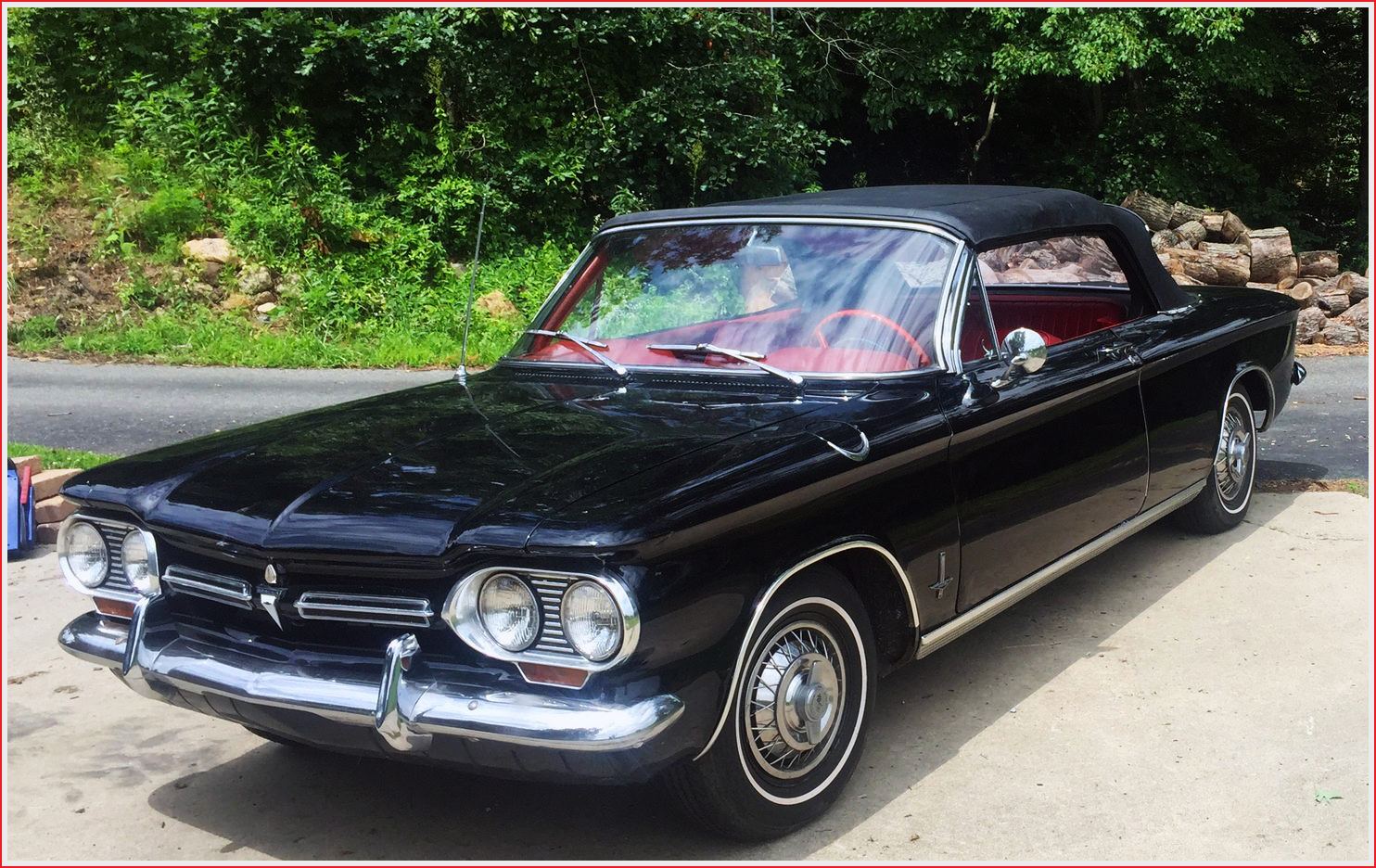
From the outside the Corvair looked like your typical early ’60s compact car, but it was like few other cars on the road. An air-cooled flat six-cylinder engine rode in the back of the car and drove the rear wheels. The Volkswagen Beetle, the Porsche 356 and the upcoming Porsche 911 were its only contemporaries in this regard, and the 911 released five years later would be the only one of those with a six-cylinder. The name originated as a portmanteau of Corvette and Bel Air, a name first applied to a 1954 Corvette-based fastback concept, the “air” part referring to it’s unique (for Detroit) air-cooled engine. Ed Cole, the engineer-turned-General Manager at Chevrolet and considered the father of the Chevy small-block V-8 engine was heavily involved in the development of the Corvette and completely involved in the development and production of the Corvair. American cars had become larger and larger as the 1950s wore on, abandoning the smaller cars of years past. By the late 1950s small foreign imports from Volkswagen, Fiat and others showed that there was sufficient demand for smaller cars. Smaller American automakers than the Big Three had revealed their own compact cars; as far back as 1953 Nash had introduced the subcompact Metropolitan, after Nash and Hudson merged to form AMC that company resurrected the compact 1950 Nash Rambler as the Rambler American in 1958 and Studebaker began producing the compact Lark in 1959. The Big Three took notice and began building their own compacts to compete. Whereas the compact offerings from Ford and Chrysler were scaled-down versions of conventional American cars, Chevrolet took a clean-slate approach with the Corvair.
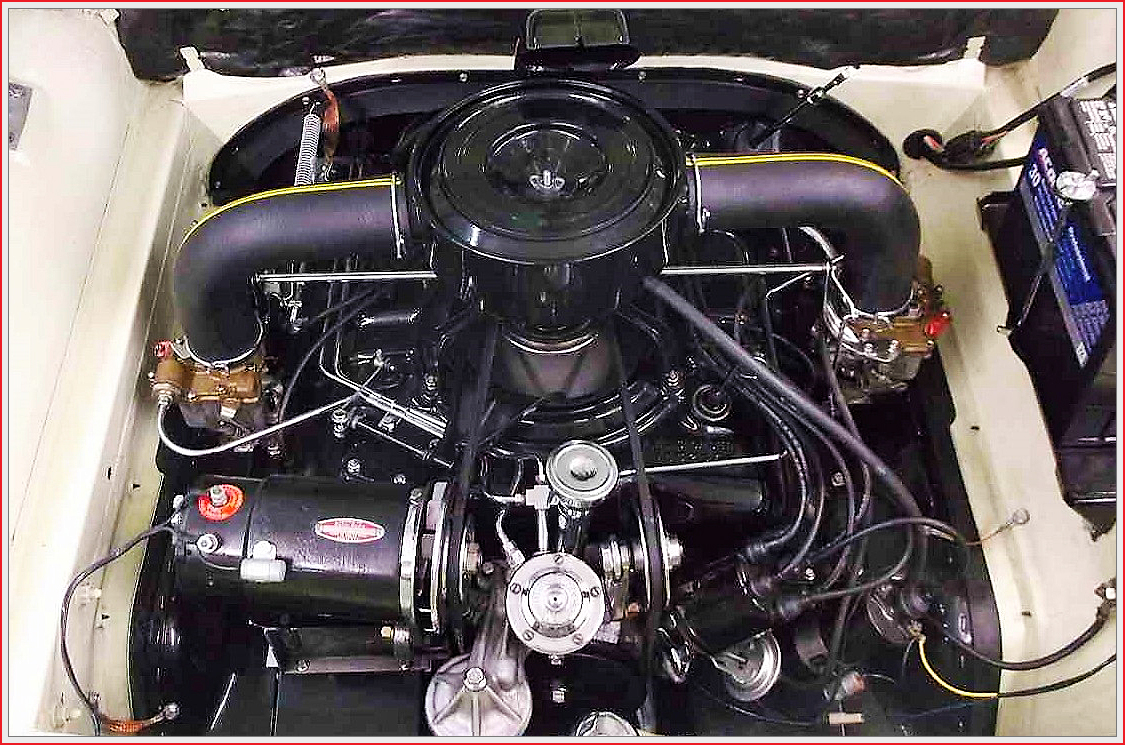
The 140 cu. in., 80HP air-cooled flat six-cylinder engine was unlike anything Detroit had produced before, had many major components made of aluminum to save weight and drove the rear wheels through a transaxle rather than a conventional transmission. The traditional body-on-frame construction was abandoned in favor of a monocoque system where structural rigidity was carried via an underpan and the body itself like the Volkswagen Beetle. The “Quadri-Flex” suspension was independent on all four wheels with the addition of independent suspension arms on the rear. and the car’s engineering earned numerous patents. The lack of a driveshaft meant that there was no need for the conventional transmission tunnel in the interior; the flat floor provided more driver and passenger foot room. The tires were wider and lower-profile than standard car tires and rode on wider wheels. A 2300 lb. curb weight meant that the Corvair needed no power steering or power brakes to control it and the Volkswagen-like swing-axle suspension provided a comfortable ride. It could be had with either a three-speed manual transmission or Chevrolet‘s 2-speed Powerglide automatic. A proposed fully synchromesh 4-speed manual transmission was put off until the 1961 model year due to casting problems as well as problems with the gear shaft. Four models were initially offered, the budget-minded 569 and the more deluxe 769 4-door sedans and the 2-door coupe 527 and 727. The deluxe Monza two-door coupe edition would make a mid-year appearance with bucket seats and upscale trim. In February of 1960 an uprated “Super Turbo Air” engine (which was not turbocharged, the name was a marketing ploy) used a hotter camshaft, revised dual-spring cylinder heads and a lower-restriction muffler to achieve 95 HP. This engine was only available with the manual transmission. Even though the Corvair was only one year removed from the giant tail fins of 1959 it had no fins and didn’t even have a chrome grill. Ed Cole made the cover of Time magazine and Motor Trend named the Corvair the 1960 Car Of The Year.
In 1961 the upscale Monza trim was introduced into the four-door sedan 569 and 769 models. The new four-speed transmission had a floor shifter. This and the introduction of the new bored-out 98HP 145 cu. in. engine caught the attention of the younger generation, who began referring to it as the “poor man’s Porsche.” Heat was now directed from the cylinders and heads as opposed to the gasoline-powered heater of the 1960 model, and factory air conditioning was introduced mid-year, something neither the Volkswagen nor the Porsche 356 could say. A “Corvair 95” panel van was new for 1962 as well as the Greenbriar Sportswagon station wagon variant that used the same body with optional rear windows. There was a budget 500 model and a more upscale 700 model wagon. Due to space constraints, A/C was not available on the panel van or Greenbriar models. Loadside and Rampside light-duty pickup versions were also available.
1962 saw several new changes. The base 500 model wagon was dropped leaving the 700 model as the only wagon, with a Monza trim option. In the Spring Chevrolet wished to cultivate a more sporty image for the Corvair, to that end they offered a convertible model as well as a 150HP turbocharged Spyder option for the Monza coupe and convertible. The Spyder would be only the second production car offered with a turbocharger, GM‘s own Oldsmobile F-85 Turbo Jetfire beat the Corvair to that distinction by only a few months. The Spyder also came with a multi-gauge instrument cluster with a tachometer, cylinder head temperature and intake manifold pressure gauges and special Spyder fender script badges and a “Turbo” logo for the rear deck. The Spyder‘s introduction spelled the end of the wagon, panel van and Loadside pickup versions, Chevrolet obviously wanted to play up the sporty aspect of Corvair. Options included metallic brake linings and a heavy-duty suspension with a front anti-roll bar, rear-axle limit straps, revised spring rates and re-calibrated shock absorbers. These provided major handling improvements by reducing the potentially violent camber change of the rear wheels when making sharp turns at high speeds.
The 1963 models carried over from 1962 with few changes. 80% of all Corvairs sold were Monzas, and 20% of those were convertibles. Minor trim and engineering changes came about including a long 3.08 top gear for better fuel economy.
Major engineering changes marked the 1964 model, but styling remained relatively unchanged. The flat-six engine got a bump from 145 to 162 cu. in. by lengthening the stroke. This increased the base HP to 95, and the high-performance engine increased to 110 HP, but the Spyder engine remained at 150 HP despite the increase in stroke. A new transverse leaf spring in the rear and softer coil springs resulted in more neutral handling, further taming the high-speed cornering bugaboos of previous models. The front anti-roll bar became standard but the heavy-duty suspension was dropped, and new finned rear drums improved braking performance. The Rampside pickup was also discontinued. Corvair sales declined sharply in 1964, partly because the exterior design had not been updated, partly because of the lack of an optional V-8 and pillarless hardtop that the competition offered, and partly because of the mid-year introduction of the Ford Mustang, which broke sales records and stole potential Corvair customers looking for a sporty, fun, affordable car.
Second Generation 1965-1969

Corvair’s second generation got a much-needed face lift as well as no “B” pillar to appeal to those who wanted a pillarless hardtop lacking in the first generation, and more importantly, suspension updates. Gone was the swing-axle rear suspension, replaced with conventional coil springs at each wheel, eliminating the high-speed cornering camber change that plagued previous models. Re-designed, more modern front and rear ends were more pleasing to the eye.

Base and optional high-performance engines were carried over from the previous year, but the Spyder engine was replaced with a 140 HP version for a new model; the Corsa. The top-of-the-line Corsa featured a new instrument panel with a 140 MPH speedometer with resettable trip odometer, although the car wasn’t capable of anything approaching that speed even with the optional new 180 HP turbocharged engine. The instrument panel also included a 6,000 RPM tachometer, temperature gauge, an analog clock with a sweeping second hand, a manifold vacuum/boost pressure gauge (with the optional turbo) and a fuel gauge. All new Corvairs had larger brakes borrowed from the Chevelle, a much better heater and an alternator replaced the previous generation’s generator. New options included an AM/FM stereo radio, in-dash air conditioning, a telescopically adjustable steering wheel, and a Special Purpose handling package with performance suspension and a quick-ratio steering box. The station wagon, panel van and pickup models had all been dropped by 1965, and this was also the last year for the Greenbriar window van.
1966 saw few changes except for a new four-speed synchromesh transmission and a two-piece steering column with a universal joint, which lessened the danger of steering column intrusion into the passenger compartment during a front-end crash.
Sales began to decrease in 1966, partly because consumer advocate Ralph Nader’s 1965 book Unsafe At Any Speed highlighted (and greatly exaggerated) the early Corvair‘s handling deficiencies that had been cured with the second generation’s suspension changes. In the book, Nader called the Corvair “the most dangerous automobile on the road” and a “one-car accident”. In 1972 the National Highway Traffic Safety Administration (NHTSA) denounced Nader’s findings and called it a fairly safe and stable car. The damage was done, however, and the Corvair‘s reputation suffered terribly as a result of the book. Sales dropped drastically, from over 235,000 in 1965 to just over 103,000 in 1966. The writing was on the wall and it was decided that further development of the Corvair would be halted. Nader based his investigations partly on the 100 or so lawsuits in connection with crashes involving the Corvair. Public response to Nader’s book played a role in the National Traffic And Motor Vehicle Safety Act of 1966, which mandated car safety belts and suggested child safety and booster seats as well as standardizing traffic control devices across the country, and creating the Federal Motor Vehicle Safety Standards that are constantly being updated and applied to new cars to this day.
As a response to declining sales the Corvair line was trimmed in 1967 to the 500 and Monza hardtop coupes and sedans and the Monza convertible. A new collapsible steering column was added as well as a dual-master cylinder braking system with reinforced hoses. New, stronger door hinges were made of steel instead of the previous aluminum. Bucket seats in the Monza models were the same, thinner “Astro” design as on the new Camaro, and Chevrolet introduced a 50,000-mile engine warranty for all their cars, including Corvair.
My brother owned a ’67 Monza for a brief time before joining the Air Force. Sadly it was destroyed by an engine fire shortly into his enlistment, paving the way for him to acquire newer and more exotic cars.
1968 saw the line further trimmed by eliminating the 4-door hardtops, leaving only the 500 and Monza hardtop coupes and Monza convertible. A/C was dropped as an option due to concerns about thermal loading from the new Air Injection Reactor, also known as the “smog pump,” that was mandated by new environmental regulations. The new safety regulations for that year saw the introduction of shoulder belts for hardtop models and side marker lights. The 500‘s steering wheel was shared with the base Nova, the Monza‘s was shared with the Camaro. A deluxe steering wheel from the Impala was optional. Corvair advertising ceased this year and sales fell through the floor, Chevrolet only moving 15,400 units.
1969 was the end for Corvair, and despite no new updates, no advertising and no locking steering column as on other ’69 GM models Chevrolet managed to produce and sell 6,000 Corvairs, only 521 of which were Monza convertibles. The innovative compact car had been undone by bad press and a general lack of interest in the project at GM after Unsafe At Any Speed. The fact that by 1967 it was a six-cylinder-only car competing in a sea of increasingly more powerful V-8 musclecars didn’t help it, either. Had Unsafe At Any Speed not been published, Corvair might have enjoyed a third generation and beyond and developed into a true rear-engined sports car to compete with Europe’s best. Sadly, we will never know if it would have made it. ✪
Got a Great Car Story? Share it! Reminisce About Your Other Favorite Cars, Too!
Seeyas Again Next Time On FLAT OUT!
It’s President Jeff D. Boofer


