


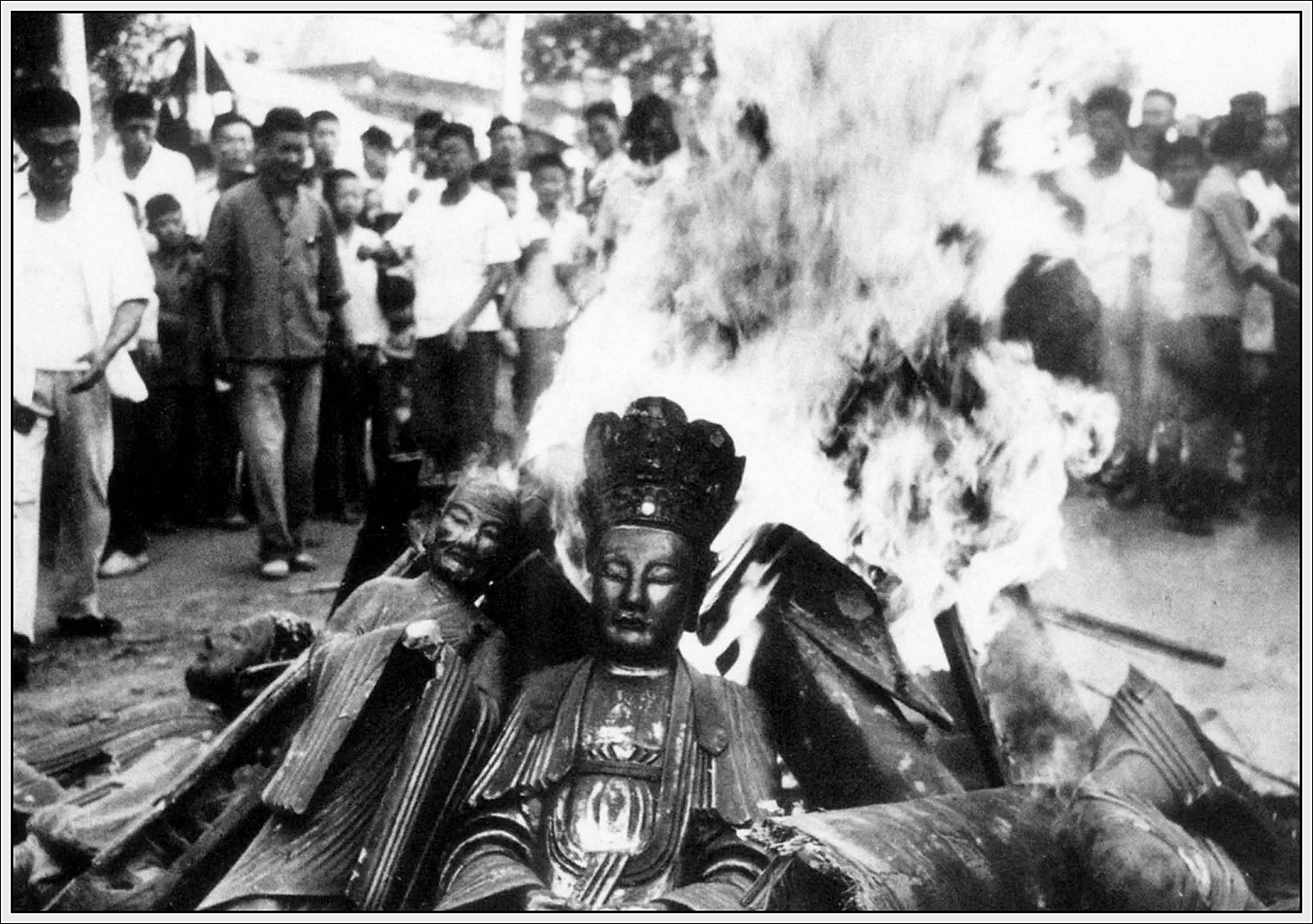

✪ There are unmistakable parallels from Mao Zedong’s “Great Proletarian Cultural Revolution” and Marxist movements today across the West...
▶️ CLICK HERE TO READ

ddd
The Cultural Revolution started with book-burning and quickly turned into tearing down statues and changing the names of places and “especially street names.” Eventually, the Red Guards would drag “enemies of the Revolution” out of their homes and publicly shame & humiliate them during “struggle sessions.” Finally, Red Guards would go from house to house, confiscating property and sometimes torturing and killing the people they considered to still be against the communist revolution.
“At the beginning of the Cultural Revolution in 1966, young Red Guards went from house to house, seeking to eradicate all vestiges of what they called “the four ‘olds’ “–old ideas, old customs, old culture and old habits. Nothing better exemplified the four olds than books.” – Jim Mann of the Los Angeles Times, 1985
The Cultural Revolution was all about purging non-communists from the nation. The effort came after the forced collectivization which occurred during the “Great Leap Forward” between 1958 &1962. That forced collectivization forced millions of rural Chinese off of their farms and into the cities in order to rapidly “industrialize” China. It resulted in a massive famine which cost more than 40 million lives. In the wake of the horrific Great Leap Forward, Mao Zedong had to destroy those who started to shift from communist thought. On August 8, 1966, the Central Committee of the Chinese Communist Party (CCP) explained:
“Although the bourgeoisie has been overthrown, it is still trying to use the old ideas, culture, customs and habits of the exploiting classes to corrupt the masses, capture their minds and endeavor to stage a come-back.”
In order to cling to their power, the CCP outlined their objective:
“…is to struggle against and crush those persons in authority who are taking the capitalist road, to criticize and repudiate the reactionary bourgeois academic ‘authorities’ and the ideology of the bourgeoisie and all other exploiting classes and to transform education, literature and art and all other parts of the superstructure that do not correspond to the socialist economic base, so as to facilitate the consolidation and development of the socialist system.”
Mao had to suppress the opposition, as all communists must to keep power after it finally becomes clear how their disastrous policies wreak havoc on citizens. Mao’s Cultural Revolution claimed the lives of millions of innocent human beings and spanned from May 16, 1966 until Mao Zedong’s death on September 9, 1976. Mao originally unleashed the Cultural Revolution movement by urging young people to rise up against their parents and teachers. Sound familiar?
The feared Red Guards who oversaw much of the vast cultural and social destruction during that evil period of China history consisted of militant high school and university students who were tasked with “eliminating all remnants of the old culture in China” and “ideological purging” party leaders and members deemed “insufficiently revolutionary.” The Red Guards were simply heavily indoctrinated teen mobs used by Mao “to enforce communism by removing capitalist, traditional and cultural elements from society” and are reminiscent of Hitler’s Brown Shirts in Germany and today’s Antifa in America and across the West today.
Chinese citizens were only allowed to read from “The Little Red Book,” or “Quotations from Chairman Mao Zedong” and other limited communist propaganda. According to the BBC, “The Ministry of Culture aimed to distribute a copy to every Chinese citizen and hundreds of new printing houses were built in order to achieve this.”
Burning Books & Tearing Down Statues
During that reign of terror, nobody was safe from the Red Guards, who could, without warning or evidence, target anyone as being an enemy of Mao and drag you to a “struggle session,” where you would be humiliated and even tortured and killed for hours on end in front of public audiences who came to witness the spectacle and delighted in the mob’s rage. Or, they would just torture people in their homes.
Unfortunately, very little about that period has been documented as today’s Chinese Communist Party strategically works to continue eliminating historical references and convince citizens everything in China has improved since the reign of the Red Guards. As communists always do, they have worked to erase the brutal era from history and maintain strict controls over the national narratives from that period or of the great famine. They have also adopted the exact same strategy in their revision of the 1989 Freedom Rebellion.
Many photos of the Cultural Revolution which still survive were taken by CCP-Approved photographer Li Zhensheng who painstakingly maintained a secret stash of negatives; carefully documented with time, names, and locations and stored under the floorboards of his home until he could smuggle them to the United States. Li Zhensheng passed away recently at the age of 79. His photographs are essential to documenting, remembering and understanding the extreme brutality of the Cultural Revolution.
Public Humiliation & Punishment During The Cultural Revolution

Accused people would be humiliated for hours at a time as large crowds stood by watching & berated them. They were often forced to stand hunched over with signs hanging around their necks or dunce caps proclaiming their guilt as “rightists, capitalists” or “traitors to the Revolution.”
Fan Shen, who was 12-years-old in 1966, describes his experience as a young communist in the fascinating book “Gang of One: Memoirs of a Red Guard.” He details his initial youthful excitement in participating in the revolution following the footsteps of his communist parents; and his slow disillusionment as he was forced to face the brutality of his actions and those of his comrades. Shen’s book is particularly important because his account matches the few images preserved in graphic detail.
During the Cultural Revolution, propaganda posters were everywhere. A central graphic theme depicted good citizens smashing “The Four Olds:” Old ideas, old customs, old culture & old habits.

Propaganda posters like this are classic examples of early Cultural Revolution Red Guard art illustrating the anti-traditional, anti-imperialist iconoclasm that persisted into the 1970s. The text on the poster translates as “Destroy the Old World. Establish the New World.”

There were also many posters portraying Mao Zedong as another one of a long line of legendary and murderous communist heroes, which indeed he was.
It should noted that most literature which survived the Cultural Revolution is often written from a revisionist perspective in an attempt to downplay the communist element of the period.
Knowing that the Left cannot progressively scrub the brutal history of the Cultural Revolution, which claimed the lives of millions of people over twenty years after the atrocities of nazi Germany, many perform a type of arcane mental gymnastics to separate Mao’s reign of terror and murder from the tyrannical tendencies of contemporary communism.
However, the Cultural Revolution as an historical event in fact represents the very essence and character of communism.
The following video drawing parallels between the Cultural Revolution and the Leftist Mob behavior today. ✪
▶️ 15 Minutes 33 Seconds






















COUNTDOWN TO INAUGURATION DAY 2025





▶️ CLICK HERE TO VIEW
▶️ 17 Minutes 56 Seconds
▶️ 19 Minutes 12 Seconds Part One
▶️ 27 Minutes 13 Seconds
▶️ 7 Minutes 13 Seconds
▶️ 7 Minutes 13 Seconds
▶️ 16 Minutes 47 Seconds
▶️ 4 Minutes 6 Seconds
▶️ 8 Minutes 20 Second ⭐️ Gary Brown
▶️ 4 Minutes 6 Seconds
▶️ 2 Minutes 2 Seconds ⭐️ bet1125
▶️ 18 Minutes 15 Seconds
▶️ 3 Minutes 41 Seconds


