


Smedley Darlington Butler (July 30, 1881 – June 21, 1940)
Major General Smedley Darlington Butler, nicknamed the Maverick Marine, was a senior United States Marine Corps officer. During his 34-year career, he fought in the Philippine–American War, the Boxer Rebellion, the Mexican Revolution, and World War I. At the time of his death, Butler was the most decorated Marine in U.S. history. By the end of his career, Butler had received sixteen medals, including five for heroism; he is the only Marine to be awarded the Brevet Medal as well as two Medals of Honor, all for separate actions.
Butler later became an outspoken critic of American wars and their consequences. In 1935, Butler wrote the book War Is a Racket, where he exposed the imperialist motivations of U.S. foreign policy and wars in which he had been involved. After retiring from service, he became a popular advocate, speaking at meetings organized by veterans, pacifists, and church groups in the 1930s.
▶️ 20 Minutes 27 Seconds
Smedley Darlington Butler was born July 30, 1881, in West Chester, Pennsylvania, the eldest of three sons. His parents, Thomas and Maud (née Darlington) Butler, were descended from local Quaker families. Both of his parents were of entirely English ancestry, and their families had been in North America since the 17th century.
His father was a lawyer, a judge and later served in the House of Representatives for 31 years as chairman of the House Naval Affairs Committee during the Harding and Coolidge Administrations. Smedley’s Marine Corps career successes occurred while his father held that politically influential Congressional seat, controlling the Marine Corps manpower and budget. Butler’s childhood home is a registered landmark.
Butler attended the West Chester Friends Graded High School, followed by The Haverford School, a Quaker-affiliated secondary school popular with sons of upper-class Philadelphia families. He became captain of the school baseball team and quarterback of its football team. Against the wishes of his father, he left school 38 days before his seventeenth birthday to enlist in the Marine Corps during the Spanish–American War. Haverford awarded him his high school diploma, nevertheless, on June 6, 1898, before the end of his final year.
In the Spanish war fervor of 1898, Butler lied about his age to receive a direct commission as a Marine second lieutenant. He trained at Marine Barracks, Washington, D.C. In July 1898, he went to Guantánamo Bay, Cuba, arriving shortly after its invasion and capture. His company soon returned to the U.S., and — after a short break — he was assigned to the armored cruiser USS New York for four months. He came home to be mustered out of service in February 1899, but on April 8, 1899, he accepted a commission as a first lieutenant in the Marine Corps.
The Marine Corps sent him to Manila, Philippines. In October 1899, he saw his first combat action when he led 300 Marines to take the town of Noveleta from Filipino troops of the new Philippine Republic.
After the excitement of this combat, garrison duty again became routine. He met Littleton Waller, a fellow Marine with whom he maintained a lifelong friendship. When Waller received command of a company in Guam, he was allowed to select five officers to take with him. Butler was amongst his choices. Before they had departed, their orders were changed, and they were sent to China instead aboard the USS Solace to help put down the Boxer Rebellion.
Butler took part in the Battle of Tientsin on July 13, 1900, and in the subsequent Gaselee Expedition, during which he saw the mutilated remains of Japanese soldiers. When he saw another Marine officer fall wounded, he climbed out of a trench to rescue him. Butler was then shot in the thigh.
Four enlisted men would receive the Medal of Honor in the battle. Butler’s commanding officer, Major Waller, personally commended him and wrote that “for such reward as you may deem proper the following officers: Lieutenant Smedley D. Butler, for the admirable control of his men in all the fights of the week, for saving a wounded man at the risk of his own life, and under a very severe fire.”
He was eligible for the Marine Corps Brevet Medal when it was created in 1921, and was one of only 20 Marines to receive it. His citation reads:
The Secretary of the Navy takes pleasure in transmitting to First Lieutenant Smedley Darlington Butler, United States Marine Corps, the Brevet Medal which is awarded in accordance with Marine Corps Order No. 26 (1921), for distinguished conduct and public service in the presence of the enemy while serving with the Second Battalion of Marines, near Tientsin, China, on 13 July 1900. On 28 March 1901, First Lieutenant Butler is appointed Captain by brevet, to take rank from 13 July 1900.
Butler participated in a series of occupations, “police actions” and interventions by the United States in Central America and the Caribbean, later called the Banana Wars because their goal was to protect American commercial interests in the region, particularly those of the United Fruit Company. This company had significant financial stakes in the production of bananas, tobacco, sugar cane, and other products throughout the Caribbean, Central America and the northern portions of South America. The U.S. was also trying to advance its own political interests by maintaining its influence in the region and especially its control of the Panama Canal.
In 1903, Butler was stationed in Puerto Rico on Culebra Island. Hearing rumors of a Honduran revolt, the United States government ordered his unit and a supporting naval detachment to sail to Honduras, 1,500 miles (2,414 km) to the west, to defend the U.S. Consulate there. Using a converted banana boat renamed the Panther, Butler and several hundred Marines landed at the port town of Puerto Cortés. In a letter home, he describes the action: they were “prepared to land and shoot everybody and everything that was breaking the peace.” but instead found a quiet town. The Marines re-boarded the Panther and continued up the coastline, looking for rebels at several towns, but found none.
After the Honduran campaign, Butler returned to Philadelphia. He married Ethel Conway Peters of Philadelphia, a daughter of civil engineer and railroad executive Richard Peters, on June 30, 1905. The couple eventually had three children: a daughter, Ethel Peters Butler, and two sons, Smedley Darlington Jr. and Thomas Richard.
From 1909 to 1912, Butler served in Nicaragua, enforcing U.S. policy. With a 104-degree fever, he led his battalion to the relief of the rebel-besieged city of Granada. In December 1909, he commanded the 3rd Battalion, 1st Marine Regiment on the Isthmus of Panama. On August 11, 1912, he was temporarily detached to command an expeditionary battalion he led in the Battle of Masaya on September 19, 1912 and the bombardment, assault, and capture of Coyotepe Hill, Nicaragua, in October 1912. In private, Butler was highly critical of the operation, writing to his parents:
What makes me mad is that the whole revolution is inspired and financed by Americans who have wild cat investments down here and want to make them good by putting in a Government which will declare a monopoly in their favor . . . The whole business is rotten to the core.
In 1914 when President Woodrow Wilson discovered that an arms shipment was about to arrive in Mexico, he sent a contingent of Marines and sailors to Veracruz to intercept it on April 21, 1914. Over the next few days, street fighting and sniper fire posed a threat to Butler’s force, but a door-to-door search rooted out most of the resistance. By April 26, the landing force of 5,800 Marines and sailors secured the city, which they held for the next six months. For his actions on April 22, Butler was awarded his first Medal of Honor. During World War I, Butler attempted to return his medal, explaining he had done nothing to deserve it. The medal was returned to him with orders to keep it and to wear it, as well.
During World War I, Butler was (to his disappointment) not assigned to a combat command on the Western Front. He made several requests for a posting in France, writing letters to his personal friend, Wendell Cushing Neville. While Butler’s superiors considered him brave and brilliant, they described him as “unreliable.”
In October 1918, at the age of 37, he was promoted to the rank of brigadier general and placed in command of Camp Pontanezen at Brest, France, a debarkation depot that funneled troops of the American Expeditionary Force to the battlefields. The camp had been unsanitary, overcrowded, and disorganized.
Butler tackled the sanitation problems. He began by solving the problem of mud: “The ground under the tents was nothing but mud, [so] he had raided the wharf at Brest of the duckboards no longer needed for the trenches, carted the first one himself up that four-mile hill to the camp, and thus provided something in the way of protection for the men to sleep on.” General John J. Pershing authorized a duckboard shoulder patch for the units. This earned Butler another nickname: “Old Duckboard.” For his exemplary service, he was awarded both the Army Distinguished Service Medal and the Navy Distinguished Service Medal, as well as the French Order of the Black Star.
Following the war, he became commanding general of the Marine barracks at Marine Corps Base Quantico, Virginia. At Quantico, he transformed the wartime training camp into a permanent Marine post. He directed the Quantico camp’s growth until it became the “showplace” of the Corps.
In 1924, newly elected Mayor of Philadelphia W. Freeland Kendrick asked President Calvin Coolidge to lend the city a military general to help him rid Philadelphia’s municipal government of crime and corruption. At the urging of Butler’s father, Coolidge authorized Butler to take the necessary leave from the Corps to serve as Philadelphia’s director of public safety, in charge of running the city’s police and fire departments from January 1924 until December 1925. He began his new job by assembling all 4,000 of the city police into the Metropolitan Opera House in shifts to introduce himself and inform them that things would change while he was in charge. Since he had not been given authority to fire corrupt police officers, he switched entire units from one part of the city to another, in order to undermine local protection rackets and profiteering.
Within 48 hours of taking over, Butler organized raids on more than 900 speakeasies, ordering that they be padlocked and — in many cases — destroyed. In addition to raiding the speakeasies, he also attempted to eliminate other illegal activities: bootlegging, prostitution, gambling, and police corruption.
From 1927 to 1929 Butler was commander of a Marine Expeditionary Force in Tientsin, China, (the China Marines). While there, he cleverly parlayed his influence among various generals and warlords to the protection of U.S. interests, ultimately winning the public acclaim of contending Chinese leaders. When he returned to the United States in 1929 he was promoted to major general, becoming, at age 48, the youngest major general of the Marine Corps.
Even before retiring from the Corps, Butler began developing his post-Corps career. In May 1931 he took part in a commission established by Oregon Governor Julius L. Meier which laid the foundations for the Oregon State Police. He began lecturing at events and conferences, and after his retirement from the Marines in 1931 he took this up full time. He donated much of his earnings from his lucrative lecture circuits to the Philadelphia unemployment relief. He toured the western United States, making 60 speeches before returning for his daughter’s marriage to Marine aviator Lt. John Wehle. Her wedding was the only time he wore his dress blue uniform after he left the Marines
During his Senate campaign, Butler spoke out forcefully about the veterans’ bonus. Veterans of World War I, many of whom had been out of work since the beginning of the Great Depression, sought immediate cash payment of Service Certificates granted to them eight years earlier via the World War Adjusted Compensation Act of 1924.
Each Service Certificate, issued to a qualified veteran soldier, bore a face value equal to the soldier’s promised payment, plus compound interest. The problem was that the certificates (like bonds), matured 20 years from the date of original issuance, thus, under extant law, the Service Certificates could not be redeemed until 1945. In June 1932, approximately 43,000 marchers—17,000 of whom were World War I veterans, their families, and affiliated groups—protested in Washington, D.C. The Bonus Expeditionary Force, also known as the “Bonus Army,” marched on Washington to advocate the passage of the “soldier’s bonus” for service during World War I.
After Congress adjourned, bonus marchers remained in the city and became unruly. On July 28, 1932, two bonus marchers were shot by police, causing the entire mob to become hostile and riotous. The FBI, then known as the United States Bureau of Investigation, checked its fingerprint records to obtain the police records of individuals who had been arrested during the riots or who had participated in the bonus march.
The veterans made camp in the Anacostia Flats while they awaited the congressional decision on whether or not to pay the bonus. On July 19 Butler arrived with his young son Thomas, the day before the official eviction by the Hoover Administration. He walked through the camp and spoke to the veterans; he told them that they were fine soldiers and they had a right to lobby Congress just as much as any corporation. He and his son spent the night and ate with the men, and in the morning Butler gave a speech to the camping veterans. He instructed them to keep their sense of humor and cautioned them not to do anything that would cost public sympathy. On July 28, army cavalry units led by General Douglas Mac Arthur dispersed the Bonus Army by riding through it and using gas. During the conflict several veterans were killed or injured.
After his retirement and later years, Butler became widely known for his outspoken lectures against war profiteering, U.S. military adventurism and what he viewed as nascent fascism in the United States. In addition to his speeches to pacifist groups, he served from 1935 to 1937 as a spokesman for the American League Against War and Fascism. In 1935, he wrote the exposé War Is a Racket, a trenchant condemnation of the profit motive behind warfare. His views on the subject are summarized in the following passage:
I spent 33 years and four months in active military service and during that period I spent most of my time as a high class muscle man for Big Business, for Wall Street and the bankers. In short, I was a racketeer; a gangster for capitalism. I helped make Mexico and especially Tampico safe for American oil interests in 1914. I helped make Haiti and Cuba a decent place for the National City Bank boys to collect revenues in. I helped in the raping of half a dozen Central American republics for the benefit of Wall Street. I helped purify Nicaragua for the International Banking House of Brown Brothers in 1902–1912. I brought light to the Dominican Republic for the American sugar interests in 1916. I helped make Honduras right for the American fruit companies in 1903. In China in 1927 I helped see to it that Standard Oil went on its way unmolested. Looking back on it, I might have given Al Capone a few hints. The best he could do was to operate his racket in three districts. I operated on three continents.
Upon his retirement, Butler bought a home in Newtown Square, Pennsylvania, where he lived with his wife. In June 1940, he checked himself into the hospital after becoming sick a few weeks earlier. His doctor described his illness as an incurable condition of the upper gastro-intestinal tract that was probably cancer. His family remained by his side, even bringing his new car so he could see it from the window. He never had a chance to drive it. On June 21, 1940, Smedley Butler died at Naval Hospital, Philadelphia.
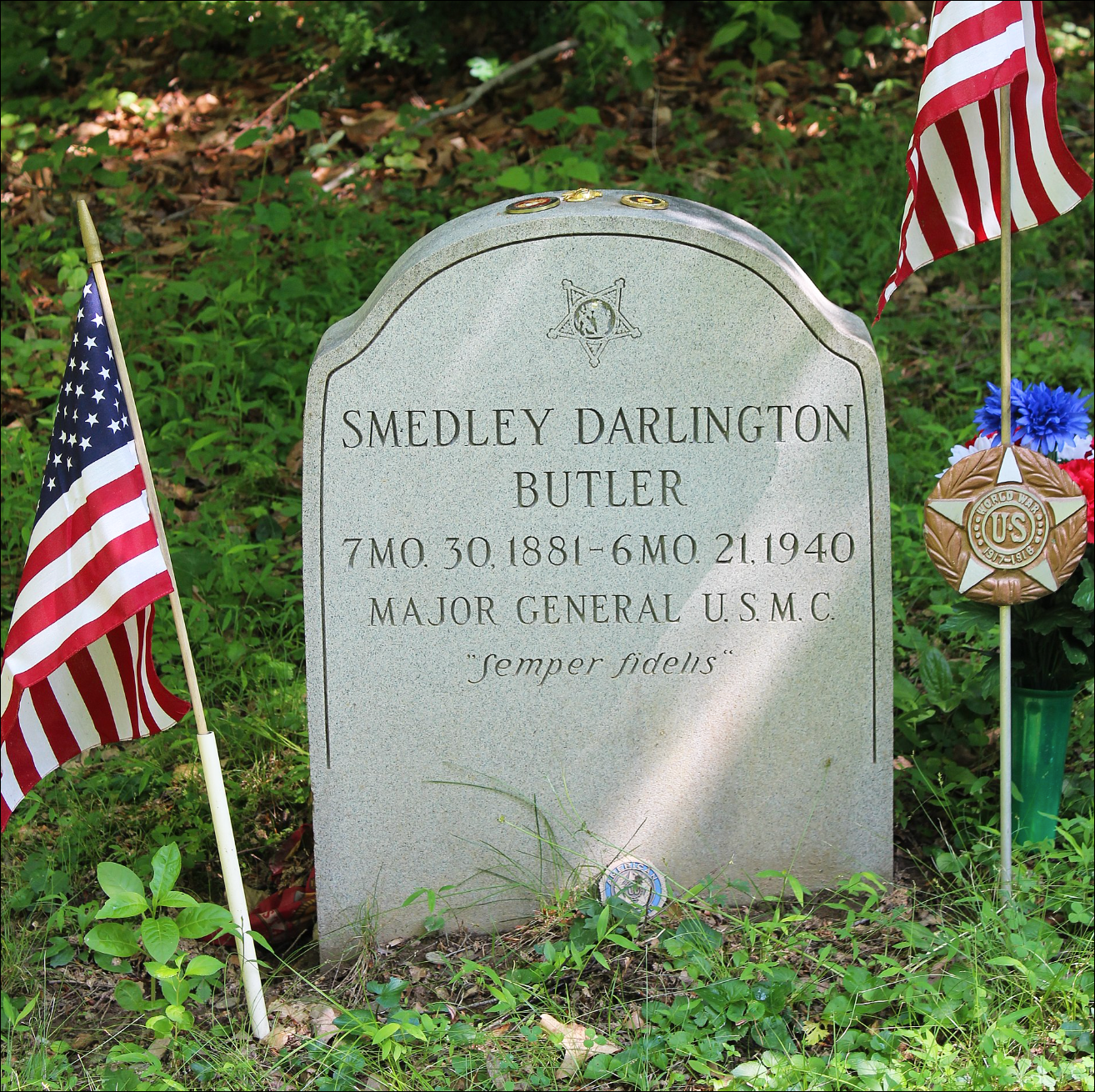
The funeral was held at his home, attended by friends and family as well as several politicians, members of the Philadelphia police force and officers of the Marine Corps. He was buried at Oaklands Cemetery in West Goshen Township, Pennsylvania. ✪

Header text
Header text


▶️ CLICK HERE TO VIEW
▶️ 11 Minutes 34 Seconds ⭐️ Gary Brown
▶️ 12 Minutes 42 Seconds
▶️ 52 Minutes 5 Seconds
▶️ 27 Minutes 59 Seconds
▶️ 10 Minutes 23 Seconds
▶️ 24 Minutes 8 Seconds
