


Alexander Hamilton (January 11, 1755 or 1757 – July 12, 1804)
✪ Alexander Hamilton was a Nevisian-born American military officer, statesman, and Founding Father who served as the first United States Secretary of the Treasury from 1789 to 1795. Born out of wedlock in Charlestown, Nevis (now St Kitts & Nevis), Hamilton was orphaned as a child and taken in by a prosperous merchant. He pursued his education in New York where, despite his age, he was a prolific and widely read pamphleteer advocating for the American revolutionary cause.
Alexander Hamilton was born and spent part of his childhood in Charlestown, the capital of the island of Nevis in the British Leeward Islands. Hamilton and his older brother James Jr. were both born out of wedlock to Rachel Faucette, a married woman of half-British and half-French Huguenot descent and James A. Hamilton, a Scotsman who was the fourth son of Alexander Hamilton, the laird of Grange, Ayrshire.
The Church of England denied membership and education to Alexander and James Jr. because their parents were not legally married. While their mother was still alive, they received “individual tutoring” and classes in a private school led by a Jewish headmistress. Alexander supplemented his education with a personal family library of 34 books.
James Hamilton later abandoned Rachel Faucette and their two sons, allegedly to “spare” her of a charge of bigamy… after finding out that her first husband intended to divorce her under Danish law on grounds of adultery and desertion. Thereafter, Rachel moved with her two children to Saint Croix, where she supported them by keeping a small store in Christiansted. She contracted yellow fever and died on February 19, 1768, leaving Hamilton orphaned. This may have had severe emotional consequences for him, even by the standards of an 18th-century childhood.
The brothers were briefly taken in by their cousin Peter Lytton. However, Lytton took his own life in July 1769, leaving his property to his mistress and their son. Afterwards, the two Hamilton brothers were subsequently separated. James Jr. apprenticed with a local carpenter, while Alexander was given a home by Thomas Stevens, a merchant from Nevis.
Alexander became a clerk at Beekman & Cruger, a local import-export firm that traded with New York and New England. Despite being only in his teenage years, Hamilton proved capable enough as a trader to be left in charge of the firm for five months in 1771 while the owner was away at sea. He remained an avid reader and later developed an interest in writing. He began to desire a life outside the island where he lived.
In October 1772, Hamilton arrived by ship in Boston and proceeded from there to New York City. Later that year, in preparation for college work, Hamilton began to fill gaps in his education at the Elizabethtown Academy, a preparatory school run by Francis Barber in Elizabethtown, New Jersey. Hamilton entered King’s College in New York City in the autumn of 1773 as a private student.
His college roommate and lifelong friend Robert Troup spoke glowingly of Hamilton’s clarity in concisely explaining the patriots’ case against the British in what is credited as Hamilton’s first public appearance on July 6. Hamilton was forced to discontinue his studies before graduating when the college closed its doors during the British occupation of the city.
In 1775, after the first engagement of American troops with the British at Lexington and Concord, Hamilton and other King’s College students joined a New York volunteer militia company called the Corsicans. He routinely drilled with the company before classes in the graveyard of nearby St. Paul’s Chapel. Hamilton studied military history and tactics on his own and was soon recommended for promotion. Under fire from the HMS Asia, he led his newly renamed unit the “Hearts of Oak” led a successful raid for British cannons in the Battery; the capture of which resulted in the unit becoming an artillery company thereafter.
Hamilton participated in the Battle of Princeton on January 3, 1777; where after an initial setback, General George Washington rallied the American troops and led them on in a successful charge against British forces.
While being stationed in Morristown, New Jersey from December 1779 to March 1780, Hamilton met Elizabeth Schuyler, a daughter of General Philip Schuyler & Catherine Van Rensselaer. They married on December 14, 1780 at the Schuyler Mansion in Albany, New York. They had eight children, Philip, Angelica, Alexander, James, John, William, Eliza and another Philip.
Hamilton eventually received an invitation he felt he could not refuse: to serve as Washington’s aide with the rank of lieutenant colonel. Hamilton served four years as Washington’s chief staff aide. He handled letters to Congress, state governors, and the most powerful generals of the Continental Army; he drafted many of Washington’s orders and letters at the latter’s direction; and, he eventually issued orders from Washington over Hamilton’s own signature. Hamilton was involved in a wide variety of high-level duties, including intelligence, diplomacy as well as negotiation with senior army officers as Washington’s emissary.
While on Washington’s staff, Hamilton long sought command and a return to active combat. As the war drew nearer to an end, he knew future opportunities for military glory were rapidly diminishing. He officially left in March and settled with his new wife Elizabeth Schuyler close to Washington’s headquarters.
Hamilton returned to New York after resigning his commission in March 1782. He passed the bar in July after six months of self-directed education; and in October, was licensed to argue cases before the Supreme Court of the State of New York. Hamilton was appointed in July 1782 to the Congress of the Confederation as a New York representative for the term beginning in November 1782.
Hamilton resigned from Congress in 1783. When the British finally left New York in 1783, he entered into a partnership with Richard Harison to continue practicing law. His legal specialty was defending Tories and British subjects. In 1784, Hamilton founded the Bank of New York.
As a member of the legislature of New York, Hamilton argued forcefully and at length in favor of a bill to recognize the sovereignty of the State of Vermont, against numerous objections to its constitutionality and policy. After much lengthy debate, consideration of the bill was deferred to a later date. After the Constitution of the United States went into effect, Hamilton said, “One of the first subjects of deliberation with the new Congress will be the independence of Kentucky, for which the southern states will be anxious. The northern will be glad to send a counterpoise in Vermont.” Vermont was finally admitted to the Union in 1791.
In 1788, Hamilton was awarded a Master of Arts degree from his alma mater, the former King’s College, now reconstituted as Columbia College. It was during this post-war period that Hamilton served on the college’s board of trustees, playing a part in the reopening the college and placing it on firm financial footing.
In 1787, Hamilton served as assemblyman from New York County in the New York State Legislature and was chosen as a delegate for the Constitutional Convention by his father-in-law Philip Schuyler. Even though Hamilton had been a leader in calling for a new Constitutional Convention, his direct influence at the Convention itself was quite limited.
Early in the Convention Hamilton made a speech proposing a President-for-Life; however, it had no effect upon the deliberations of the convention. He proposed to have an elected president and elected senators who would serve for life, contingent upon “good behavior” and subject to removal for corruption or abuse. This idea contributed later to the hostile view of Hamilton as a monarchist sympathizer, held by James Madison. According to Madison’s notes, Hamilton said in regards to the executive, “The English model was the only good one on this subject. The hereditary interest of the king was so interwoven with that of the nation, and his personal emoluments so great, that he was placed above the danger of being corrupted from abroad… Let one executive be appointed for life who dares execute his powers.”
During the convention, Hamilton constructed his own draft for the Constitution based on the convention debates, but he never presented it. This draft had most of the features of the actual Constitution. In this draft, the Senate was to be elected in proportion to the population, being two-fifths the size of the House, and the President and Senators were to be elected through complex multistage elections, in which chosen electors would elect smaller bodies of electors; they would hold office for life, but were removable for misconduct. The President would have an absolute veto. The Supreme Court was to have immediate jurisdiction over all lawsuits involving the United States and state governors were to be appointed by the federal government.
Hamilton recruited John Jay and James Madison to write The Federalist Papers, a series of essays, to defend the proposed Constitution. He made the largest contribution to that effort, writing 51 of the 85 published essays. Hamilton supervised the entire project, enlisted the participants, wrote the majority of the essays, and oversaw the publication. During the project, each person was responsible for their areas of expertise. Jay covered foreign relations. Madison covered the history of republics and confederacies, along with the anatomy of the new government. Hamilton covered the branches of government most pertinent to him: the executive and judicial branches, with some aspects of the Senate, as well as covering military matters and taxation. The papers first appeared in The Independent Journal on October 27, 1787.
Hamilton’s Report on a National Bank was a projection from the first Report on the Public Credit. Hamilton suggested that Congress should charter the national bank with a capitalization of $10 million, one-fifth of which would be handled by the government. Since the government did not have the money, it would borrow the money from the bank itself, and repay the loan in ten even annual installments. The rest was to be made available to individual investors. The bank was to be governed by a twenty-five-member board of directors that was to represent a large majority of the private shareholders, which Hamilton considered essential for his being under a private direction. Hamilton’s bank model had many similarities to that of the Bank of England, except Hamilton wanted to exclude the government from being involved in public debt, but provide a large, firm, and elastic money supply for the functioning of normal businesses and usual economic development.
In 1791, Hamilton submitted his Report on the Establishment of a Mint to the House of Representatives. Many of Hamilton’s ideas for this report were derived from European economists as well as resolutions from the 1785 and 1786 Continental Congress meetings.
Because the most circulated coins in the United States at the time were Spanish currency, Hamilton proposed that minting a United States dollar weighing almost as much as the Spanish peso would be the simplest way to introduce a national currency. Hamilton proposed that the U.S. dollar should have fractional coins using decimals, rather than eighths like the Spanish coinage. He also desired the minting of small value coins, such as silver ten-cent and copper cent and half-cent pieces, for reducing the cost of living for the poor. One of his main objectives was for the general public to become accustomed to handling money on a frequent basis.
By 1792, Hamilton’s principles were adopted by Congress, resulting in the Coinage Act of 1792, and the creation of the US Mint. There would be a ten-dollar Gold Eagle coin, a silver dollar and fractional money ranging from one-half to fifty cents. The coining of silver and gold was issued by 1795.
One of the principal sources of revenue Hamilton prevailed upon Congress to approve was an excise tax on whiskey. In his first Tariff Bill in January 1790, Hamilton proposed to raise the three million dollars needed to pay for government operating expenses and interest on domestic and foreign debts by means of an increase on duties on imported wines, distilled spirits, tea, coffee, and domestic spirits. It failed, with Congress complying with most recommendations excluding the excise tax on whiskey.
Hamilton’s next report was his Report on Manufactures: a report for manufacturing that would expand the United States’ independence. Hamilton argued that developing an industrial economy is impossible without protective tariffs. Among the ways that the government should assist manufacturing, Hamilton argued for government assistance to “infant industries” so they could grow to achieve economies of scale.He also called for encouraging immigration for people to better themselves in similar employment opportunities.
Hamilton’s wife suffered a miscarriage while he was absent during his armed repression of the Whiskey Rebellion. In the wake of this, Hamilton tendered his resignation from office on December 1, 1794, giving Washington two months’ notice. Before leaving his post on January 31, 1795, Hamilton submitted the Report on a Plan for the Further Support of Public Credit to Congress to curb the national debt problem. Hamilton had grown dissatisfied with what he viewed as a lack of a comprehensive plan to fix the public debt. He wished to have new taxes passed with older ones made permanent and stated that any surplus from the excise tax on liquor would be pledged to lower public debt. His proposals were included in a bill by Congress within slightly over a month after his departure as Treasury Secretary. Some months later, Hamilton resumed his law practice in New York to remain closer to his family. Hamilton’s resignation as Secretary of the Treasury in 1795 did not remove him from public life. With the resumption of his law practice, he remained close to George Washington as an advisor and friend.
In the summer of 1797, Hamilton became the first major American politician publicly involved in a sex scandal. Six years earlier, in the summer of 1791, 34-year-old Hamilton became involved in an affair with 23-year-old Maria Reynolds. According to Hamilton’s account Maria approached him at his house in Philadelphia, claiming that her husband James Reynolds was abusive and had abandoned her, and she wished to return to her relatives in New York but lacked the means. Hamilton recorded her address and subsequently delivered $30 personally to her boarding house, where she led him into her bedroom and “Some conversation ensued from which it was quickly apparent that other than pecuniary consolation would be acceptable.” The two began an intermittent illicit affair that lasted approximately until June 1792.
Over the course of that year, while the affair was taking place, James Reynolds was well aware of his wife’s infidelity and likely orchestrated it from the beginning. He continually supported their relationship to extort blackmail money regularly from Hamilton. The common practice of the day for men of equal social standing was for the wronged husband to seek retribution in a duel; but Reynolds, of a lower social status and realizing how much Hamilton had to lose if his activity came into public view, resorted to extortion instead. After an initial request of $1,000 to which Hamilton complied, Reynolds invited Hamilton to renew his visits to his wife “as a friend” only to extort forced “loans” after each visit that, most likely in collusion, Maria solicited with her letters. In the end, the blackmail payments totaled over $1,300 including the initial extortion.
Hamilton also served as Inspector General of the United States Army from July 18, 1798, to June 15, 1800. Because Washington was unwilling to leave Mount Vernon unless it were to command an army in the field, Hamilton became the de facto head of the army, to John Adams’s considerable displeasure. If full-scale war broke out with France, Hamilton argued that the army should conquer the North American colonies of France’s ally, Spain, bordering the United States. Hamilton was prepared to march the army through the Southern United States if necessary. Hamilton aided in all areas of the army’s development, and after Washington’s death he was by default the Senior Officer of the United States Army from December 14, 1799, to June 15, 1800. The army was to guard against invasion from France.
Even though Hamilton did not like Jefferson and disagreed with him on many issues, he viewed Jefferson as the lesser of two evils during the election of 1800. Hamilton spoke of Jefferson as being “by far not so a dangerous man” and of Aaron Burr as a “mischievous enemy” to the principal measure of the past administration.
When it became clear that Jefferson had developed his own concerns about Burr and would not support his return to the vice presidency, Burr sought the New York governorship in 1804 with Federalist support, against the Jeffersonian candidate Morgan Lewis, but was defeated by forces including Hamilton.
Soon after Lewis’ gubernatorial victory, the Albany Register published Charles D. Cooper’s letters, citing Hamilton’s opposition to Burr and alleging that Hamilton had expressed “a still more despicable opinion” of the vice president at an upstate New York dinner party.
Burr, sensing an attack on his honor, and recovering from his defeat, demanded an apology in the form of a letter. Hamilton wrote a letter in response and ultimately refused because he could not recall the instance of insulting Burr. After a series of attempts to reconcile were to no avail, a duel was arranged through liaisons on June 27, 1804.
The concept of honor was fundamental to Hamilton’s vision of himself and of the nation. Historians have noted, as evidence of the importance that honor held in Hamilton’s value system, that Hamilton had previously been a party to seven “affairs of honor” as a principal, and to three as an advisor or second. Such affairs of honor were often concluded prior to reaching their final stage, i.e. a duel.
Before the duel, Hamilton wrote an explanation of his decision to participate while at the same time intending to “throw away” his shot. His desire to be available for future political matters also played a factor in this decision. A week before the duel, at an annual Independence Day dinner of the Society of the Cincinnati, both Hamilton and Burr were in attendance. Separate accounts confirm that Hamilton was uncharacteristically effusive while Burr was, by contrast, uncharacteristically withdrawn.
The duel began at dawn on July 11, 1804, along the west bank of the Hudson River on a rocky ledge in Weehawken, New Jersey. Both opponents were rowed over from Manhattan separately from different locations, as the spot was not accessible from the west due to the steepness of the adjoining cliffs. Coincidentally, the duel took place relatively close to the location of the duel that had ended the life of Hamilton’s eldest son, Philip, three years earlier.
Vice President Burr shot Hamilton, delivering what proved to be a fatal wound. Hamilton’s shot broke a tree branch directly above Burr’s head. Burr’s shot hit Hamilton in the lower abdomen above his right hip. The bullet ricocheted off Hamilton’s second or third false rib, fracturing it and causing considerable damage to his internal organs, particularly his liver and diaphragm, before becoming lodged in his first or second lumbar vertebra.
The paralyzed Hamilton was immediately attended by the same surgeon who tended his Phillip Hamilton previously and then ferried to the Greenwich Village boarding house of his friend William Bayard Jr., who had been waiting on the dock. On his deathbed, Hamilton asked the Episcopal Bishop of New York, Benjamin Moore, to give him holy communion.
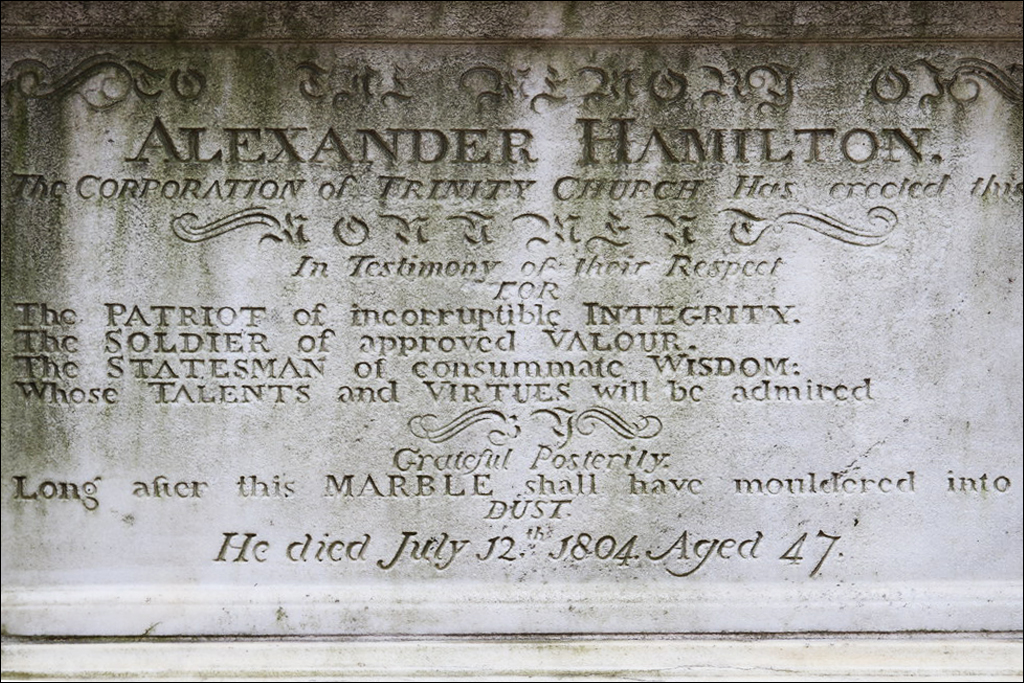
After final visits from his family, friends, and considerable suffering for at least 31 hours, Hamilton died at two o’clock the following afternoon, July 12, 1804. The city fathers halted all business at noon two days later for Hamilton’s funeral. The procession route of about two miles organized by the Society of the Cincinnati had so many participants of every class of citizen that it took hours to complete and was widely reported nationwide by newspapers. Hamilton was buried in the Trinity Church Cemetery. ✪


▶️ CLICK HERE TO VIEW
▶️ 15 Minutes 12 Seconds
▶️ 10 Minutes 50 Seconds
▶️ 10 Minutes 15 Seconds ⭐️ Michael Brower
▶️ 4 Minutes 23 Seconds
▶️ 6 Minutes 11 Seconds
