J Robert Oppenheimer: April 22, 1904–February 18, 1967

✪ J Robert Oppenheimer (born Julius Robert Oppenheimer) was an American theoretical physicist who served as the director of the Manhattan Project’s Los Alamos Laboratory during World War II. He is often called the “father of the atomic bomb” for his role in overseeing the development of the first nuclear weapons.
Oppenheimer was born Julius Robert Oppenheimer into a non-observant Jewish family in New York City on April 22, 1904, to Ella (née Friedman), a painter: and Julius Seligmann Oppenheimer, a successful textile importer. Robert had a younger brother, Frank, who also became a physicist Their father was born in Hanau, when it was still part of the Hesse-Nassau Province of the Kingdom of Prussia, and as a teenager made his way to the United States in 1888, without money, higher education, or even English. He was hired by a textile company and within a decade was an executive there, eventually becoming wealthy. In 1912, the family moved to an apartment on Riverside Drive near West 88th Street, Manhattan, an area known for luxurious mansions and townhouses.
Oppenheimer was initially educated at Alcuin Preparatory School. In 1911, he entered the Ethical Culture Society School, promote training based on the Ethical Culture Movement, whose motto was “Deed before Creed.” Oppenheimer’s father had been a member of the Society for many years, serving on its board of trustees.Oppenheimer was a versatile student, interested in English and French literature, and particularly mineralogy He completed third and fourth grades in one year and skipped half of eighth grade. He took private music lessons. During his final year of school, Oppenheimer became interested in chemistry. He graduated in 1921, but his further education was delayed a year by an attack of colitis contracted while prospecting in Joachimstal during a family vacation in Czechoslovakia. He recovered in New Mexico, where he developed a love for horseback riding and the Southwestern United States.
During the 1920s, Oppenheimer remained uninformed on world affairs. He claimed that he did not read newspapers or popular magazines and only learned of the Wall Street crash of 1929 while he was on a walk with Ernest Lawrence six months after the crash occurred.
Oppenheimer entered Harvard College in 1922 at age 18. He majored in chemistry; Harvard also required studies in history, literature, and philosophy or mathematics. To compensate for the delay caused by his illness, he took six courses each term instead of the usual four. He was admitted to the undergraduate honor society Phi Beta Kappa and was granted graduate standing in physics on the basis of independent study, allowing him to bypass basic courses in favor of advanced ones. He was attracted to experimental physics by a course on thermodynamics taught by Percy Bridgman. Oppenheimer graduated from Harvard in 1925 with a Bachelor of Arts, summa cum laude, after only three years of study.
After being accepted at Christ’s College, Cambridge, in 1924, Oppenheimer wrote to Ernest Rutherford requesting permission to work at the Cavendish Laboratory. Oppenheimer was very unhappy at Cambridge and wrote to a friend: “I am having a pretty bad time. The lab work is a terrible bore, and I am so bad at it that it is impossible to feel that I am learning anything.”
Oppenheimer had regular sessions with a psychiatrist in Harley Street, London. Oppenheimer was a tall, thin chain smoker, who often neglected to eat during periods of intense concentration. Many friends said he could be self-destructive. Fergusson once tried to distract Oppenheimer from apparent depression by telling him about his girlfriend, Frances Keeley, and how he had proposed to her.
In 1926, Oppenheimer left Cambridge for the University of Göttingen to study under Max Born; Göttingen was one of the world’s leading centers for theoretical physics. Oppenheimer made friends who went on to great success,
Oppenheimer obtained his Doctor of Philosophy degree in March 1927 at age 23, supervised by Born. After the oral exam, James Franck, the professor administering it, reportedly said, “I’m glad that’s over. He was on the point of questioning me.” Oppenheimer published more than a dozen papers while in Europe, including many important contributions to the new field of quantum mechanics.
Oppenheimer was awarded a United States National Research Council fellowship to the California Institute of Technology (Caltech) in September 1927. Bridgman also wanted him at Harvard, so a compromise was reached whereby he split his fellowship for the 1927–28 academic year between Harvard in 1927 and Caltech in 1928. At Caltech, he struck up a close friendship with Linus Pauling; they planned to mount a joint attack on the nature of the chemical bond, a field in which Pauling was a pioneer, with Oppenheimer supplying the mathematics and Pauling interpreting the results.
Oppenheimer later invited Pauling to be head of the Chemistry Division of the Manhattan Project, but Pauling refused, saying he was a pacifist
In the autumn of 1928, Oppenheimer visited Paul Ehrenfest’s institute at the University of Leiden in the Netherlands, where he impressed by giving lectures in Dutch, despite having little experience with the language. There, he was given the nickname of Opje, later anglicized by his students as “Oppie.”
On returning to the United States, Oppenheimer accepted an associate professorship from the University of California, Berkeley. Before he began his Berkeley professorship, Oppenheimer was diagnosed with a mild case of tuberculosis and spent some weeks with his brother Frank at a New Mexico ranch, which he leased and eventually purchased. When he heard the ranch was available for lease, he exclaimed, “Hot dog!” and he later called it Perro Caliente (“hot dog” in Spanish)
He recovered from tuberculosis and returned to Berkeley, where he prospered as an advisor and collaborator to a generation of physicists who admired him for his intellectual virtuosity and broad interests. His students and colleagues saw him as mesmerizing: hypnotic in private interaction, but often frigid in more public settings. His associates fell into two camps: one saw him as an aloof and impressive genius and aesthete, the other as a pretentious and insecure poseur. His students almost always fell into the former category, adopting his walk, speech, and other mannerisms, and even his inclination for reading entire texts in their original languages.Hans Bethe said of him:
Probably the most important ingredient he brought to his teaching was his exquisite taste. He always knew what were the important problems, as shown by his choice of subjects. He truly lived with those problems, struggling for a solution, and he communicated his concern to the group. In its heyday, there were about eight or ten graduate students in his group and about six Post-doctoral Fellows. He met this group once a day in his office and discussed with one after another the status of the student’s research problem. He was interested in everything, and in one afternoon they might discuss quantum electrodynamics, cosmic rays, electron pair production and nuclear physics.
Oppenheimer’s mother died in 1931, and he became closer to his father who, although still living in New York, became a frequent visitor in California. When his father died in 1937, leaving $392,602 (equivalent to $8.3 million in 2023) to be divided between Oppenheimer and his brother Frank, Oppenheimer immediately wrote out a will that left his estate to the University of California to be used for graduate scholarships
Oppenheimer did important research in theoretical astronomy (especially as related to general relativity and nuclear theory), nuclear physics, spectroscopy, and quantum field theory, including its extension into quantum electrodynamics. The formal mathematics of relativistic quantum mechanics also attracted his attention, although he doubted its validity.
Oppenheimer made important contributions to the theory of cosmic ray showers. He also worked on the problem of field electron emission.
In the late 1930s, Oppenheimer became interested in astrophysics, most likely through his friendship with Richard Tolman, resulting in a series of papers. In the first of these, “On the Stability of Stellar Neutron Cores” (1938) explored the properties of white dwarfs.
Oppenheimer’s papers were considered difficult to understand even by the standards of the abstract topics he was expert in. He was fond of using elegant, if extremely complex, mathematical techniques to demonstrate physical principles, though he was sometimes criticized for making mathematical mistakes, presumably out of haste. “His physics was good,” said his student Snyder, “but his arithmetic awful.”
Many of Oppenheimer’s closest associates were active in the Communist Party in the 1930s or 1940s, including his brother Frank. From 1937 to 1942, Oppenheimer was a member at Berkeley of what he called a “discussion group.”
The Federal Bureau of Investigation (FBI) opened a file on Oppenheimer in March 1941.The FBI noted that Oppenheimer was on the executive committee of the American Civil Liberties Union, which it considered a communist front organization. Shortly thereafter, the FBI added Oppenheimer to its Custodial Detention Index, for arrest in case of national emergency.
When he joined the Manhattan Project in 1942, Oppenheimer wrote on his personal security questionnaire that he had been “a member of just about every Communist Front organization on the West Coast.” Years later, he claimed that he did not remember writing this, that it was not true, and that if he had written anything along those lines, it was “a half-jocular overstatement.”
In 1953, Oppenheimer was on the sponsoring committee for a conference on “Science and Freedom” organized by the Congress for Cultural Freedom, an anti-communist cultural organization.
At his 1954 security clearance hearings, Oppenheimer denied being a member of the Communist Party but identified himself as a fellow traveler, which he defined as someone who agrees with many of communism’s goals but is not willing to blindly follow orders from any Communist Party apparatus.
Throughout the development of the atomic bomb, Oppenheimer was under investigation by both the FBI and the Manhattan Project’s internal security arm for his past left-wing associations. He was followed by Army security agents during a trip to California in June 1943
Oppenheimer’s diverse interests sometimes interrupted his focus on science. He liked things that were difficult and since much of the scientific work appeared easy for him, he developed an interest in the mystical and the cryptic. After going to Harvard, he began to acquaint himself with the classical Hindu texts through their English translations He also had an interest in learning languages and learned Sanskrit. He eventually read literary works such as the Bhagavad Gita and Meghaduta in the original Sanskrit, and deeply pondered them.
Oppenheimer never became a Hindu in the traditional sense; he did not join any temple nor pray to any god. He “was really taken by the charm and the general wisdom of the Bhagavad-Gita,” his brother said. Oppenheimer once remarked, “I have read the Greeks; I find the Hindus deeper.”
Oppenheimer was overeducated in those fields which lie outside the scientific tradition, such as his interest in religion, in the Hindu religion in particular, which resulted in a feeling for the mystery of the universe that surrounded him almost like a fog. He saw physics clearly, looking toward what had already been done, but at the border he tended to feel there was much more of the mysterious and novel than there actually was … [he turned] away from the hard, crude methods of theoretical physics into a mystical realm of broad intuition…. In Oppenheimer the element of earthiness was feeble. Yet it was essentially this spiritual quality, this refinement as expressed in speech and manner, that was the basis of his charisma. He never expressed himself completely. He always left a feeling that there were depths of sensibility and insight not yet revealed. These may be the qualities of the born leader who seems to have reserves of uncommitted strength.
On October 9, 1941, two months before the United States entered World War II, President Franklin D. Roosevelt approved a crash program to develop an atomic bomb. Ernest Lawrence brought Oppenheimer into the Manhattan Project on October 21.
In June 1942, the U.S. Army established the Manhattan Engineer District to handle its part in the atom bomb project, beginning the process of transferring responsibility from the Office of Scientific Research and Development to the military.
Brigadier General Leslie R. Groves Jr selected Oppenheimer to head the project’s secret weapons laboratory, although it is not known precisely when. This decision surprised many, because Oppenheimer had left-wing political views and no record as a leader of large projects.
Oppenheimer favored a location for the laboratory in New Mexico, not far from his ranch. On November 16, 1942, he, Groves and others toured a prospective site. The engineers were concerned about the poor access road and the water supply but otherwise felt that it was ideal. The Los Alamos Laboratory was built on the site of the school, taking over some of its buildings, while many new buildings were erected in great haste.
At this point in the war, there was considerable anxiety among the scientists that the German nuclear weapons program might be progressing faster than the Manhattan Project. In 1943, development efforts were directed to a plutonium gun-type fission weapon called “Thin Man.”
In July 1944, Oppenheimer abandoned the Thin Man gun design in favor of an implosion-type weapon; a smaller version of Thin Man became Little Boy. Using chemical explosive lenses, a sub-critical sphere of fissile material could be squeezed into a smaller and denser form.
In the early morning hours of July 16, 1945, near Alamogordo, New Mexico, the work at Los Alamos culminated in the test of the world’s first nuclear weapon. Oppenheimer had code-named the site “Trinity” in mid-1944, saying later that the name came from John Donne’s Holy Sonnets.
Brigadier General Thomas Farrell, who was present in the control bunker with Oppenheimer, recalled:
Dr. Oppenheimer, on whom had rested a very heavy burden, grew tenser as the last seconds ticked off. He scarcely breathed. He held on to a post to steady himself. For the last few seconds, he stared directly ahead and then when the announcer shouted “Now!” and there came this tremendous burst of light followed shortly thereafter by the deep growling roar of the explosion, his face relaxed into an expression of tremendous relief.
Oppenheimer’s brother Frank recalled Oppenheimer’s first words as “I guess it worked.“
We knew the world would not be the same. A few people laughed, a few people cried. Most people were silent. I remembered the line from the Hindu scripture, the Bhagavad Gita; Vishnu is trying to persuade the Prince that he should do his duty and, to impress him, takes on his multi-armed form and says, “Now I am become Death, the destroyer of worlds.” I suppose we all thought that, one way or another.
Once the public learned of the Manhattan Project after the bombings of Hiroshima and Nagasaki, Oppenheimer—suddenly a household name as the “father of the atomic bomb”—became a national spokesman for science, emblematic of a new type of technocratic power; he appeared on the covers of Life and Time. Nuclear physics became a powerful force as nations realized the strategic and political power that atomic weapons conferred.
Oppenheimer brought together intellectuals at the height of their powers and from a variety of disciplines to answer the most pertinent questions of the age. Oppenheimer played a role on a number of government panels and study projects during the late 1940s and early 1950s
As a member of the Board of Consultants to a committee appointed by Truman, Oppenheimer strongly influenced the 1946 Acheson–Lilienthal Report. In this report, the committee advocated the creation of an international Atomic Development Authority, which would own all fissionable material and the means of its production, such as mines and laboratories, and atomic power plants where it could be used for peaceful energy production.
After the Atomic Energy Commission (AEC) came into being in 1947 as a civilian agency in control of nuclear research and weapons issues, Oppenheimer was appointed as the chairman of its General Advisory Committee (GAC). From this position, he advised on a number of nuclear-related issues, including project funding, laboratory construction and even international policy.
Starting in 1954, Oppenheimer lived for several months of each year on the island of Saint John in the U.S. Virgin Islands. In 1957, he purchased a 2-acre tract of land on Gibney Beach, where he built a spartan home on the beach. He spent considerable time sailing with his daughter Toni and wife Kitty
Oppenheimer was increasingly concerned about the danger that scientific inventions could pose to humanity. He joined with Albert Einstein, Bertrand Russell, Joseph Rotblat, and other eminent scientists and academics to establish what would eventually, in 1960, become the World Academy of Art and Science.
Deprived of political influence, Oppenheimer continued to lecture, write, and work on physics. He toured Europe and Japan, giving talks about the history of science, the role of science in society, and the nature of the universe.
In March 1963, the General Advisory committee of the AEC selected Oppenheimer to receive its Enrico Fermi Award, an award Congress had created in 1954. Kennedy was assassinated before he could present the award to Oppenheimer, but his successor, Lyndon Johnson, did so in a December 1963 ceremony at which he cited Oppenheimer’s “contributions to theoretical physics as a teacher and originator of ideas, [and] leadership of the Los Alamos Laboratory and the atomic energy program during critical years.”
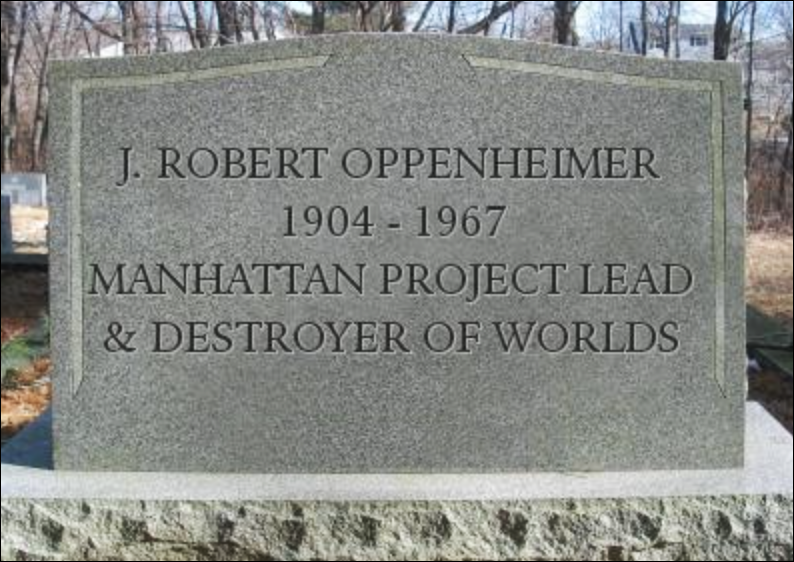
A chain smoker (of Chesterfield cigarettes), Oppenheimer was diagnosed with throat cancer in late 1965. After inconclusive surgery, he underwent unsuccessful radiation treatment and chemotherapy late in 1966. On February 18, 1967, he died in his sleep at his home in Princeton, aged 62 years. A memorial service was held a week later at Alexander Hall on the campus of Princeton University. The service was attended by 600 of his scientific, political, and military associates. ✪