


James Harold Doolittle (December 14, 1896 – September 27, 1993)
James Harold Doolittle was an American military general and aviation pioneer who received the Medal of Honor for his daring raid on Japan during World War II. He also made early coast-to-coast flights, record-breaking speed flights, won many flying races, and helped develop and flight-test instrument flying.
Doolittle was born December 14, 1896, in Alameda, California, and spent his youth in Nome, Alaska, where he earned a reputation as a boxer. His parents were Frank Henry Doolittle (1869–1918) and Rosa (Rose) Cerenah Doolittle ( Shephard; 1869–1930). Doolittle saw his first airplane on a school field trip at the 1910 Los Angeles International Air Meet at Dominguez Field.
In October 1917, Doolittle enlisted in the Signal Corps Reserve as a flying cadet and received ground training at the School of Military Aeronautics (an Army school) on the campus of the University of California. He flight-trained at Rockwell Field, California. On March 11, 1918, Doolittle received his Reserve Military Aviator rating and was commissioned as a second lieutenant in the Signal Officers Reserve Corps of the U.S. Army.
During World War I, Doolittle remained in the United States as a flight instructor and performed his war service at Camp John Dick Aviation Concentration Center (“Camp Dick”), Texas; Wright Field, Ohio; Gerstner Field, Louisiana; Rockwell Field, California; Kelly Field, Texas and Eagle Pass, Texas.
Doolittle married Josephine “Joe” E. Daniels on December 24, 1917 at a dinner celebration after Jimmy Doolittle’s first all-instrument flight in 1929 and remained married for exactly 71 years (she died on December 24th, 1988) The Doolittles had two sons, James Jr., and John. Both became military officers and pilots. James Jr. was an A-26 Invader pilot in the U.S. Army Air Forces during World War II and later a fighter pilot in the U.S. Air Force in the late 1940s through the late 1950s.
The other son John P. Doolittle, retired from the Air Force as a colonel, and his grandson, Colonel James H. Doolittle III, was the vice commander of the Air Force Flight Test Center at Edwards Air Force Base, California.
Doolittle was one of the most famous pilots during the inter-war period. On September 4, 1922, he made the first of many pioneering flights, flying a De Havilland DH-4 – which was equipped with early navigational instruments – in the first cross-country flight, from Pablo Beach (now Jacksonville Beach), Florida, to Rockwell Field, San Diego, California, in 21 hours and 19 minutes, making only one refueling stop at Kelly Field. The U.S. Army awarded him the Distinguished Flying Cross.
In July 1923, after serving as a test pilot and aeronautical engineer at McCook Field, Doolittle entered the Massachusetts Institute of Technology. In March 1924, he conducted aircraft acceleration tests at McCook Field, which became the basis of his master’s thesis and led to his second Distinguished Flying Cross. He received his MS degree in Aeronautics from MIT in June 1924.
Following graduation, Doolittle attended special training in high-speed seaplanes at Naval Air Station Anacostia in Washington, D.C. He also served with the Naval Test Board at Mitchel Field, Long Island, New York and was a familiar figure in air speed record attempts in the New York area. He won the Schneider Cup race in a Curtiss R3C in 1925 with an average speed of 232 MPH.
In 1927, Doolittle was the first to perform an outside loop, previously thought to be a fatal maneuver. Carried out in a Curtiss fighter at Wright Field in Ohio, Doolittle executed the dive from 10,000 feet reaching 280 mph, bottomed out upside down, then climbed and completed the loop.
Doolittle’s most important contribution to aeronautical technology was his early advancement of instrument flying. He was the first to recognize that true operational freedom in the air could not be achieved until pilots developed the ability to control and navigate aircraft in flight from takeoff run to landing rollout, regardless of the range of vision from the cockpit. Doolittle was the first to envision that a pilot could be trained to use instruments to fly through fog, clouds, precipitation of all forms, darkness, or any other impediment to visibility and in spite of the pilot’s own possibly convoluted motion sense inputs: as aircraft became faster and more maneuverable, pilots could become seriously disoriented without visual cues from outside the cockpit, because aircraft could move in ways that pilots’ senses could not accurately decipher.
In 1929, he became the first pilot to take off, fly and land an airplane using only instruments without any view outside the cockpit. Having returned to Mitchell Field that September, he helped to develop blind-flying equipment. He was then the first to test the now universally used artificial horizon and directional gyroscope. These accomplishments made all-weather airline operations practical.
Doolittle resigned his regular commission on February 15, 1930, and was commissioned a Major in the Air Reserve Corps a month later, being named manager of the Aviation Department of Shell Oil Company, in which capacity he conducted numerous aviation tests. Doolittle helped influence Shell Oil Company to produce the first quantities of 100 octane aviation gasoline. High octane fuel would be crucial to the high-performance planes that were developed in the late 1930s.
In 1932, Doolittle set the world’s high-speed record for land planes at 296 miles per hour in the Shell Speed Dash. Later, he took the Thompson Trophy race at Cleveland in the notorious Gee Bee R-1 racer with a speed averaging 252 miles per hour. After having won the three big air racing trophies of the time, the Schneider, Bendix, and Thompson, he officially retired from air racing stating, “I have yet to hear anyone engaged in this work dying of old age.”
Doolittle returned to active duty in the U.S. Army Air Corps on July 1, 1940. Following the reorganization of the Army Air Corps into the USAAF in June 1941, Doolittle was promoted to lieutenant colonel on January 2, 1942, and assigned to Army Air Forces Headquarters to plan the first retaliatory air raid on the Japanese homeland following the attack on Pearl Harbor. He volunteered for and received General H.H. Arnold’s approval to lead the top secret attack of 16 B-25 medium bombers from the aircraft carrier USS Hornet, with targets in Tokyo, Kobe, Yokohama, Osaka and Nagoya.
On April 18, 1942 Doolittle and his 16 B-25 crews took off from Hornet, reached Japan, and bombed their targets. Fifteen of the planes then headed for their recovery airfield in China, while one crew chose to land in Russia due to their bomber’s unusually high fuel consumption. Doolittle and his crew bailed out safely over China in the night when their B-25 ran out of fuel. By that time, they had been flying for about 12 hours.
The Doolittle Raid is viewed by historians as a major morale-building victory for the United States. Although the damage done to Japanese war industry was minor, the raid showed the Japanese that their homeland was vulnerable to air attack and forced them to withdraw several front-line fighter units from Pacific war zones for homeland defense. More significantly, Japanese commanders considered the raid deeply embarrassing, and their attempt to close the perceived gap in their Pacific defense perimeter led directly to the decisive American victory at the Battle of Midway in June 1942.
Doolittle went on to fly more combat missions as commander of the 12th Air Force in North Africa, for which he was awarded four Air Medals. He later commanded the 12th, 15th and 8th Air Forces in Europe. Doolittle received the Medal of Honor from President Franklin D. Roosevelt at the White House for planning and leading his raid on Japan. He was also promoted to brigadier general.
Maj. Gen. Doolittle took command of the Fifteenth Air Force in the Mediterranean Theater of Operations on November 1943. On June 10, he flew as co-pilot with Jack Sims, fellow Tokyo Raider, in a B-26 Marauder of the 320th Bombardment Group, 442nd Bombardment Squadron on a mission to attack gun emplacements at Pantelleria. Doolittle continued to fly despite the risk of capture.
Doolittle’s major influence on the European air war occurred late in 1943—and primarily after he took command of the Eighth Air Force on January 6, 1944 when he changed the policy of requiring escorting fighters to remain with their bombers at all times. Instead, he permitted escort fighters to fly far ahead of the bombers’ combat box formations, allowing them to freely engage the German fighters lying in wait for the bombers.
On 5 January 1946, Doolittle reverted to inactive reserve status in the Army Air Forces in the grade of lieutenant general, a rarity in those days when reserve officers were usually limited to the rank of major general or rear admiral; a restriction that would not end in the US armed forces until the 21st century. He retired from the United States Army on 10 May 1946. On 18 September 1947, his reserve commission as a general officer was transferred to the newly established United States Air Force. Doolittle returned to Shell Oil as a vice president, and later as a director.
In 1952, following a string of three air crashes in two months at Elizabeth, New Jersey, President Harry S. Truman appointed Doolittle to lead a presidential commission examining the safety of urban airports. The report “Airports and Their Neighbors” led to zoning requirements for buildings near approaches, early noise control requirements, and initial work on “super airports” with 10,000 ft runways, suited to handle150 ton aircraft.
Doolittle retired from Air Force Reserve duty on February 28, 1959. He remained active in other capacities, including chairman of the board of TRW Space Technology Laboratories. In 1966, Doolittle was inducted into the International Air & Space Hall of Fame.
On April 4, 1985, President Ronald Reagan promoted Doolittle to the rank of full four-star general (O-10) on the U.S. Air Force retired list. In addition to his Medal of Honor for the Tokyo raid, Doolittle received the Presidential Medal of Freedom, two Distinguished Service Medals, the Silver Star, three Distinguished Flying Crosses, the Bronze Star Medal, four Air Medals, and decorations from Belgium, China, Ecuador, France, Great Britain, and Poland. He was the first American to be awarded both the Medal of Honor and the Medal of Freedom. He is also one of only two persons (the other being Douglas MacArthur) to receive both the Medal of Honor and a British knighthood, when he was appointed an honorary Knight Commander of the Order of the Bath.
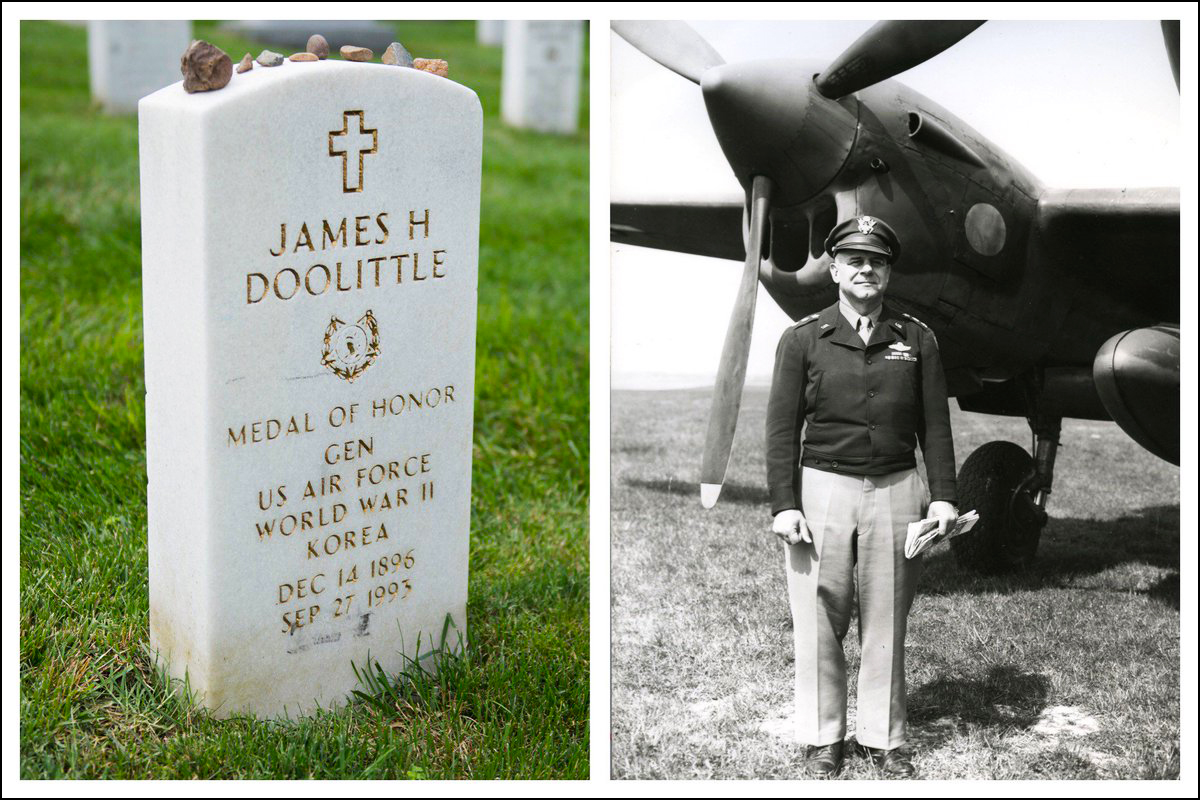
James H. “Jimmy” Doolittle died from a stroke at the age of 96 in Pebble Beach, California, on September 27, 1993, and is buried at Arlington National Cemetery next to his wife. ✪


