⭐️ 10mm Man


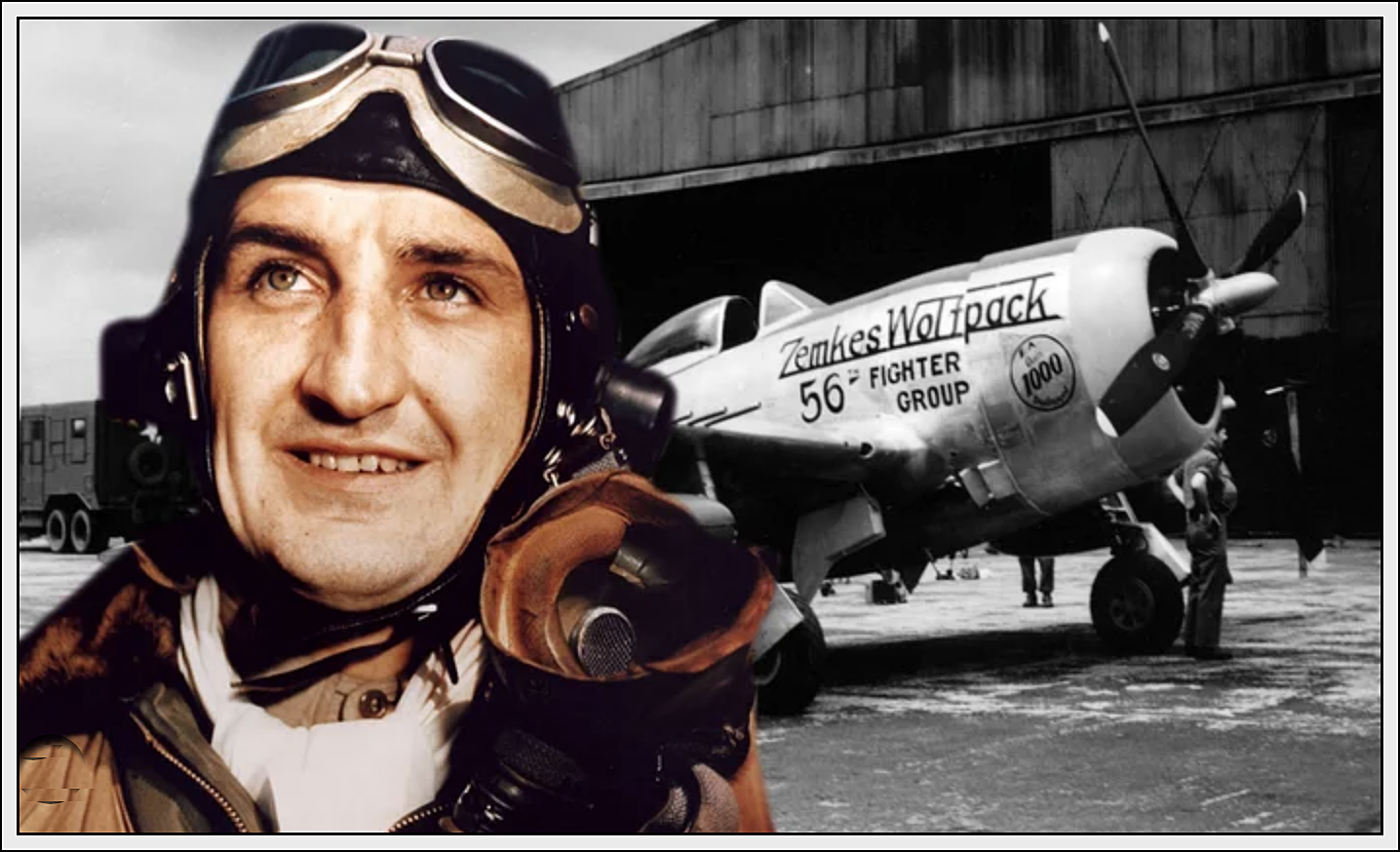

Francis Stanley “Gabby“ Gabreski: January 28, 1919–January 31, 2002
✪ Francis Stanley “Gabby” Gabreski (born Franciszek Stanisław Gabryszewski) was an American military career pilot in the United States Air Force who retired as a colonel after 26 years of military service. He was the top American and United States Army Air Forces fighter ace over Europe during World War II; and a jet fighter ace with the Air Force in the Korean War.
Although best known for his credited destruction of 34½ aircraft in aerial combat and being one of only seven U.S. combat pilots to become an ace in two wars, Gabreski was also one of the Air Force’s most accomplished leaders. In addition to commanding two fighter squadrons, he had six command tours at group or wing level, including one in combat in Korea, totaling over 11 years of command and 15 overall in operational fighter assignments.
Colonel Francis Stanley (“Gabby”) Gabreski was born on January 28, 1919 in Oil City, Pennsylvania; the second child of Stanislaw Gabryszewski, a railroad car repairer, and Jozefa Kapica Gabryszewsky, both immigrants from Poland. He attended Oil City High Schoo & graduated in 1938.
Gabreski’s parents had big dreams for him which included attending the University of Notre Dame. He did so in 1938, but because he was unprepared for real academic work he almost failed during his Freshman year.
Howeverm during his first year at Notre Dame, Gabreski developed an interest in flying. He took lessons in a Taylor Cub and accumulated six hours of flight time. As his autobiography indicates, he struggled to fly smoothly and did not fly solo, after being advised by his instructor Homer Stockert that he did not “have the touch to be a pilot.”
After two years of study at the University of Notre Dame, Gabreski enlisted as a Flying Cadet, Air Corps, United States Army, at Pittsburgh, Pennsylvania. He was 5 feet, 8 inches tall and weighed 146 pounds.
After his induction into the U.S. Army in Pittsburgh, Gabreski undertook primary flight training at Parks Air College, near East St. Louis, Illinois, flying the Stearman PT-17. Gabreski was a mediocre trainee and was forced to pass an elimination check ride during primary instruction in order to continue training. After completing flight training, on 14 March 1941, Gabreski was commissioned as a second lieutenant in the Air Reserve.
He advanced to basic flight training at Gunter Army Air Base, Alabama, in the Vultee BT-13 and completed his advanced training at Maxwell Field, Alabama, in the North American AT-6 Texan. Gabreski earned his wings and his commission as a second lieutenant in the Air Corps in March 1941, after which he then sailed for Hawaii aboard the SS Washington to his first assignment.
In Hawaii, Lieutenant Gabreski was assigned as a fighter pilot with the 45th Pursuit Squadron, 15th Pursuit Group, at Wheeler Army Airfield, Territory of Hawaii. He flew Curtiss P-36 Hawks and P-40 Warhawks. While at Wheeler, Gabreski met his future wife, Miss Catherine Mary Cochran. They planned to marry, but were delayed when the Imperial Japanese Navy attacked Pearl Harbor on 7 December 1941.During that action, Gabreski joined several members of his squadron in flying P-36 fighters in an attempt to intercept the attackers, but the Japanese had already withdrawn.
On 1 March 1942, Gabreski was promoted to first lieutenant, Air Corps, Army of the United States (A.U.S.), and then to captain, 16 October 1942. Captain Gabreski was sent to Britain with the 56th Fighter Group.
In Britain, Gabreski closely followed the reports of the Battle of Britain and the role Polish RAF squadrons played in it, especially by the legendary No. 303 Polish Fighter Squadron. He became concerned that the US did not have enough experienced fighter pilots. This gave him an idea: since Polish squadrons had proved to be capable within the RAF and since he himself was of Polish origin and spoke Polish, he offered to serve as a liaison officer to the Polish squadrons to learn from their experience. His idea was approved, and he was promoted to captain.
Because of his Polish lineage and his fluency in the language, Gabreski requested assignment to a Polish fighter squadron fighting with the Royal Air Force. His request was approved and he was assigned to No. 315 Squadron, based at RAF Northolt, London, England, where he flew the new Supermarine Spitfire Mk.IX.
Gabreski flew patrol sweeps over the Channel. He first encountered Luftwaffe opposition on February 3, when a group of Focke-Wulf Fw 190s jumped his squadron. Too excited to make a “kill,” Gabreski learned during that battle that he had to keep calm during a mission; a lesson which would come to serve him well many times later in the war. He later spoke with great esteem about the Polish pilots and the lessons they taught him. In all, Gabreski flew 20 missions with the Poles and engaged in combat once.
On February 27, 1943, Gabreski became part of the 56th Fighter Group, flying the Republic P-47 Thunderbolt, assigned to the 61st Fighter Squadron; and quickly became a flight leader. He was immediately resented by many of his fellow pilots, due to the fact he was extremely opinionated and outspoken. In May, shortly after the group moved to RAF Halesworth and entered combat, Gabreski was promoted to major.
On November 26, 1943, the 56th Fighter Group was assigned to cover the withdrawal of Boeing B-17 Flying Fortress bombers which had bombed Bremen, Germany. The P-47s arrived to find the bombers under heavy attack near Oldenburg and dived into the fray. Gabreski recorded his fourth and fifth kills to become an ace, but had a close brush with death on December 11 when a 20 mm cannon shell lodged in his engine without exploding, destroying its turbocharger. Low on fuel and ammunition, Gabreski outmaneuvered a Bf 109 until it succeeded in placing a burst of fire into his P-47, disabling the engine. However, Gabreski stayed in the airplane until he could restart it at a lower altitude, where the turbocharger was not needed, and continue flying.
Gabreski’s victory total steadily climbed through the winter of 1943–44. By March 27, he had 18 victory credits and six multiple-kill missions to rank third in the “ace race” which had developed within VIII Fighter Command. He downed only one more aircraft in the next two months.
On May 22, Gabreski shot down three Fw 190s over an airfield in northwest Germany to become the leading ace in the European Theater of Operations (passing Eddie Rickenbacker’s record from World War I in the process), and on July 5, 1944, became America’s leading ace in the ETO, with his score of 28 destroyed matching the total at the time of confirmed victories of the Pacific Theatre’s top American ace, Richard Bong. This total was never surpassed by any U.S. pilot fighting the Luftwaffe.
On July 20, 1944, Gabreski reached the 300-hour combat time limit for Eighth Air Force fighter pilots and was awaiting an aircraft to return him to the United States on leave and reassignment. He had already advised Kay Cochran to proceed with their wedding plans; and his hometown of Oil City, Pennsylvania, had raised $2,000 for their wedding present in anticipation of his return.
Francis and Kay Gabreski had nine children during their 48 years of marriage. Two of their three sons graduated from the United States Air Force Academy and became career Air Force pilots. His daughter-in-law Terry L. Gabreski was promoted to lieutenant general in August 2005, the highest-ranking woman in the USAF until her retirement in 2010. Kay Gabreski died as the result of injuries from an automobile accident as they both were returning from the Oshkosh Air Show on August 6, 1993. She was interred in Calverton National Cemetery, 25 miles from their home in Dix Hills.
However, Gabreski found a bomber escort mission to Russelheim, Germany, was scheduled for that morning; and instead of boarding the transport, he requested to “fly just one more.” Returning from this mission, Gabreski observed several Heinkel He 111s parked on the airfield at Niedermendig, Germany and took his airplane down to attack.
Dissatisfied with his first strafing run on the He 111s, he returned for a second pass. When his tracers went over the parked bomber, he dropped the nose of his Thunderbolt to adjust, and its propeller clipped the runway, bending the tips.The damage caused his engine to vibrate violently and he was forced to crash land. Gabreski then ran into the nearby woods and eluded capture for five days. After being captured, he was interrogated by Obergefreiter Hanns Scharff & eventually sent to Stalag Luft I.
Gabreski flew 166 combat sorties and was officially credited by the USAAF with 28 aircraft destroyed in air combat and 3 on the ground.
Following his repatriation, Gabreski returned to the United States and married Kay Cochran on June 11, 1945. After a 90-day recuperative leave, he became Chief of Fighter Test Section at Wright Field, Ohio. At the same time, he completed test pilot training at its Engineering Flight Test School. In April 1946, he left the service, worked for Douglas Aircraft for a year, then was recalled to active duty in April 1947 to command the 55th Fighter Squadron, 20th Fighter Group, at Shaw Air Force Base, South Carolina
Gabreski would participate in aerial combat again during the Korean War. On July 8, 1951, flying his fifth mission in an F-86, Gabreski shot down a MiG-15, followed by additional MiG kills on September 2 and October 2.
Gabreski was frequently criticized for having a poor attitude towards wingmen. One historian, citing five interviews with pilots and an unpublished manuscript by a sixth, observed that Gabreski always flew the fastest aircraft available and failed to notice when his slower wingmen could not keep up.
Gabreski also made the first intentional violation of rules of engagement that prohibited combat with MiGs over China. (The MiG force was based in this ostensible sanctuary during the entire war.) Gabreski and a fellow former 56th pilot, Colonel Walker M. Mahurin, planned and executed a mission in early 1952 in which their F-86s turned off their IFF equipment and overflew two Chinese bases.
Gabreski’s Korean tour was due to end in June. As he approached his mission limit in early April, he quit logging sorties to avoid being transferred from his command.
On his return to the United States, Gabreski received the key to the city from San Francisco Mayor Elmer E. Robinson and on June 17 was given a ticker-tape parade up Market Street.
Gabreski’s 6½ MiG-15 kill credits make him only one of seven U.S. pilots to become an ace in more than one war. Gabreski was officially credited with 123 combat missions in Korea, totaling 289 for his career. Although he flew many F-86s in combat, his assigned aircraft was F-86E-10-NA 51-2740, nicknamed “Gabby.”
Gabreski’s Air Force career continued for another 15 years, during which time he held three wing commands totaling nearly nine years of duty. Gabreski retired on November 1, 1967. Per his USAF official biography, he retired with more than 5,000 flying hours, 4,000 of them in jets.
Following his retirement from the Air Force, Gabreski worked for Grumman Aerospace until August 1978. He was asked by New York Governor Hugh Carey to serve as president of the financially stressed and state-owned Long Island Rail Road in an attempt to improve the commuter line.
After what he described as an 18-month struggle with the board of the Metropolitan Transportation Authority, Gabreski resigned from that job on February 26, 1981. He charged that the creation of an executive director’s position, and its appointee, obstructed his efforts to improve service, replace equipment, and change its executive staff. However, a severe heat wave in the summer of 1980 that overwhelmed the commuter line’s air conditioning systems was apparently the final straw that forced his resignation.
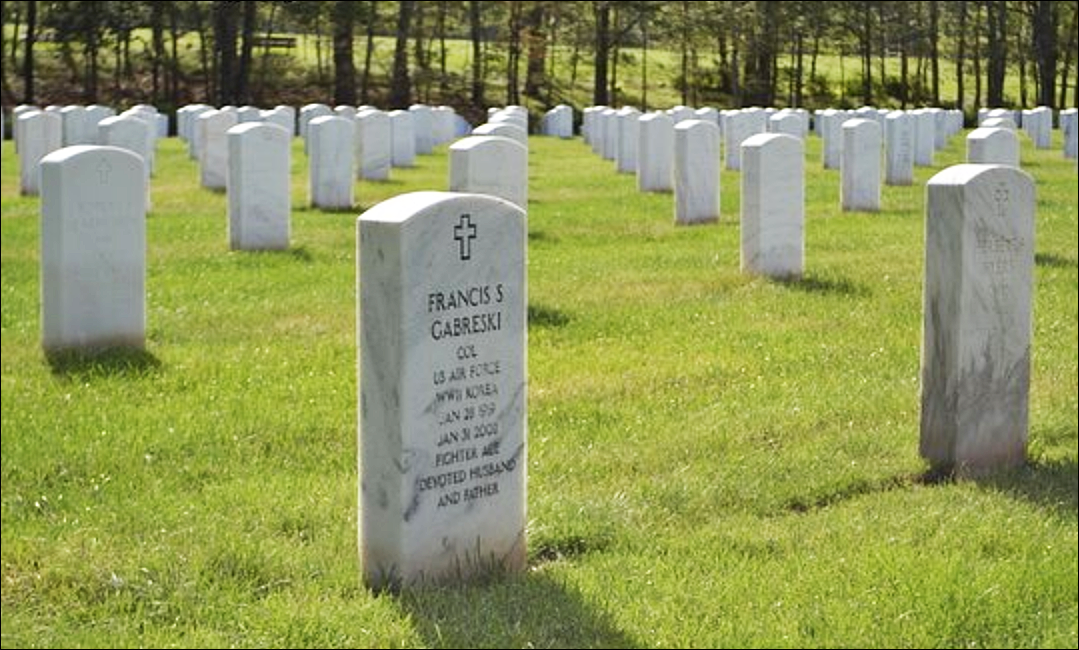
Gabreski died of a heart attack in Huntington Hospital, Long Island, New York on January 31, 2002. He & Kay are buried in Calverton National Cemetery in Wading River, New York. Gabreski’s funeral on February 6 was with full military honors and included a missing man formation flyover by F-15E Strike Eagles from the 4th Fighter Wing, Seymour Johnson Air Force Base, North Carolina. In 1978, Gabreski was inducted into the National Aviation Hall of Fame.✪