


Harriet Tubman (March 1822–March 10, 1913)
✪ Harriet Tubman (born Araminta Ross) was an American abolitionist and social activist. After escaping slavery, Tubman made some 13 missions to rescue approximately 70 enslaved people, including her family and friends by using a network of antislavery activists and safe houses known collectively as the Underground Railroad. During the American Civil War, she also served as an armed scout and spy for the Union Army. In her later years, Tubman was an activist in the Women’s Suffrage Movement.
Tubman was born Araminta “Minty” Ross to enslaved parents, Harriet (“Rit”) Green and Ben Ross. Rit was enslaved by Mary Pattison Brodess (and later her son Edward). Ben was enslaved by Anthony Thompson, who became Mary Brodess’s second husband and who ran a large plantation near the Blackwater River in the Madison area of Dorchester County, Maryland.
As with many enslaved people in the United States, neither the exact year nor place of Tubman’s birth is known. Tubman reported the year of her birth as 1825, while her death certificate lists 1815 and her gravestone lists 1820. Historian Kate Larson’s 2004 biography of Tubman records her birth year as 1822, based on the record of a midwife payment and several other historical documents, including her runaway advertisement. Based on Larson’s work, more recent biographies have accepted March 1822 as the most likely timing of Tubman’s birth.
Tubman’s maternal grandmother, Modesty, arrived in the U.S. on a slave ship from Africa; and no other information is available about her other ancestors. As a child, Tubman was told that she seemed like an Ashanti person because of her character traits, though no evidence has been found to confirm or deny this lineage. Her mother, Rit (who may have had a white father), was a cook for the Brodess family. Her father, Ben, was a skilled woodsman who managed the timber work on Thompson’s plantation. They married around 1808 and, according to court records, had nine children together: Linah, Mariah Ritty, Soph, Robert, Minty (Harriet), Ben, Rachel, Henry and Moses.
Rit struggled to keep her family together as slavery threatened to tear it apart. Edward Brodess sold three of her daughters (Linah, Mariah Ritty, and Soph), separating them from the family forever. When a trader from Georgia approached Brodess about buying Rit’s youngest son, Moses, she hid him for a month, aided by other enslaved people and freedmen in the community.
Tubman’s mother was assigned to “the big house” and had scarce time for her own family. Consequently, as a child Tubman took care of a younger brother and baby, as was typical in large families of the time. When she was five or six years old, Brodess hired Harriet out as a nursemaid to a woman named “Miss Susan.” Tubman was ordered to care for the baby and rock the cradle as it slept. When the baby woke up and cried, Tubman was whipped. She later recounted a particular day when she was lashed five times before breakfast. She carried the scars for the rest of her life.
As an adolescent, Tubman suffered a severe head injury when an overseer threw a two-pound metal weight at another slave who was attempting to flee. The weight struck Tubman instead, which she said: “broke my skull.” Bleeding and unconscious, she was returned to her enslaver’s house and laid on the seat of a loom, where she remained without medical care for two days. After this incident, Tubman frequently experienced extremely painful headaches.
Soon after her injury, Tubman began experiencing visions and vivid dreams, which she interpreted as revelations from God. These spiritual experiences had a profound effect on Tubman’s personality and she acquired a passionate faith in God. Although Tubman remained illiterate, she was told Bible stories by her mother and likely attended a Methodist church with her family.
The injury also caused dizziness, pain, and spells of hypersomnia, which occurred throughout her life. These experiences, combined with her Methodist upbringing, led her to become devoutly religious.
In 1849, Tubman became ill again, which diminished her value to slave traders. Edward Brodess tried to sell her, but could not find a buyer. Angry at him for trying to sell her and for continuing to enslave her relatives, Tubman began to pray for God to make Brodess change his ways. She said later: “I prayed all night long for my master till the first of March; and all the time he was bringing people to look at me, and trying to sell me.” When it appeared as though a sale was being concluded, Tubman changed her prayer: “First of March I began to pray, ‘Oh Lord, if you ain’t never going to change that man’s heart, kill him, Lord, and take him out of the way.” A week later, Brodess died and Tubman expressed regret for her earlier sentiments.
Tubman and her brothers, Ben and Henry, escaped from slavery on September 17, 1849. Because they were hired out, Eliza Brodess probably did not recognize their absence as an escape attempt for some time. Two weeks later, she posted a runaway notice in the Cambridge Democrat, offering a reward of up to US$100 each (equivalent to $3,520 in 2022) for their capture and return to slavery. Once they had left, Tubman’s brothers had second thoughts. Ben may have regretted leaving his wife and children. The two men went back, forcing Tubman to return with them.
Sometime in October or November, Tubman escaped again, this time without her brothers. While her exact route is unknown, Tubman made use of the network known as the Underground Railroad. This informal system was composed of free and enslaved black people, white abolitionists, and other activists. Most prominent among the latter in Maryland at the time were Quakers (members of the Religious Society of Friends).
Tubman was forced to travel by night, guided by the North Star and trying to avoid slave catchers eager to collect rewards for fugitive slaves. The particulars of her first journey are unknown. Because other escapees from slavery used the routes, Tubman did not discuss them until later in life. She crossed into Pennsylvania with a feeling of relief and awe, and recalled the experience years later:
When I found I had crossed that line, I looked at my hands to see if I was the same person. There was such a glory over everything; the sun came like gold through the trees, and over the fields, and I felt like I was in Heaven.
In December 1850, Tubman was warned that her niece Kessiah and Kessiah’s children would soon be sold in Cambridge. Tubman went to Baltimore, where her brother-in-law Tom Tubman hid her until the sale. Kessiah’s husband, a free black man named John Bowley, made the winning bid for his wife. When night fell, Bowley sailed the family on a log canoe 60 miles (97 kilometres) to Baltimore, where they met with Tubman, who brought the family to Philadelphia.
Early next year she returned to Maryland to guide away other family members. Word of her exploits had encouraged her family, and she became more confident with each trip to Maryland.
In December 1851, Tubman guided an unidentified group of 11 escapees, possibly including the Bowleys and several others she had helped rescue earlier, northward. There is evidence to suggest that Tubman and her group stopped at the home of abolitionist and former slave Frederick Douglass. Douglass and Tubman admired one another greatly as they both struggled against slavery. Years later he contrasted his efforts with hers, writing:
Most that I have done and suffered in the service of our cause has been in public, and I have received much encouragement at every step of the way. You, on the other hand, have labored in a private way. I have wrought in the day – you in the night. … The midnight sky and the silent stars have been the witnesses of your devotion to freedom and of your heroism. Excepting John Brown – of sacred memory – I know of no one who has willingly encountered more perils and hardships to serve our enslaved people than you have.
From 1851 to 1862, Tubman returned repeatedly to the Eastern Shore of Maryland, rescuing some 70 slaves in about 13 expeditions. Tubman’s dangerous work required ingenuity. She usually worked during winter, when long nights and cold weather minimized the chance of being seen. She would start the escapes on Saturday evenings, since newspapers would not print runaway notices until Monday morning.
Tubman’s faith was another important resource as she ventured repeatedly into Maryland. The visions from her childhood head injury continued, and she saw them as divine premonitions. She spoke of “consulting with God,” and trusted that He would keep her safe. Garrett once said of her, “I never met with any person of any color who had more confidence in the voice of God, as spoken direct to her soul.” Her faith also provided immediate assistance. She used spirituals as coded messages, warning fellow travelers of danger or to signal a clear path.
She carried a revolver as protection from slave catchers and their dogs. Tubman also threatened to shoot anyone who tried to turn back since that would risk the safety of the remaining group, as well as anyone who helped them on the way. Tubman spoke of one man who insisted he was going to go back to the plantation. She pointed the gun at his head and said, “Go on or die.”
Tubman and the fugitives she assisted were never captured. Years later, she told an audience: “I was conductor of the Underground Railroad for eight years, and I can say what most conductors can’t say – I never ran my train off the track and I never lost a passenger.”
In November 1860, Tubman conducted her last rescue mission. When the Civil War broke out in 1861, Tubman saw a Union victory as a key step toward the abolition of slavery.
However, U.S. President Abraham Lincoln was not yet prepared to enforce emancipation on the southern states. Tubman condemned Lincoln’s response and his general unwillingness to consider ending slavery in the U.S., for both moral and practical reasons:
God won’t let master Lincoln beat the South till he does the right thing. Master Lincoln, he’s a great man, and I am a poor negro; but the negro can tell master Lincoln how to save the money and the young men. He can do it by setting the negro free.
When Lincoln issued His Emancipation Proclamation, Tubman considered it a positive but incomplete step toward the goal of liberating all black people from slavery.
Later that year, Tubman’s intelligence gathering played a key role in the raid at Combahee Ferry. She guided three steamboats with black soldiers under Montgomery’s command past mines on the Combahee River to assault several plantations. Once ashore, the Union troops set fire to the plantations, destroying infrastructure and seizing thousands of dollars worth of food and supplies.
Newspapers heralded Tubman’s “patriotism, sagacity, energy, [and] ability” in the raid, and she was praised for her recruiting efforts – more than 100 of the newly liberated men joined the Union army. Although her contributions have sometimes been exaggerated, her role in the raid led to her being widely credited as the first woman to lead U.S. troops in an armed assault.
Tubman had received little pay for her Union military service. She was not a regular soldier and was only occasionally compensated for her work as a spy and scout; her work as a nurse was entirely unpaid. Her unofficial status caused great difficulty in documenting her service, and the U.S. government was slow in recognizing its debt to her. Meanwhile, her humanitarian work for her family and the formerly enslaved kept her in a state of constant poverty.
Tubman spent her remaining years in Auburn, tending to her family and other people in need. In addition to managing her farm, she took in boarders and worked various jobs to pay the bills and support her elderly parents.
In her later years, Tubman worked to promote the cause of women’s suffrage. A white woman once asked Tubman whether she believed women ought to have the vote, and received the reply: “I suffered enough to believe it.”
In the 1870s, Tubman became active in the Thompson Memorial African Methodist Episcopal (AME) Zion Church in Auburn. In 1895, she began discussions with AME Zion leaders and others to create a Harriet Tubman Home for the Aged that would care for “indigent colored people.”
Despite her financial limitations, in 1896 Tubman bid $1215 at auction for a 25-acre farm adjacent to the one she already owned, to use for the new facility. The home would not open for another five years.
As Tubman aged, her childhood head trauma continued to trouble her. Unable to sleep because of pain and “buzzing” in her head, in the late 1890s she asked a doctor at Boston’s Massachusetts General Hospital to operate. In her words, he “sawed open my skull, and raised it up, and now it feels more comfortable.” She reportedly received no anesthesia and instead bit down on a bullet, as she had seen Civil War soldiers do when their limbs were amputated.
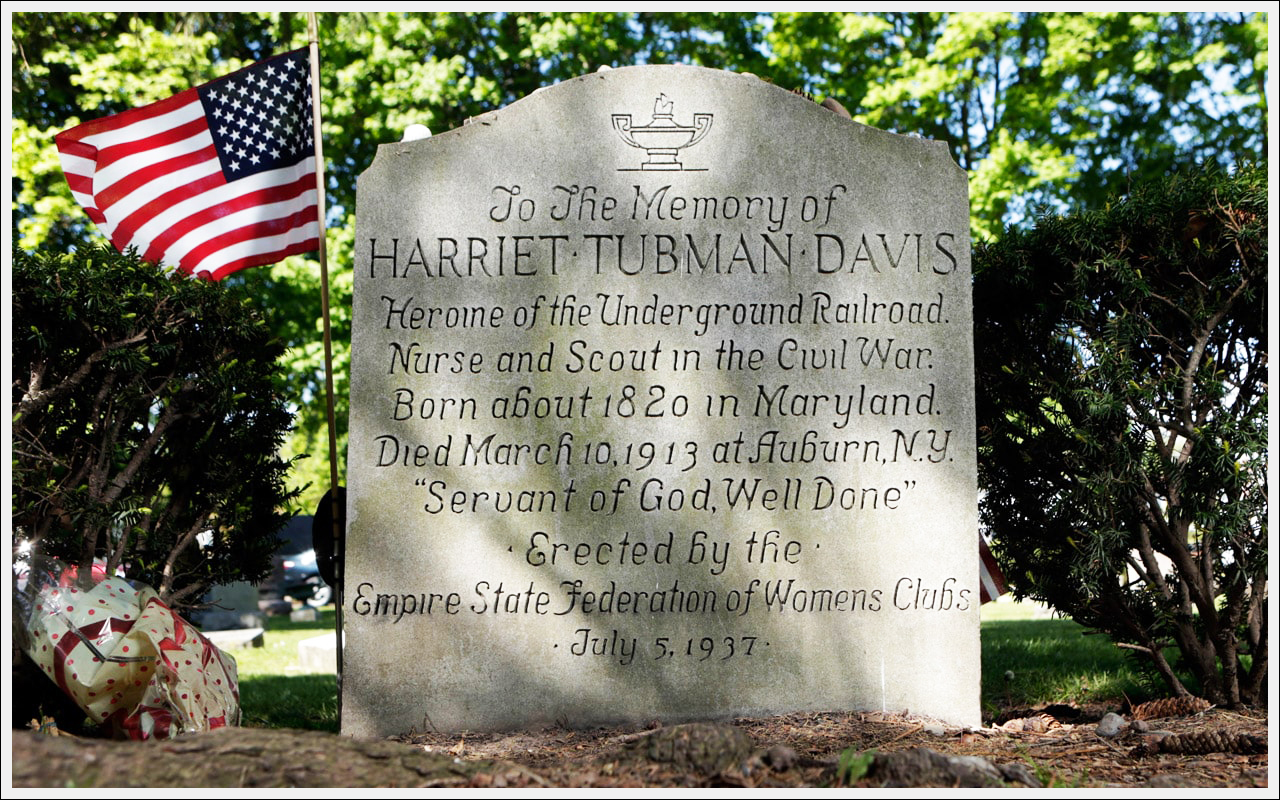
By 1911, Tubman’s body was so frail that she was admitted into the rest home named in her honor. A New York newspaper described her as “ill and penniless,” prompting supporters to offer a new round of donations. Surrounded by friends and family members, she died of pneumonia on March 10, 1913. Just before she died, she quoted the Gospel of John to those in the room: “I go away to prepare a place for you.” Tubman was buried with semi-military honors at Fort Hill Cemetery in Auburn.✪





▶️ CLICK HERE TO VIEW
NOTE: This feature module is currently under construction. More podcast/series channels links will be added in the coming days & weeks. If there’s a podcast or video link you’d like to see posted here, please email your suggestions to vip@thenewamericanist.com


▶️ CLICK HERE TO VIEW
▶️ 11 Minutes 50 Seconds ⭐️ Gary Brown
▶️ 1 hour 17 Minutes 04 Seconds
▶️ 1 Hour 30 Minutes 28 Seconds
▶️ 10 Minutes 9 Seconds
▶️ 14 Minutes 6 Seconds
▶️ 21 Minutes 28 Seconds
▶️ 5 Minutes 49 Seconds
