
⭐️ Howie Roak


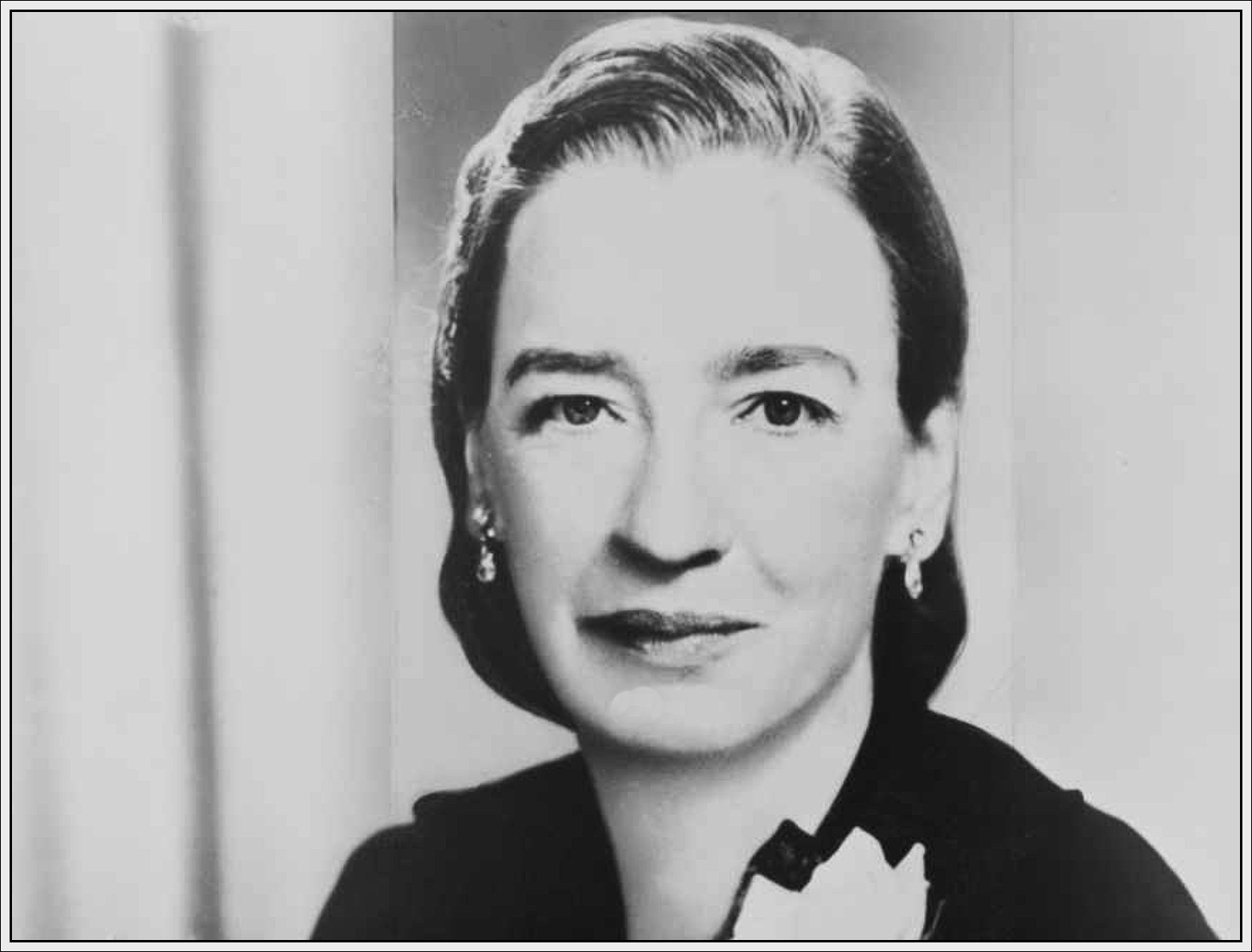

Grace Brewster Hopper (December 9, 1906 – January 1, 1992)
✪ Grace Brewster Hopper (maiden family name Murray) was an American computer scientist, mathematician, and United States Navy rear admiral. One of the first programmers of the Harvard Mark I computer. She was also a pioneer of computer programming who invented one of the first linkers. Hopper was the first to devise the theory of machine-independent programming languages, and the FLOW-MATIC programming language she created using this theory was later extended to create COBOL, an early high-level programming language which is still in use today.
Prior to joining the Navy, Hopper earned a Ph.D. in both mathematics and mathematical physics from Yale University and was a professor of mathematics at Vassar College. Hopper attempted to enlist in the Navy during World War II but was rejected because she was 34 years old. She instead joined the Navy Reserves, leaving her position at Vassar. Hopper formally began her computing career in 1944 when she worked on the Harvard Mark I team led by Howard H. Aiken. In 1949, she joined the Eckert–Mauchly Computer Corporation and was part of the team that developed the UNIVAC I computer.
She believed that programming should be simplified with an English based computer programming language. Her compiler converted English terms into machine code which could be understood by computers. During her wartime service, she co-authored three papers based on her work on the Harvard Mark 1. She is accredited with writing the first computer manual, “A Manual of Operation for the Automatic Sequence Controlled Calculator.”
Grace Brewster Murray was born in New York City. She was the eldest of three children. Her parents, Walter Fletcher Murray and Mary Campbell Van Horne, were of Scottish and Dutch descent and attended West End Collegiate Church. Her great-grandfather, Alexander Wilson Russell, an admiral in the US Navy, fought in the Battle of Mobile Bay during the Civil War.
Grace was very curious as a child and this would prove to be a lifelong characteristic. At the age of seven, she decided to determine how an alarm clock worked and dismantled seven alarm clocks before her mother realized what she was doing (she was then limited to only one clock). For her preparatory school education, she attended the Hartridge School in Plainfield, New Jersey. Grace was initially rejected for early admission to Vassar College at age 16 (because her test scores in Latin were too low), but she was admitted the following year. She graduated Phi Beta Kappa from Vassar in 1928 with a bachelor’s degree in mathematics and physics. She earned her master’s degree at Yale University in 1930.
In 1930, Grace Murray married New York University professor Vincent Foster Hopper (1906–1976); they divorced in 1945. Although she did not marry again, she retained his surname.
In 1934, Hopper earned a Ph.D. in mathematics from Yale. under the direction of Øystein Ore. Her dissertation, “New Types of Irreducibility Criteria,” was published that same year. She began teaching mathematics at Vassar in 1931, and was promoted to associate professor in 1941.
Hopper tried to commission in the Navy early in World War II, however she was turned down. At age 34, she was too old to enlist and her weight to height ratio was too low. She was also denied on the basis that her job as a mathematician and mathematics professor at Vassar College was valuable to the war effort. During the war in 1943, Hopper obtained a leave of absence from Vassar and was sworn into the United States Navy Reserve; she was one of many women who volunteered to serve in the WAVES.
She reported in December and trained at the Naval Reserve Midshipmen’s School at Smith College in Northampton, Massachusetts. Hopper graduated first in her class in 1944, and was assigned to the Bureau of Ships Computation Project at Harvard University as a lieutenant, junior grade. She served on the Mark I computer programming staff headed by Howard H. Aiken.
Hopper’s request to transfer to the regular Navy at the end of the war was also declined due to her advanced age of 38. She continued to serve in the Navy Reserve. Hopper remained at the Harvard Computation Lab until 1949, turning down a full professorship at Vassar in favor of working as a research fellow under a Navy contract at Harvard.
In 1949, Hopper became an employee of the Eckert–Mauchly Computer Corporation as a senior mathematician and joined the team developing the UNIVAC I. When Hopper recommended the development of a new programming language that would use entirely English words, she “was told very quickly that [she] couldn’t do this because computers didn’t understand English.” Still, she persisted. “It’s much easier for most people to write an English statement than it is to use symbols,” she explained. “So I decided data processors ought to be able to write their programs in English, and the computers would translate them into machine code.”
In 1952, she had an operational link-loader, which at the time was referred to as a compiler. She later said that “Nobody believed that,” and that she “had a running compiler and nobody would touch it. They told me computers could only do arithmetic.”
In the spring of 1959, computer experts from industry and government were brought together in a two-day conference known as the Conference on Data Systems Languages (CODASYL). Hopper served as a technical consultant to the committee, and many of her former employees served on the short-term committee that defined the new language COBOL (an acronym for COmmon Business-Oriented Language). COBOL went on to become the most ubiquitous computer business language to date.
From 1967 to 1977, Hopper served as the director of the Navy Programming Languages Group in the Navy’s Office of Information Systems Planning and was promoted to the rank of captain in 1973. She developed validation software for COBOL and its compiler as part of a COBOL standardization program for the entire Navy
In the 1970s, Hopper advocated for the Defense Department to replace large, centralized systems with networks of small, distributed computers. Any user on any computer node could access common databases located on the network. She developed the implementation of standards for testing computer systems and components, most significantly for early programming languages such as FORTRAN and COBOL.
In accordance with Navy attrition regulations, Hopper retired from the Naval Reserve with the rank of Commander at age 60 at the end of 1966. She was recalled to active duty in August 1967 for a six-month period that turned into an indefinite assignment. She retired again in 1971 but was again asked to return to active duty in 1972. She was promoted to captain in 1973 by Admiral Elmo R. Zumwalt Jr.
Throughout much of her later career, Hopper was much in demand as a speaker at various computer-related events. She was well known for her lively and irreverent speaking style, as well as a rich treasury of early war stories. She also received the nickname “Grandma COBOL.”
Following a career that spanned more than 42 years, Rear Admiral Hopper took retirement from the Navy on August 14, 1986. At the time, she was the oldest serving member of the US Navy. At a celebration held in Boston onboard the USS Constitution to commemorate her retirement, Hopper was awarded the Defense Distinguished Service Medal, the highest non-combat decoration awarded by the Department of Defense.
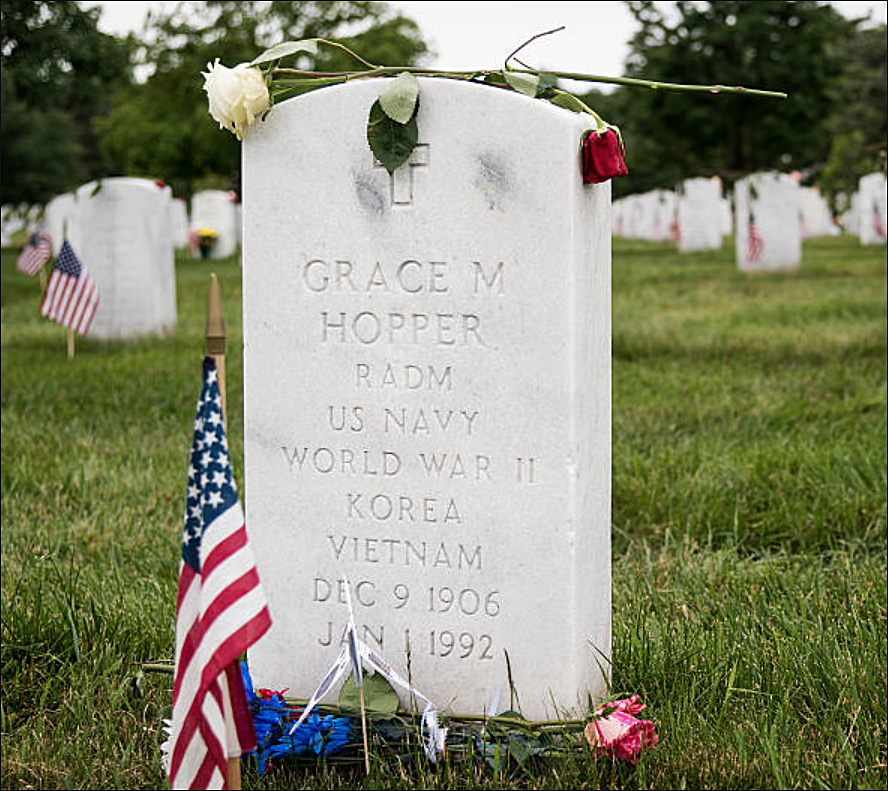
Hopper died in her sleep of natural causes at her home in Arlington County, Virginia on New Years Day 1992 at 85 years of age. She was interred with full military honors in Arlington National Cemetery.
Historian Jay Elliot describes Grace Hopper as appearing to be “all Navy,” but when you reached inside, you found a “Pirate” waiting to be released.✪


▶️ CLICK HERE TO VIEW
▶️ 1 Hour 40 Minutes 22 Seconds
▶️ 1 Hour 5 Minutes 52 Seconds
▶️ 5 Minutes 49 Seconds
▶️ 4 Minutes 41 Seconds ⭐️ Bosun Higgs
▶️ 21 Minutes 31 Seconds
▶️ 5 Minutes 25 Seconds
