


Phineas Taylor Barnum (July 5, 1810 – April 7, 1891)
✪ Phineas Taylor Barnum was an American showman, businessman, author, philanthropist and politician most often remembered for promoting celebrated hoaxes and founding the Barnum & Bailey Circus (1871–2017) with James Anthony Bailey. He said of himself, “I am a showman by profession … and all the gilding shall make nothing else of me.” He is widely credited with coining the adage “There’s a sucker born every minute.”
▶️ 8 Minutes
Barnum was born in Bethel, Connecticut, the son of innkeeper, tailor, and store-keeper Philo Barnum (1778–1826) and his second wife Irene Taylor. His maternal grandfather Phineas Taylor was a Whig, legislator, landowner, justice of the peace, and lottery schemer who had a great influence on him as a child.
Barnum was involved in owning & operating several businesses over the years; including a general store, a book auction trade, real estate speculation and a statewide lottery network. He started a weekly newspaper in 1829 called The Herald of Freedom in Danbury, Connecticut. His editorials against the elders of local churches led to libel suits and a prosecution which resulted in imprisonment for two months, but he became a champion of the liberal movement upon his release. He sold his store in 1834.
Barnum began his career as a showman in 1835 when he was only 25 with the purchase and exhibition of a blind and almost completely paralyzed slave woman named Joice Heth, whom an acquaintance was trumpeting around Philadelphia as George Washington’s former 161 year old nurse.
On November 8, 1829, Barnum married Charity Hallett and they had four children: Caroline Cornelia (1833–1911), Helen Maria (1840–1915), Frances Irena (1842–1844), and Pauline Taylor (1846–1877). Charity died on November 19, 1873 and he married Nancy Fish, the daughter of his close friend John Fish, the following year. Nancy was 40 years younger than him.
Barnum had a year of mixed success with his first variety troupe called “Barnum’s Grand Scientific and Musical Theater,” followed by the Panic of 1837 and three years of difficult financial circumstances. He purchased Scudder’s American Museum located at Broadway and Ann Street, New York City in 1841. He improved the attraction by upgrading the building and adding exhibits; then renamed it “Barnum’s American Museum.” It became an extremely popular showplace with the public. He added a lighthouse lamp which attracted attention up and down Broadway along with flags along the roof’s edge which drew attention during the daytime, while giant paintings of animals between the upper windows drew attention from pedestrians on the sidewalk below. The roof was transformed to a strolling garden with a view of the city, from where he daily launched hot-air balloon rides. A changing series of live acts and curiosities were continually added to the exhibits of stuffed animals; including albinos, giants, little people, jugglers, magicians, exotic women, detailed models of cities and famous battles and a menagerie of exotic animals.
In 1842, Barnum introduced his first major hoax: a creature with the body of a monkey and the tail of a fish known as the “Feejee” mermaid. He leased it from fellow museum owner Moses Kimball of Boston who became his friend, confidant, and collaborator. Barnum justified his hoaxes by saying that they were merely advertisements to draw attention to the museum. “I don’t believe in duping the public,” he said, “but I believe in first attracting and then pleasing them.”
He next followed the mermaid by exhibiting Charles Stratton, the little person called “General Tom Thumb“ (“the Smallest Person who ever Walked Alone”) who was then four years old but was claimed to be 11. With heavy coaching and natural talent, the boy was taught to imitate people from Hercules to Napoleon. By late 1846, Barnum’s Museum was drawing more than 400,000 visitors a year.
Barnum became aware of the popularity of a European singer named Jenny Lind, the “Swedish Nightingale,” during his European tour with Tom Thumb when her career was at its height in Europe. Barnum had never heard her sing and conceded to being unmusical himself, but still approached her to sing in America at $1,000 a night for 150 nights, all expenses paid by him.
Lind demanded the fee in advance and Barnum agreed. This permitted her to raise a fund for charities, principally endowing schools for poor children in Sweden. Barnum borrowed heavily on his mansion and museum to raise the money to pay Lind but he still fell short of funds; so he persuaded a Philadelphia minister that Lind would be a good influence on American morals and the minister lent him the final $6,000.
Lind and her small company sailed to America in September 1850, but she was a celebrity even before she arrived thanks to month’s of Barnum’s preparations & publicity. Close to 40,000 people greeted her when her ship arrived at the docks and another 20,000 at her hotel. The press was also in attendance; and of course, “Jenny Lind memorabilia items” were available to everyone to buy. The tour began with a concert at Castle Garden on September 11, 1850 and was a major success, recouping Barnum four times the amount of his original investment. When Lind realized how much money Barnum stood to make from the tour, she insisted on a new agreement which he signed. Lind performed 93 concerts in America for Barnum, earning her about $350,000, while Barnum netted at least $500,000 (equivalent to $16,286,000 in 2021).
Barnum’s next challenge was to change public attitudes about the theater which was widely seen at the time as a so-called “den of evil.” He wanted to reposition theaters as palaces of edification and delight as places of respectable middle-class entertainment. He built New York City’s largest and most modern theater, naming it the “Moral Lecture Room.” He hoped that this would avoid seedy connotations & associations, attract a family crowd and win the approval of the moral crusaders of New York City. He started the nation’s first theatrical matinées to encourage families to attend and to lessen their fear of crime.
He organized flower shows, beauty contests, dog shows, and poultry contests, but the most popular were his baby contests such as the fattest baby or the handsomest twins. In 1853 he started the pictorial weekly newspaper Illustrated News. A year later, he completed his autobiography which sold more than a million copies over the course of numerous revisions and editions.
In the early 1850s, Barnum began investing heavily in the development of East Bridgeport, Connecticut. He made substantial loans to the Jerome Clock Company to get it to move to his new industrial area, but the company went bankrupt in 1856, taking Barnum’s wealth with it. Ralph Waldo Emerson proclaimed that Barnum’s downfall showed “the gods were visible again” and other critics celebrated Barnum’s public dilemma. But Tom Thumb offered his services and the two undertook another European tour. By 1860, Barnum had emerged from debt and built a mansion which he called “Lindencroft,” and he resumed ownership of his museum.
Barnum went on to create America’s first public aquarium and to expand the wax figure department of his museum. His “Seven Grand Salons” demonstrated the Seven Wonders of the World. These collections eventually expanded to four large buildings. He published a “Guide Book to the Museum” which claimed 850,000 “curiosities.”
During the Civil War, Barnum’s museum drew large audiences seeking diversion from the conflict. He added pro-Unionist exhibits, lectures and dramas, demonstrating his commitment to the cause. Barnum’s Unionist sympathies eventually incited a Confederate sympathizer to start a fire in 1864. Barnum’s American Museum burned to the ground on July 13, 1865 from a fire of unknown origin. Barnum re-established it at another location in New York City, but this also was destroyed by fire in March 1868. The loss was too great the second time and Barnum retired from the museum business.
Barnum did not enter the circus business until he was 60 years old. In 1870, he established “P. T. Barnum’s Grand Traveling Museum, Menagerie, Caravan & Hippodrome” in Delavan, Wisconsin with William Cameron Coup. It was a traveling showcase circus, menagerie, and museum of “freaks,” It went through various changes of name: “P. T. Barnum’s Travelling World’s Fair, Great Roman Hippodrome and Greatest Show on Earth,” and “P. T. Barnum’s Greatest Show on Earth, The Great London Circus, Sanger’s Royal British Menagerie and The Grand International Allied Shows United.” After an 1881 merger with James Bailey and James L. Hutchinson, the name soon shortened to “Barnum & Bailey’s.”
Barnum and Bailey split up in 1885, but reunited again in 1888 with “Barnum & Bailey’s Greatest Show On Earth,” which would later become the “Barnum & Bailey Circus” and tour the world.
Barnum was one of the first circus owners to move his circus by train, on the suggestion of Bailey and other business partners, and probably the first to own his own train. Given the lack of paved highways in America at that time, this turned out to be a shrewd decision that vastly expanded Barnum’s geographical reach and market. In this new industry, Barnum leaned heavily on the advice of his partners, most of whom were young enough to be his sons. Barnum also became known as the “Shakespeare of Advertising” due to his innovative ideas and impressive use of marketing & promotion.
Barnum wrote several books, including Life of P. T. Barnum (1855), The Humbugs of the World (1865), Struggles and Triumphs (1869), Forest and jungle, or, Thrilling Adventures In All Quarters Of The Globe and The Art of Money-Getting (1880).
Barnum was often referred to as the “Prince of Humbugs,” and he saw nothing wrong with entertainers or vendors using hoaxes (or “humbug,” as he termed it) in promotional material as long as the public received fair entertainment value for their money. However, he was contemptuous of those who made money through fraud, especially the spiritualist mediums popular in his day.
Barnum was significantly involved in politics. He mainly focused on race, slavery, and sectionalism in the period leading up to the American Civil War. He opposed the Kansas–Nebraska Act of 1854, which supported slavery. He left the Democrat Party because it endorsed slavery to become a member of the new anti-slavery Republican Party. Barnum claimed that “politics were always distasteful to me,” yet he was elected to the Connecticut legislature in 1865 as the Republican representative for Fairfield and served four terms.
He said during the ratification of the Thirteenth Amendment to the United States Constitution: “A human soul, ‘that God has created and Christ died for,’ is not to be trifled with. It may tenant the body of a Chinaman, a Turk, an Arab or a Hottentot—it is still an immortal spirit.” He also acknowledged that he had owned slaves when he lived in the South. “I whipped my slaves. I ought to have been whipped a thousand times for this myself. But then I was a Democrat—one of those nondescript Democrats, who are Northern men with Southern principles.”
In 1875, he worked as the mayor of Bridgeport, Connecticut to improve the city’s water supply, install gas lighting in the streets and enforce liquor and prostitution laws. He was instrumental in starting Bridgeport Hospital, founded in 1878, and served as its first president.
Barnum also co-founded the Bridgeport & Port Jefferson Steamboat Company in 1883 with Charles E. Tooker, which still continues to operate across the Long Island Sound between Port Jefferson, New York and Bridgeport. The company owns and operates three vessels, one of which is named the M.V. PT Barnum.
Barnum built four mansions in Bridgeport, Connecticut: Iranistan, Lindencroft, Waldemere and Marina. Iranistan was the most notable being of Moorish Revival styled architecture designed by Leopold Eidlitz with domes, spires, and lacy fretwork inspired by the Royal Pavilion in Brighton, England. It was built in 1848 but burned down in 1857. The Marina Mansion was demolished by the University of Bridgeport in 1964 in order to build their school cafeteria.
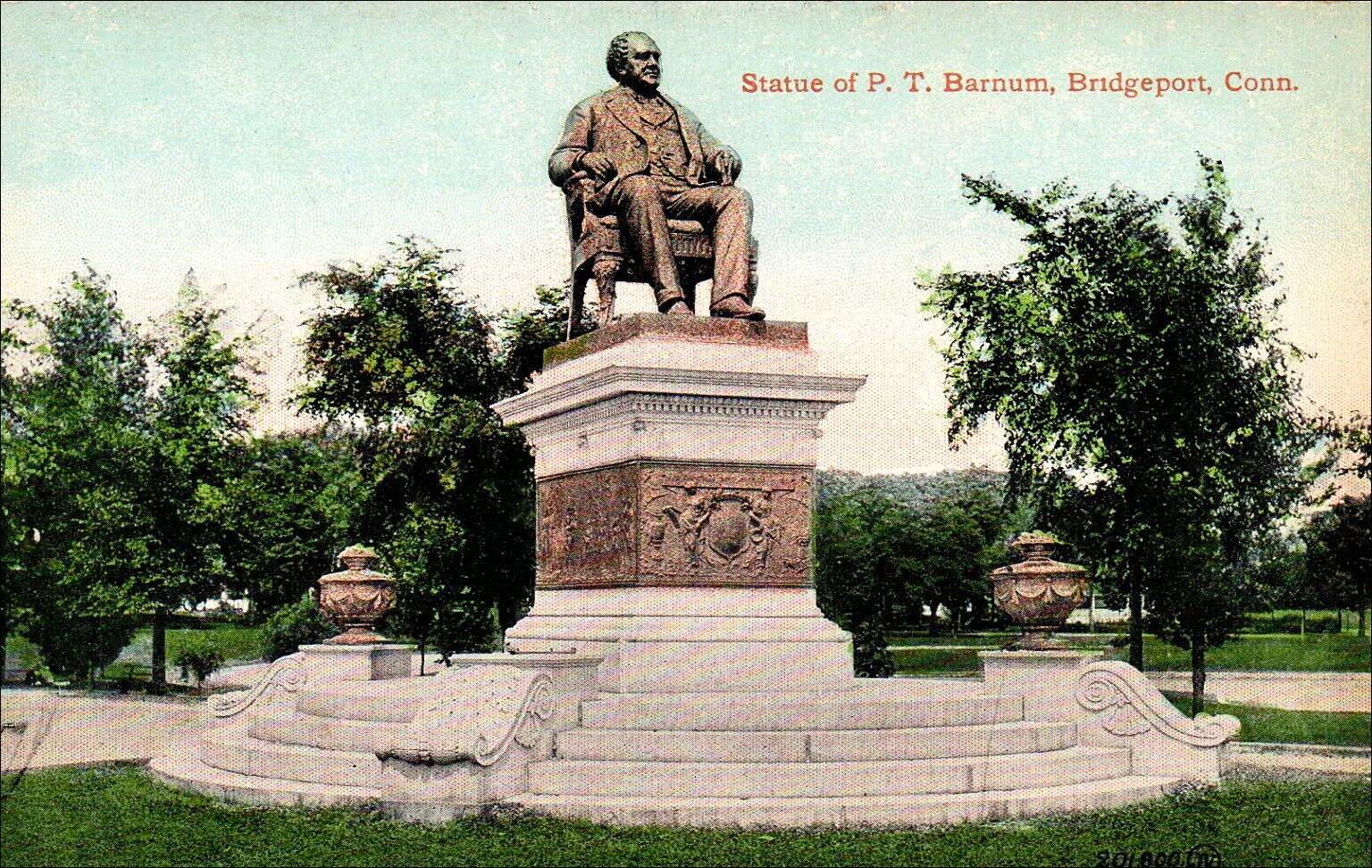
Barnum died from a stroke at home in 1891 ta the age of 80. He is buried in Mountain Grove Cemetery, Bridgeport, Connecticut. A cemetery he designed. At his death, critics praised Barnum for his good works and called him an icon of American spirit and ingenuity. He asked the Evening Sun to print his obituary just prior to his death so that he might read it. On April 7, 1891, Barnum asked about the box-office receipts for the day and a few hours later, he was dead. The Barnum Museum in Bridgeport houses many of Barnum’s oddities and curiosities.✪


▶️ CLICK HERE TO VIEW
▶️ 1 Hour 33 Minutes 39 Seconds
▶️ 12 Minutes 14 Seconds ⭐️ welcome-2-ww-3, Michael Brower
