


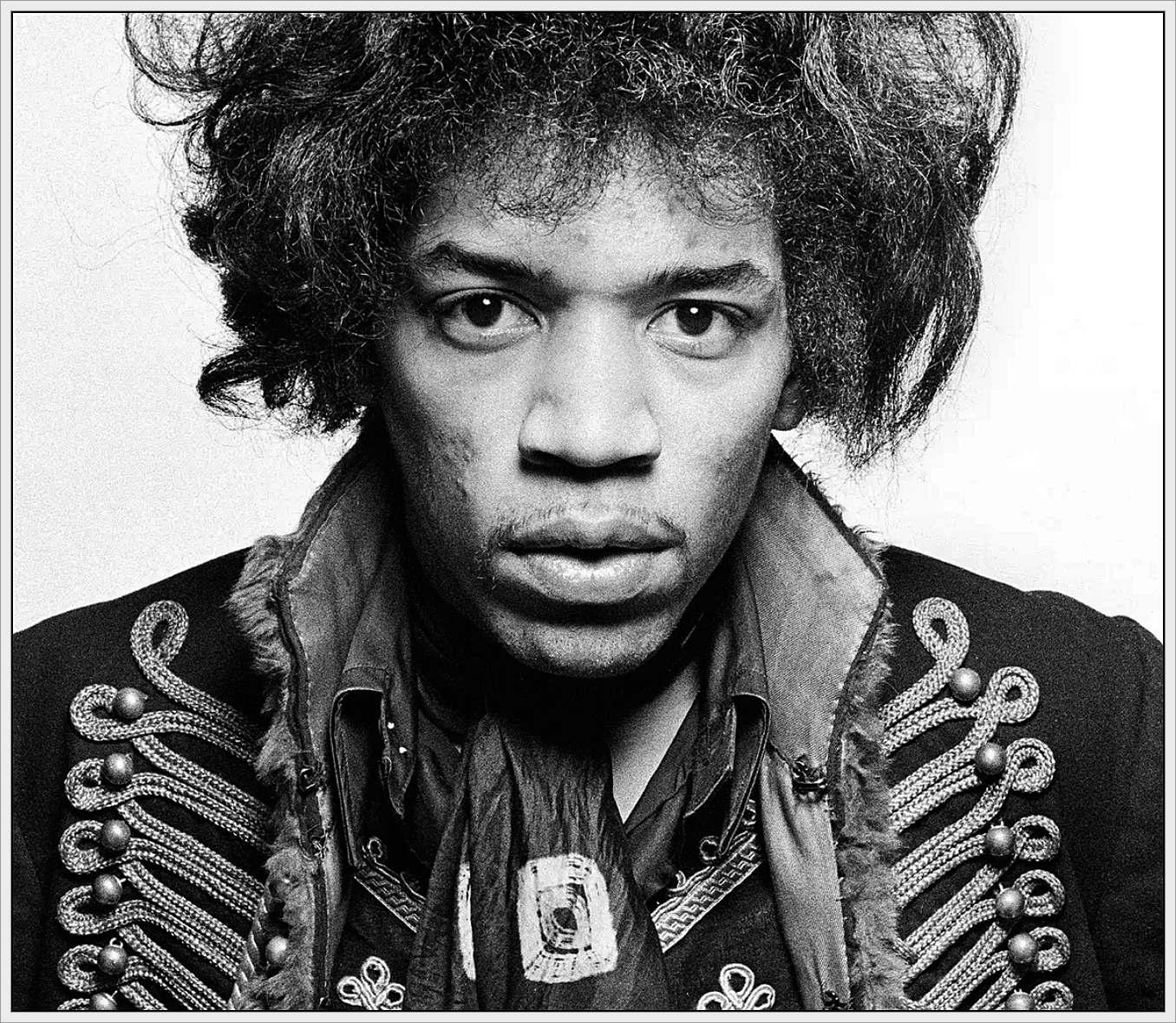

Johnny Allen Hendrix (November 27, 1942 – September 18, 1970)
✪ James Marshall “Jimi“ Hendrix (born Johnny Allen Hendrix) was an American guitarist, singer and songwriter. Although his mainstream career spanned only four years, he is widely regarded as one of the most influential electric guitarists in the history of popular music, and one of the most celebrated musicians of the 20th century. The Rock and Roll Hall of Fame describes him as “arguably the greatest instrumentalist in the history of rock music.”
Hendrix was primarily inspired by American rock and roll and electric blues. He favored overdriven amplifiers with high volume and gain, and was instrumental in popularizing the previously undesirable sounds caused by guitar amplifier feedback. He was also one of the first guitarists to make extensive use of tone-altering effects units in mainstream rock, such as fuzz distortion, Octavia, wah-wah, and Uni-Vibe. He was the first musician to use stereophonic phasing effects in recordings.
Players before him had experimented with feedback and distortion, but Hendrix turned those effects and others into a controlled, fluid vocabulary every bit as personal as the blues with which he began.
Johnny Allen Hendrix was born on November 27, 1942 in Seattle, Washington; the first in a family of five siblings. In 1946, Johnny’s parents changed his name to James Marshall Hendrix, in honor of his father Al and his late brother Leon Marshall. Hendrix was of African American and Irish ancestry.
At Horace Mann Elementary School in Seattle during the mid-1950s, Hendrix’s habit of carrying a broom with him to emulate a guitar gained the attention of the school’s social worker. After more than a year of his clinging to a broom like a security blanket, she wrote a letter requesting school funding intended for underprivileged children, insisting that leaving him without a guitar might result in psychological damage. Her efforts failed and James’ father Al also refused to buy him a guitar.
In 1957, while helping his father with a side-job, Hendrix found a ukulele amongst the garbage they were removing from an older woman’s home. She told him that he could keep the instrument, which had only one string. Learning by ear, he played single notes, following along to Elvis Presley songs, particularly “Hound Dog.”
In 1958, Hendrix completed his studies at Washington Junior High School and began attending Garfield High School but never graduated.
In mid-1958, at the age of 15, Hendrix acquired his first acoustic guitar, for $5 (equivalent to $47 in 2021). He played for hours everyday, while watching others and learning from more experienced guitarists. He also listened to blues artists such as Muddy Waters, B.B. King, Howlin’ Wolf, and Robert Johnson. The first tune Hendrix learned to play on his guitar was the television theme “Peter Gunn.”
Soon after acquiring his acoustic guitar, Hendrix formed his first band, the Velvetones. Without an electric guitar, he could barely be heard over the sound of the group. He realized after the first three months he needed an electric guitar. In mid-1959, his father finally relented and bought him a white Supro Ozark. Hendrix’s first gig was with an unnamed band in the Jaffe Room of Seattle’s Temple De Hirsch, but they fired him between sets for showing off. He then joined the Rocking Kings, which played professionally at venues such as the Birdland Club. When his guitar was stolen after he left it backstage overnight, Al bought him a red Silvertone Danelectro.
Law authorities had twice caught Hendrix riding in stolen cars before he was 18 years old. Given a choice between going to prison or joining the Army, Hendrix chose the latter and enlisted on May 31, 1961. After completing eight weeks of basic training at Fort Ord, California, he was assigned to the 101st Airborne Division and stationed at Fort Campbell, Kentucky. He arrived on November 8 and soon afterward wrote to his father: “There’s nothing but physical training and harassment here for two weeks, then when you go to jump school … you get hell. They work you to death, fussing and fighting.” In his next letter home, Hendrix, who had left his guitar in Seattle at the home of his girlfriend Betty Jean Morgan, asked his father to send it to him as soon as possible, stating: “I really need it now.” His father obliged.
In November 1961, fellow serviceman Billy Cox walked past an army club and heard Hendrix playing. Impressed by Hendrix’s technique, which Cox described as a combination of “John Lee Hooker and Beethoven,” Cox borrowed a bass guitar and the two jammed together. Within weeks, they began performing at base clubs on the weekends with other musicians in a loosely organized band, the Casuals.
Hendrix completed his paratrooper training on January 11, 1962 and Major General C. W. G. Rich awarded him the prestigious Screaming Eagles patch. However, by February, his personal conduct had begun to draw criticism from his superiors. They labeled him an unqualified marksman and often caught him napping while on duty or failing to report for bed checks. On May 24, Hendrix’s platoon sergeant, James C. Spears, filed a report in which he stated: “He has no interest whatsoever in the Army … It is my opinion that Private Hendrix will never come up to the standards required of a soldier. I feel that the military service will benefit if he is discharged as soon as possible.” On June 29, 1962, Hendrix was granted a general discharge under honorable conditions.
Hendrix entered a small club in Clarksville, Tennessee, in July 1962, drawn in by live music. He stopped for a drink and ended up spending most of the $400 ($3,924 in 2022 terms) that he had saved during his time in the Army. “I went in this jazz joint and had a drink,” he explained. “I liked it and I stayed. People tell me I get foolish, good-natured sometimes. Anyway, I guess I felt real benevolent that day. I must have been handing out bills to anyone that asked me. I came out of that place with sixteen dollars left.” Alcohol eventually became “the scourge of his existence, driving him to fits of pique, even rare bursts of atypical, physical violence”
In September 1962, after Cox was discharged from the Army, he and Hendrix moved about 20 miles (32 km) across the state line from Fort Campbell to Clarksville, Tennessee, and formed a band, the King Kasuals. Although they began playing low-paying gigs at obscure venues, the band eventually moved to Nashville’s Jefferson Street, which was the traditional heart of the city’s black community and home to a thriving rhythm and blues music scene. They earned a brief residency playing at a popular venue in town, the Club del Morocco, and for the next two years Hendrix made a living performing at a circuit of venues throughout the South that were affiliated with the Theater Owners’ Booking Association (TOBA), widely known as the chitlin’ circuit.
In addition to playing in his own band, Hendrix often performed as a backing musician for various soul, R&B, and blues musicians, including Wilson Pickett, Slim Harpo, Sam Cooke, Ike & Tina Turner and Jackie Wilson.
In March 1964, Hendrix recorded the two-part single “Testify” with the Isley Brothers. Released in June, it failed to chart. In May, he provided guitar instrumentation for the Don Covay song, “Mercy Mercy.” Issued in August by Rosemart Records and distributed by Atlantic, the track reached number 35 on the Billboard chart. Hendrix toured with the Isleys during much of 1964, but near the end of October, after growing tired of playing the same set every night, he left the band.
In July 1965, Hendrix made his first television appearance on Nashville’s Channel 5 Night Train. Performing in Little Richard’s ensemble band, he backed up vocalists Buddy and Stacy on “Shotgun.” The video recording of the show marks the earliest known footage of Hendrix performing.
Feeling restricted by his experiences as an R&B sideman, Hendrix next moved in 1966 to New York City’s Greenwich Village, which had a vibrant and diverse music scene. There, he was offered a residency at the Cafe Wha? on MacDougal Street and formed his own band that June, Jimmy James and the Blue Flames, which included future Spirit guitarist Randy California.The Blue Flames played at several clubs in New York and Hendrix began developing his guitar style and material that he would soon use with the Experience.
By May 1966, Hendrix was struggling to earn a living wage playing the R&B circuit, so he briefly rejoined Curtis Knight and the Squires for an engagement at one of New York City’s most popular nightspots, the Cheetah Club. During a performance, Linda Keith, the girlfriend of Rolling Stones guitarist Keith Richards, noticed Hendrix and was “mesmerized” by his playing She invited him to join her for a drink, and the two became friends. Rock historians assert that it was with Linda Keith in late 1966 when Hendrix first used LSD.
While Hendrix was playing as Jimmy James and the Blue Flames, Keith recommended him to Stones manager Andrew Loog Oldham and producer Seymour Stein. However, they failed to see Hendrix’s musical potential, and rejected him. Next, Keith referred him to Chas Chandler, who was leaving the Animals and was interested in managing and producing artists.
Chandler liked the Billy Roberts song “Hey Joe,” and was convinced he could create it as a hit single with the right artist. Impressed with Hendrix’s version of the song, he brought him to London on September 24, 1966. Following Hendrix’s arrival in London, Chandler began recruiting members for a band designed to highlight his talents, the Jimi Hendrix Experience. Chandler also convinced Hendrix to change the spelling of his first name from Jimmy to the more exotic Jimi.
In mid-October 1966, Chandler arranged an engagement for the Experience as Johnny Hallyday’s supporting act during a brief tour of France. Thus, the Jimi Hendrix Experience performed their first show on October 13, 1966, at the Novelty in Evreux. Their enthusiastically received 15-minute performance at the Olympia theatre in Paris on October 18 marks the earliest known recording of the band.
Released in the UK on May 12, 1967, Are You Experienced spent 33 weeks on the charts, peaking at number two. In 1989, Noe Goldwasser, the founding editor of Guitar World, described Are You Experienced as “the album that shook the world … leaving it forever changed.” It was only prevented from reaching the top spot by the Beatles’ Sgt. Pepper’s Lonely Hearts Club Band.
In 2005, Rolling Stone called the double-platinum LP Hendrix’s “epochal debut,” and they ranked it the 15th greatest album of all time, noting his “exploitation of amp howl” and characterizing his guitar playing as “incendiary … historic in itself.”
The second Experience album, Axis: Bold as Love, opens with the track “EXP,” which used microphonic and harmonic feedback in a new & creative fashion. The scheduled release date for Axis was almost delayed when Hendrix lost the master tape of side one of the LP, leaving it in the back seat of a London taxi. It also showcased an experimental stereo panning effect in which sounds emanating from Hendrix’s guitar move through the stereo image, revolving around the listener. The piece reflected his growing interest in science fiction and outer space.
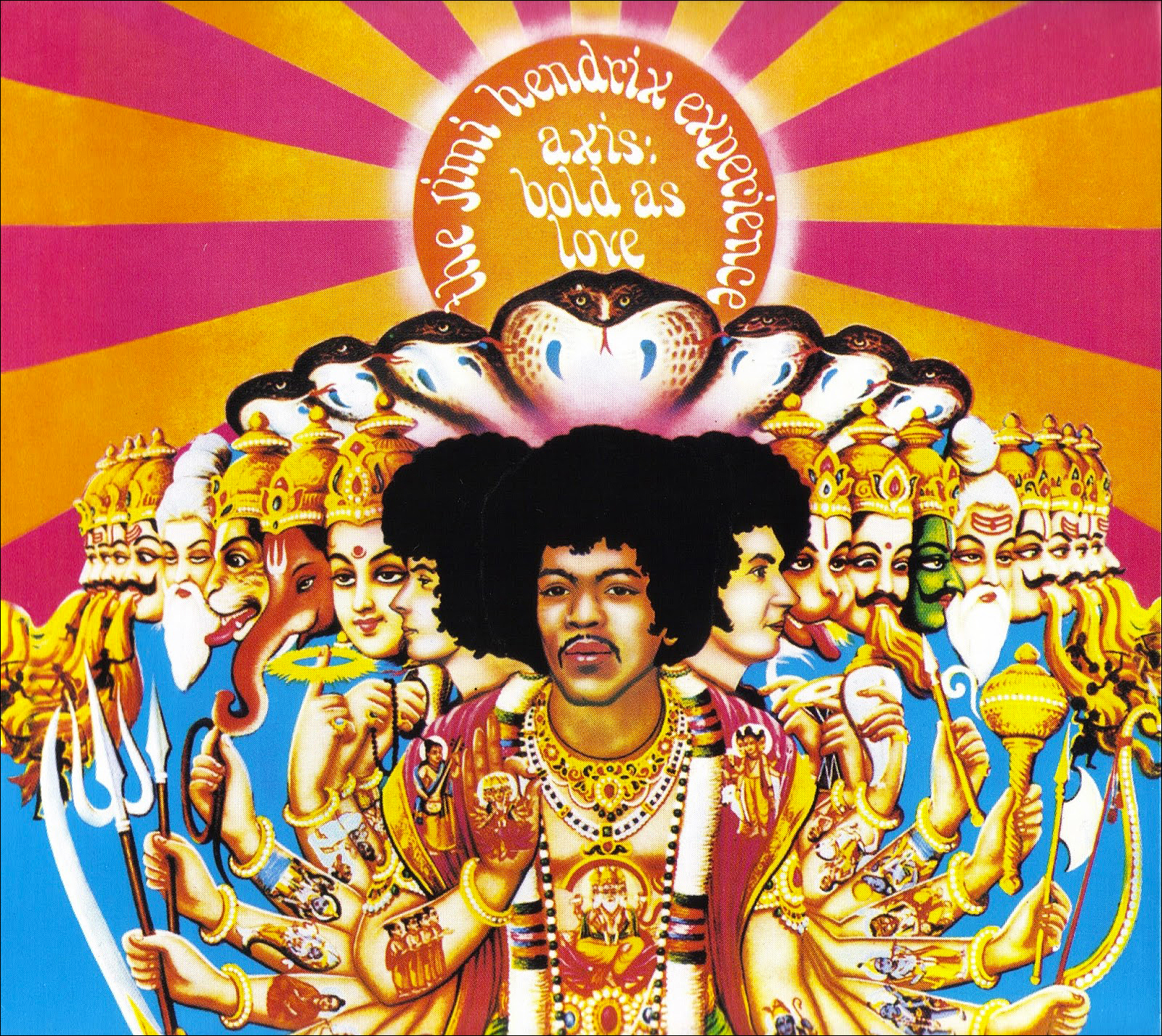
Axis featured psychedelic cover art that depicts Hendrix and the Experience as various avatars of Vishnu, incorporating a painting of them by Roger Law, from a photo-portrait by Karl Ferris. The painting was then superimposed on a copy of a mass-produced religious poster. Hendrix stated that the cover, which cost $5,000 to produce, would have been more appropriate had it highlighted his American Indian heritage. He said, “You got it wrong … I’m not that kind of Indian.” The album was released the album in the UK on December 1, 1967, where it peaked at number five, spending 16 weeks on the charts. In February 1968, Axis: Bold as Love reached number three in the US.
Recording for the Experience’s third and final studio album, Electric Ladyland, began as early as December 20, 1967, at Olympic Studios. Electric Ladyland was released on October 25, and by mid-November it had reached number one in the US, spending two weeks at the top spot.The double LP was Hendrix’s most commercially successful release and his only number one album. It peaked at number six in the UK, spending 12 weeks on the chart. Electric Ladyland included Hendrix’s cover of a Bob Dylan song, “All Along the Watchtower”, which became Hendrix’s highest-selling single and his only US top 40 hit.
In 1989, Noe Goldwasser, the founding editor of Guitar World, described Electric Ladyland as “Hendrix’s masterpiece.” According to author Michael Heatley, “most critics agree” that the album is “the fullest realization of Jimi’s far-reaching ambitions.” In 2004, author Peter Doggett wrote: “For pure experimental genius, melodic flair, conceptual vision and instrumental brilliance, Electric Ladyland remains a prime contender for the status of rock’s greatest album.”
The last performance of the original Experience lineup took place on June 29, 1969, at Barry Fey’s Denver Pop Festival, a three-day event held at Denver’s Mile High Stadium that was marked by police using tear gas to control the audience. The band narrowly escaped from the venue in the back of a rental truck, which was partly crushed by fans who had climbed on top of the vehicle.
By 1969, Hendrix was the world’s highest-paid rock musician. In August, he headlined the Woodstock Music and Art Fair that included many of the most popular bands of the time. Hendrix heard reports that the size of the audience had grown enormously, which concerned him as he did not enjoy performing for large crowds. He was an important draw for the event, and although he accepted substantially less money for the appearance than his usual fee, he was the festival’s highest-paid performer.
Hendrix decided to move his midnight Sunday slot to Monday morning, closing the show. The band took the stage around 8:00 a.m, by which time Hendrix had been awake for more than three days. The audience, which had peaked at an estimated 400,000 people was reduced to 30,000. The festival MC, Chip Monck, introduced the group as “the Jimi Hendrix Experience,” but Hendrix clarified: “We decided to change the whole thing around and call it ‘Gypsy Sun and Rainbows.’ For short, it’s nothin’ but a ‘Band of Gypsys’.”
Hendrix’s performance included a rendition of the US national anthem, “The Star-Spangled Banner,” with copious feedback, distortion, and sustain to imitate the sounds made by rockets and bombs. Contemporary political pundits described his interpretation as a statement against the Vietnam War. Three weeks later Hendrix said: “We’re all Americans … it was like ‘Go America!’… We play it the way the air is in America today. The air is slightly static, see.” Upon leaving the stage, he collapsed from exhaustion.
The Band of Gypsys album was the only official live Hendrix LP made commercially available during his lifetime; several tracks from the Woodstock and Monterey shows were released later that year. The album was released in April 1970 by Capitol Records and it reached the top ten in both the US and the UK.
During the first half of 1970, Hendrix sporadically worked on material for what would have been his next LP. Many of the tracks were posthumously released in 1971 as The Cry of Love. Soon afterward, he and his band took a break from recording and began the Cry of Love tour at the L.A. Forum, performing for 20,000 people.
Several shows were recorded, and they produced some of Hendrix’s most memorable live performances. At one of them, the second Atlanta International Pop Festival, on July 4, he played to the largest American audience of his career. According to authors Scott Schinder and Andy Schwartz, as many as 500,000 people attended the concert. On July 17, they appeared at the New York Pop Festival; Hendrix had again consumed too many drugs before the show, and the set was considered a disaster. The American leg of the tour, which included 32 performances, ended in Honolulu, Hawaii, on August 1, 1970. This would be Hendrix’s final concert appearance in the US.
On September 2, 1970, Hendrix abandoned a performance in Aarhus after three songs, stating: “I’ve been dead a long time.” Four days later, he gave his final concert appearance, at the Isle of Fehmarn Festival in Germany. He was met with booing and jeering from fans in response to his cancellation of a show slated for the end of the previous night’s bill due to torrential rain and risk of electrocution.
On September 16, Hendrix performed in public for the last time during an informal jam at Ronnie Scott’s Jazz Club in Soho with Eric Burdon and his latest band, War. They began by playing a few of their recent hits, and after a brief intermission Hendrix joined them during “Mother Earth” and “Tobacco Road.” His performance was uncharacteristically subdued; he quietly played backing guitar, and refrained from the histrionics that people had come to expect from him. He died less than 48 hours later.
Details concerning Hendrix’s last day and death are highly disputed. He spent much of September 17, 1970, in London with Monika Dannemann, the only witness to his final hours. Dannemann said that she prepared a meal for them at her apartment in the Samarkand Hotel around 11 p.m., when they shared a bottle of wine. She drove him to the residence of an acquaintance at approximately 1:45 a.m., where he remained for about an hour before she picked him up and drove them back to her flat at 3 a.m. She said that they talked until around 7 a.m., when they went to sleep. Dannemann awoke around 11 a.m. and found Hendrix breathing but unconscious and unresponsive. She called for an ambulance at 11:18 a.m., and it arrived nine minutes later. Paramedics transported Hendrix to St Mary Abbots Hospital where Dr. John Bannister pronounced him dead at 12:45 p.m. on September 18.
Coroner Gavin Thurston ordered a post-mortem examination which was performed on September 21 by Professor Robert Donald Teare, a forensic pathologist. Thurston completed the inquest on September 28 and concluded that Hendrix aspirated his own vomit and died of asphyxia while intoxicated with barbiturates. Citing “insufficient evidence of the circumstances,” he declared an open verdict. Dannemann later revealed that Hendrix had taken nine of her prescribed Vesparax sleeping tablets, 18 times the recommended dosage.
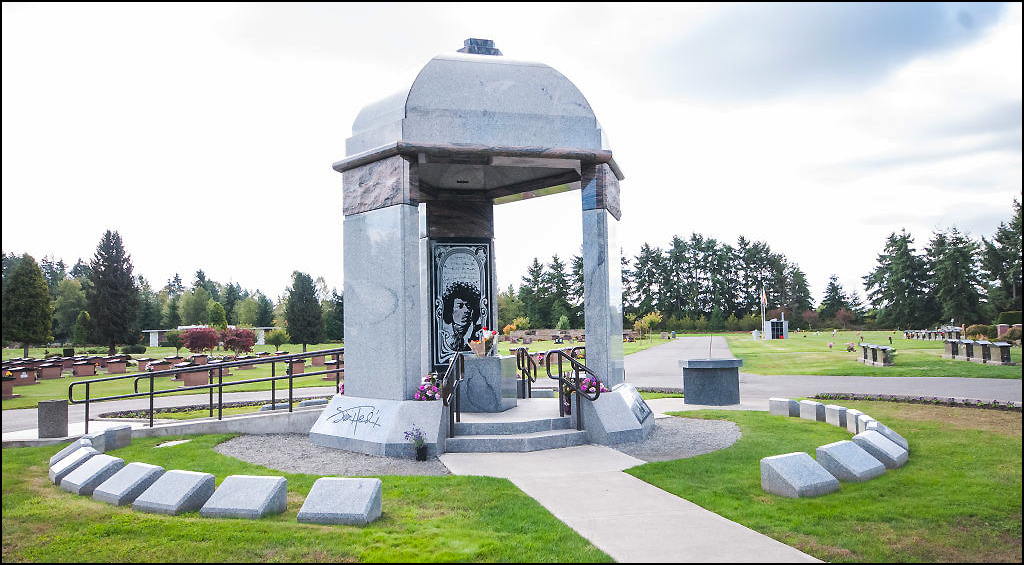
Desmond Henley embalmed Hendrix’s body which was flown to Seattle on September 29. Hendrix’s family and friends held a service at Dunlap Baptist Church in Seattle’s Rainier Valley on Thursday, October 1. His body was interred at Greenwood Cemetery in nearby Renton, the same location of his mother’s grave. ✪


▶️ CLICK HERE TO VIEW
▶️ 1 Hour 46 Minutes 26 Seconds
▶️ 3 Minutes 55 Seconds
▶️ 37 Minutes 20 Seconds
▶️ 29 Minutes 52 Seconds
▶️ 12 Minutes 31 Seconds
