


Wilbur Wright (April 16, 1867 – May 30, 1912)
Orville Wright (August 19, 1871 – January 30, 1948)
✪ Wilbur & Orville Wright were American aviation pioneers generally credited with inventing, building and flying the world’s first successful motor-operated airplane. They made the first controlled, sustained flight of a powered, heavier-than-air aircraft with the Wright Flyer on December 17, 1903, 4 miles south of Kitty Hawk, North Carolina at what is now known as Kill Devil Hills. The brothers were also the first to invent aircraft controls that made fixed-wing powered flight possible.
Wilbur and Orville Wright were two of seven children born to Milton Wright (1828–1917), a clergyman of English and Dutch ancestry; and Susan Catherine Koerner (1831–1889), of German and Swiss ancestry. Milton Wright’s mother, Catherine Reeder, was descended from the progenitor of the Vanderbilt family – one of America’s richest families – and the Huguenot Gano family of New Rochelle, New York. Wilbur was born near Millville, Indiana, in 1867; Orville in Dayton, Ohio, in 1871.
The Wright brothers never married & none of the Wright children had middle names. Instead, their father tried hard to give them distinctive first names.
In elementary school, Orville was given to mischief and was once expelled. In 1878, when the family lived in Cedar Rapids, Iowa, their father brought home a toy helicopter for his two younger sons. The device was based on an invention of French aeronautical pioneer Alphonse Pénaud. Made of paper, bamboo and cork with a rubber band to twirl its rotor, it was about 1 ft (30 cm) long. Wilbur and Orville played with it until it broke, and then built their own. In later years, they pointed to their experience with this toy as the spark of their interest in flying.
Both brothers attended high school, but did not receive their diplomas.
In late 1885 or early 1886 Wilbur was struck in the face by a hockey stick while playing an ice-skating game with friends, resulting in the loss of his front teeth. He had been vigorous and athletic until then, and although his injuries did not appear especially severe, he became withdrawn. He had planned to attend Yale. Instead, he spent the next few years largely housebound. During this time he cared for his mother, who was terminally ill with tuberculosis, read extensively in his family’s library and ably assisted his father.
Orville dropped out of high school after his junior year to start a printing business in 1889, having designed and built his own printing press with Wilbur’s help. Wilbur joined the print shop, and in March the brothers launched a weekly newspaper, the West Side News. In April 1890 they converted the paper to a daily, The Evening Item, but it lasted only four months. They then focused on commercial printing.
In December 1892 the brothers opened a repair and sales shop (the Wright Cycle Exchange, later the Wright Cycle Company) and in 1896 began manufacturing their own brand of bicycles. They used this business endeavor to fund their growing interest in flight.
The Wright brothers always presented a unified image to the public, sharing equally in the credit for their invention.
On the basis of observation, Wilbur concluded that birds changed the angle of the ends of their wings to make their bodies roll right or left. The brothers decided this would also be a good way for a flying machine to turn – to “bank” or “lean” into the turn just like a bird – and just like a person riding a bicycle, an experience with which they were thoroughly familiar. Equally important, they hoped this method would enable recovery when the wind tilted the machine to one side (lateral balance). They puzzled over how to achieve the same effect with man-made wings and eventually discovered wing-warping when Wilbur idly twisted a long inner-tube box at the bicycle shop.
The Wright brothers always wanted the pilot to have absolute control. For that reason, their early designs made no concessions toward built-in stability (such as dihedral wings).
On July 27, 1899, the brothers put wing warping to the test by building and flying a biplane kite with a 5-foot (1.5 m) wingspan, and a curved wing with a 1 foot (0.30 m) chord. In 1900 the brothers went to Kitty Hawk, North Carolina, to begin their manned gliding experiments. Kitty Hawk, although remote, was closer to Dayton than other places which were considered including California and Florida.
According to some Wright biographers, Wilbur probably did all the gliding until 1902, perhaps to exercise his authority as older brother and protect Orville from potential injury so he would not have to explain to their father, Bishop Wright, how Orville got hurt.
The brothers flew the glider for only a few days in the early autumn of 1900 at Kitty Hawk. In the first tests, probably on October 3, Wilbur was aboard while the glider flew as a kite not far above the ground with men below holding tether ropes
As planned, the pilot would lay flat on the lower wing to reduce aerodynamic drag. As a glide ended, the pilot was supposed to lower himself to a vertical position through an opening in the wing and land on his feet with his arms wrapped over the framework. Within a few glides, however, they discovered the pilot could remain prone on the wing, headfirst, without undue danger when landing. They made all their flights in that position for the next five years.
Before returning to Kitty Hawk in the summer of 1901, Wilbur published two articles, “The Angle of Incidence” in The Aeronautical Journal, and “The Horizontal Position During Gliding Flight” in Illustrierte Aeronautische Mitteilungen. The brothers brought all of the material they thought was needed to be self-sufficient at Kitty Hawk.
Hoping to improve lift, they built their 1901 glider with a much larger wing area and made dozens of flights in July and August for distances of 50 to 400 ft (15 to 122 m). The glider stalled a few times, but the parachute effect of the forward elevator allowed Wilbur to make a safe flat landing, instead of a nose-dive.
Wind tunnel tests, made from October to December 1901, were described by biographer Fred Howard as “the most crucial and fruitful aeronautical experiments ever conducted in so short a time with so few materials and at so little expense.” In their September 1908 Century Magazine article, the Wrights explained, “The calculations on which all flying machines had been based were unreliable, and … every experiment was simply groping in the dark … We cast it all aside and decided to rely entirely upon our own investigations.”
In short, the Wrights discovered the true purpose of the movable vertical rudder. Its role was not to change the direction of flight, as a rudder does in sailing; but rather, aim or align the aircraft correctly during banking turns and when leveling off from turns and wind disturbances.
Thus did three-axis control evolve: wing-warping for roll (lateral motion), forward elevator for pitch (up and down) and rear rudder for yaw (side to side). On March 23, 1903, the Wrights applied for their famous patent for a “Flying Machine.” Peter Jakab of the Smithsonian asserts that perfection of the 1902 glider essentially represents invention of the airplane.
In 1903 the brothers built the powered Wright Flyer, using their preferred material for construction, spruce. They also designed and carved their own wooden propellers, and had a purpose-built gasoline engine fabricated in their bicycle shop. They thought propeller design would be a simple matter and intended to adapt data from shipbuilding. However, their library research disclosed no established formulae for either marine or air propellers, and they found themselves with no sure starting point.
The Wright brothers wrote their 1903 patent application themselves, but it was originally rejected. In January 1904, they hired Ohio patent attorney Henry Toulmin, and on May 22, 1906, they were granted U.S. Patent 821393 for “new and useful Improvements in Flying Machines”
To keep the weight down the engine block was cast from aluminum, a rare practice at the time. The Wright/Taylor engine had a primitive version of a carburetor, and had no fuel pump. Gasoline was gravity-fed from the fuel tank mounted on a wing strut into a chamber next to the cylinders where it was mixed with air: The fuel-air mixture was then vaporized by heat from the crankcase, forcing it into the cylinders.
The Flyer cost less than a thousand dollarsand had a wingspan of 40.3 ft, weighed 605 lb and had a 12 horsepower (8.9 kW), 180 lb (82 kg) engine.
On December 14, 1903, Orville stalled after takeoff & caused minor damage to the Flyer. Following repairs, the Wrights finally took to the air on December 17, 1903, making two flights each from level ground into a freezing headwind gusting to 27 miles per hour (43 km/h). The first flight, by Orville at 10:35 am, of 120 feet (37 m) in 12 seconds, at a speed of only 6.8 miles per hour (10.9 km/h) over the ground, was recorded in a famous photograph. The next two flights covered approximately 175 and 200 feet (53 and 61 m) made by Wilbur and Orville respectively at an altitude about 10 feet (3.0 m) above the ground. The following is Orville Wright’s account of the final flight of the day:
Wilbur started the fourth and last flight at just about 12 o’clock. The first few hundred feet were up and down, as before, but by the time three hundred ft had been covered, the machine was under much better control. The course for the next four or five hundred feet had but little undulation. However, when out about eight hundred feet the machine began pitching again, and, in one of its darts downward, struck the ground. The distance over the ground was measured to be 852 feet; the time of the flight was 59 seconds. The frame supporting the front rudder was badly broken, but the main part of the machine was not injured at all. We estimated that the machine could be put in condition for flight again in about a day or two.
Five people witnessed these flights: Adam Etheridge, John T. Daniels (who snapped the famous “first flight” photo using Orville’s pre-positioned camera), and Will Dough, all of the U.S. government coastal lifesaving crew; area businessman W.C. Brinkley; and Johnny Moore and a teenaged boy who lived in the area. After the men hauled the Flyer back from its fourth flight, a powerful gust of wind flipped it over several times despite the crew’s attempt to hold it down. Severely damaged, the Wright Flyer never flew again.
Years later Orville restored it, lending it to several U.S. locations for display, then to the Science Museum in London, before it was permanently installed its current residence in 1948, the Smithsonian Institution.
▶️ 2 Minutes 32 Seconds
The Wrights sent a telegram about the flights to their father, requesting that he “inform press” however, the Dayton Journal refused to publish the story, saying the flights were too short to be of any importance.The Wrights issued their own factual statement to the press in January. Nevertheless, the flights did not create public excitement – if people even knew about them – and the news soon faded.
In 1904 the Wrights built the Wright Flyer II. They decided to avoid the expense of travel and bringing supplies to the Outer Banks and set up an airfield at Huffman Prairie, a cow pasture eight miles northeast of Dayton. The Wrights referred to the airfield as Simms Station in their flying school brochure.
They invited reporters to their first flight attempt of the year on May 23, on the condition that no photographs be taken. Engine troubles and slack winds prevented any flying and they could only manage a very short hop a few days later with fewer reporters present. After their poor local showing, newspapers virtually ignored them for the next year and a half. However, the Wrights were glad to be free from the distraction of press reporters.
On September 20, 1904, Wilbur flew the first complete circle in history by a manned heavier-than-air powered machine, covering 4,080 feet in about a minute and a half. Their two best flights were November 9 by Wilbur and December 1 by Orville, each exceeding five minutes and covering nearly three miles in almost four circles. By the end of the year the brothers had accumulated about 50 minutes in the air in 105 flights over the rather soggy 85 acres pasture.
Wilbur made the last and longest flight, 24.5 miles (39.4 km) in 38 minutes and 3 seconds, ending with a safe landing when the fuel ran out. The flight was seen by a number of people, including several invited friends, their father Milton and neighboring farmers.
In years to come, Dayton newspapers would proudly celebrate the hometown Wright brothers as national heroes, but the local reporters somehow missed one of the most important stories in history as it was happening only a few miles from their doorstep.
The brothers contacted the United States Department of War, the British War Office and a French syndicate on October 19, 1905. The U.S. Board of Ordnance and Fortification replied on October 24, 1905, specifying they would take no further action “until a machine is produced which by actual operation is shown to be able to produce horizontal flight and to carry an operator.” In May 1908, Orville wrote:
A practical flyer having been finally realized, we spent the years 1906 and 1907 in constructing new machines and in business negotiations. It was not till May of this year that experiments were resumed at Kill Devil Hill, North Carolina …”
With further input from the Wrights, the U.S. Army Signal Corps issued Specification 486 in December 1907, inviting bids for construction of a flying machine under military contract. The Wrights submitted their bid in January & and were awarded a contract on February 8, 1908.
On May 25, 1910, back at Huffman Prairie, Orville piloted two unique flights. First, he took off on a six-minute flight with Wilbur as his passenger, the only time the Wright brothers ever flew together. They received permission from their father to make the flight. They had always promised Milton they would never fly together to avoid the chance of a double tragedy and to ensure one brother would remain to continue their experiments. Next, Orville took his 82-year-old father on a nearly 7-minute flight, the only powered aerial excursion of Milton Wright’s life. The aircraft rose to about 350 feet (107 m) while the elderly Wright called to his son, “Higher, Orville, higher!”
The Wright Company was incorporated on November 22, 1909. The brothers sold their patents to the company for $100,000 and also received one-third of the shares in a million dollar stock issue and a 10 percent royalty on every airplane sold. With Wilbur as president and Orville as vice president, the company set up a factory in Dayton and a flying school / test flight field at Huffman Prairie; the headquarters office was located in New York City.
The Wright Company transported the first known commercial air cargo on November 7, 1910, by flying two bolts of dress silk 65 miles (105 km) from Dayton to Columbus, Ohio, for the Morehouse-Martens Department Store, which paid a $5,000 fee. Company pilot Phil Parmelee made the flight – which was more an exercise in advertising than a simple delivery – in an hour and six minutes with the cargo strapped in the passenger’s seat. The silk was cut into small pieces and sold as souvenirs.
Both Wilbur and Orville were lifelong bachelors. Wilbur once quipped that he ‘did not have time for both a wife and an airplane.’ The 1909 short silent film Wilbur Wright und seine Flugmaschine (which translates to Wilbur Wright and his Flying Machine) is considered to be the first use of motion picture aerial photography as filmed from a heavier-than-air aircraft. Following a brief training flight he gave to a German pilot in Berlin in June 1911, Wilbur never flew again. He gradually became occupied with business matters for the Wright Company
Wilbur became seriously ill on a business trip to Boston in April 1912. A type of illness sometimes attributed to eating bad shellfish. After returning to Dayton in early May 1912, worn down in mind and body, he fell ill again and was diagnosed with typhoid fever. He lingered on, his symptoms relapsing and remitting for many days. Wilbur died, at age 45, at the Wright family home on May 30. His father wrote about Wilbur in his diary: “A short life, full of consequences. An unfailing intellect, imperturbable temper, great self-reliance and as great modesty, seeing the right clearly, pursuing it steadfastly, he lived and died.”
Orville succeeded to the presidency of the Wright Company upon Wilbur’s death. Orville made his last flight as a pilot in 1918 in a 1911 Model B. He retired from business and became an elder statesman of aviation, serving on various official boards and committees, including the National Advisory Committee for Aeronautics (NACA) and the Aeronautical Chamber of Commerce (ACCA)
On April 19, 1944, the second production Lockheed Constellation, piloted by Howard Hughes and TWA president Jack Frye, flew from Burbank, California to Washington, DC in 6 hours and 57 minutes (2300 mi, 330.9 mph). On the return trip, the airliner stopped at Wright Field to give Orville Wright his last airplane flight, more than 40 years after his historic first flight. He may even have briefly handled the controls. He commented that the wingspan of the Constellation was longer than the distance of his first flight.
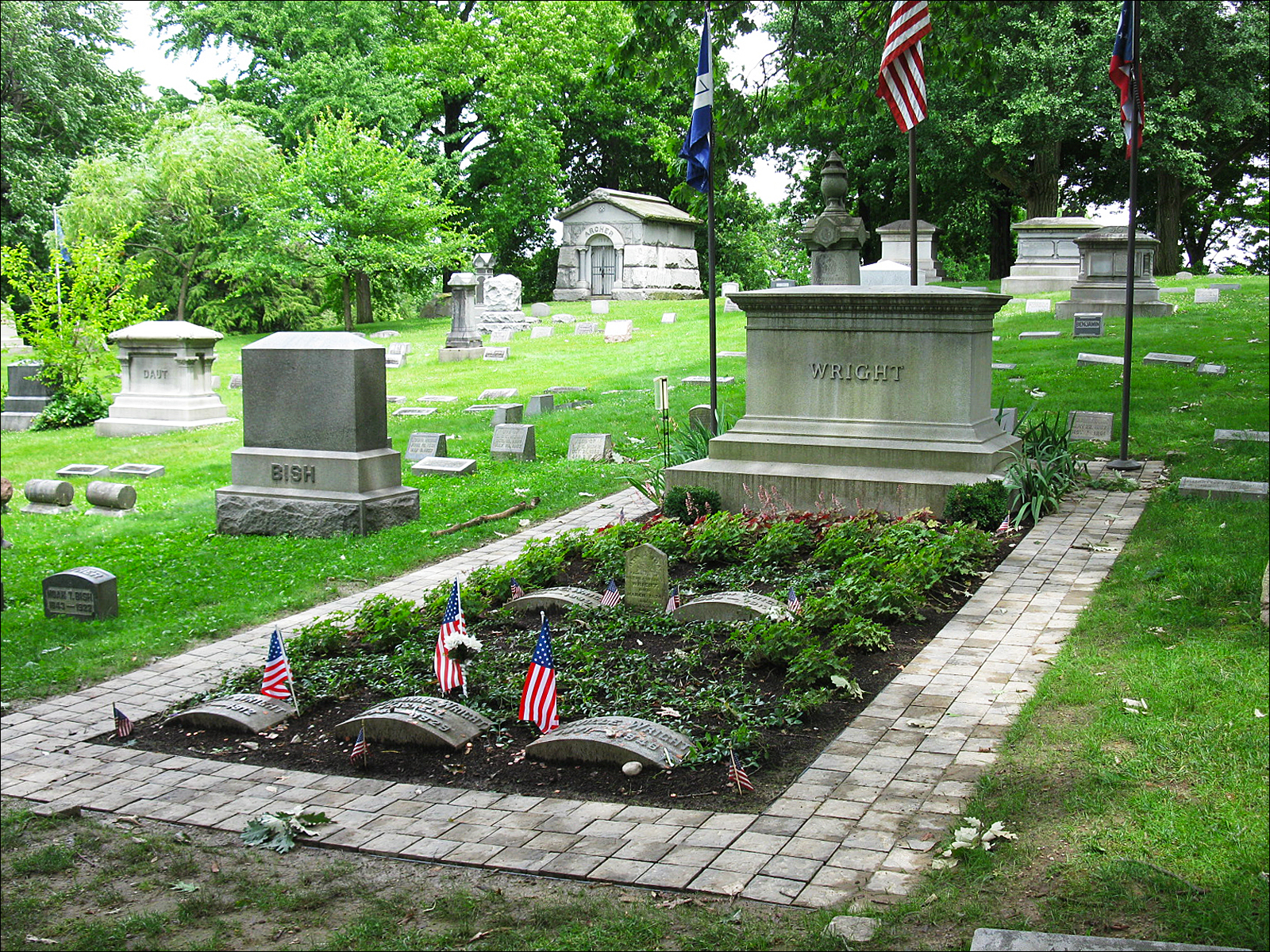
Orville died at age 76 on January 30, 1948, over 35 years after his brother, following his second heart attack, having lived from the horse-and-buggy age to the dawn of supersonic flight. Both brothers are buried in the family plot at Woodland Cemetery in Dayton, Ohio. John T. Daniels, the Coast Guardsman who took their famous first flight photo, died the day after Orville. ✪


▶️ CLICK HERE TO VIEW
▶️ 1 Hour 18 Minutes 10 Seconds
▶️ 10 Minutes 52 Seconds ⭐️ Gary Brown
▶️ 6 Minutes 43 Seconds ⭐️ louisiana_mom
▶️ 11 Minutes 33 Seconds ⭐️ Michal Brower
▶️ 2 Minutes 51 Seconds
▶️ 58 Seconds
