


Charles Monroe “Sparky“ Schulz: November 26, 1922 – February 12, 2000
✪ Charles M. Schulz was an American cartoonist and the creator of the comic strip Peanuts. He is widely regarded as one of the most influential & successful cartoonists in history and cited by many cartoonists as their major creative influence; including Jim Davis, Murray Ball, Bill Watterson, Matt Groening and Dav Pilkey.
Watterson states:
“Peanuts pretty much defines the modern comic strip, so even now it’s hard to see it with fresh eyes. The clean, minimalist drawings, the sarcastic humor, the unflinching emotional honesty, the inner thoughts of a household pet, the serious treatment of children, the wild fantasies, the merchandising on an enormous scale – in countless ways, Schulz blazed the wide trail that most every cartoonist since has tried to follow.”
Charles Monroe Schulz was born in Minneapolis, Minnesota on November 26, 1922 and grew up in Saint Paul. He was the only child of Carl Schulz and Dena Halverson and was of German and Norwegian descent. His uncle called him “Sparky” after the horse Spark Plug in Billy DeBeck’s comic strip Barney Google, which Schulz enjoyed reading as a child.
From an early age, Schulz loved drawing and sometimes drew his family dog, Spike, who ate unusual things, such as pins and tacks. In 1937, Schulz drew a picture of Spike and sent it to Ripley’s Believe It or Not! His drawing appeared in Robert Ripley’s syndicated panel, captioned, “A hunting dog that eats pins, tacks, and razor blades is owned by C. F. Schulz, St. Paul, Minn.” and “Drawn by ‘Sparky'” (C.F. was his Charles’ father, Carl Fred Schulz)
Schulz attended Richards Gordon Elementary School in Saint Paul, where he skipped two half-grades. He became a shy & timid teenager, perhaps as a result of being the youngest in his class at Central High School. One well-known episode in his high school life was the rejection of his drawings by his high school yearbook. A five foot tall statue of Snoopy would be placed in the school’s main office 60 years later.
In February 1943, Schulz’s mother Dena died after a long illness. At the time of her death, he had only recently been made aware that she suffered from cancer. Schulz had by all accounts been very close to his mother and her death had a significant impact on him.
Around the same time, Schulz was drafted into the United States Army. He served as a staff sergeant with the 20th Armored Division in Europe during World War II as a squad leader on a .50 caliber machine gun team. His unit saw combat only at the very end of the war. Schulz said he had only one opportunity to fire his machine gun but forgot to load it and that the German soldier he could have fired at willingly surrendered. Years later, Schulz proudly spoke of his wartime service. For being under fire he did receive the Combat Infantry Badge, of which he was very proud.
In late 1945, Schulz returned to Minnesota, where he did lettering for a Roman Catholic comic magazine, Timeless Topix. Before he was drafted, Schulz had taken a correspondence course from the school Art Instruction, Inc., and in July 1946 took a job at the school, where he reviewed and graded students’ work. He worked at the school for several years while he was developing his career as a comic creator.
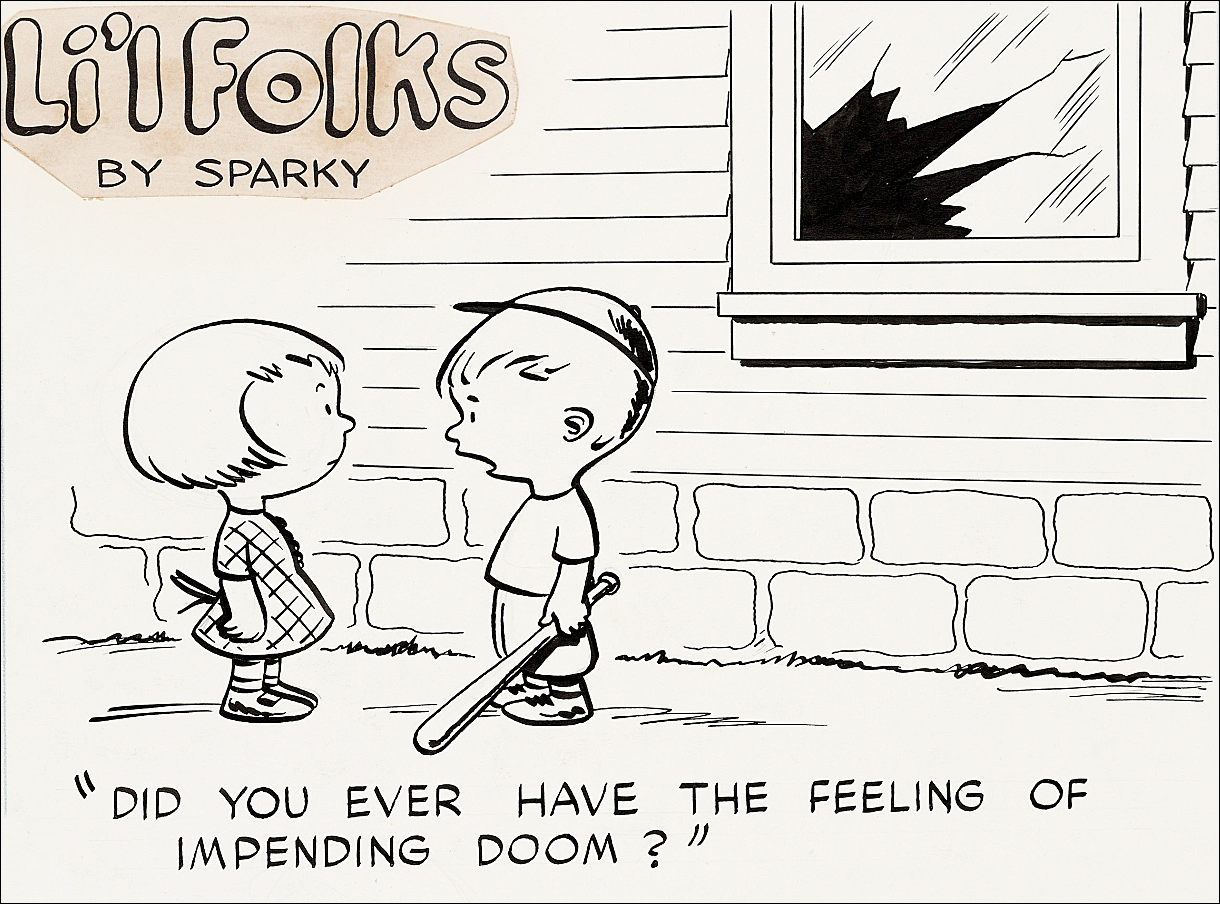
Schulz’s first group of regular cartoons was a weekly series of one-panel jokes called Li’l Folks & was published from June 1947 to January 1950 in the St. Paul Pioneer Press, with Schulz usually doing four one-panel drawings per issue. It was in Li’l Folks that Schulz first used the name Charlie Brown for a character, although he applied the name in four gags to three different boys as well as one buried in sand. The series also had a dog that looked much like Snoopy. In May 1948, Schulz sold his first one-panel drawing to The Saturday Evening Post; and within the next two years, a total of 17 untitled drawings by Schulz were published in the Post.
Around the same time, he tried to syndicate Li’l Folks through the Newspaper Enterprise Association. Schulz would have been an independent contractor for the syndicate, unheard of in the 1940s, but the deal fell through. Li’l Folks was dropped.
Later that year, Schulz approached United Feature Syndicate with the one-panel series Li’l Folks and the syndicate became interested. By that time Schulz had also developed a comic strip, usually using four panels rather than one; and to Schulz’s delight, the syndicate preferred that version. But to his consternation, the syndicate changed the title for Schulz’s strip to avoid legal conflicts and selected a new name, Peanuts.
Peanuts made its first appearance on October 2, 1950, in seven newspapers. The weekly Sunday page debuted on January 6, 1952. After a slow start, Peanuts eventually became one of the most popular comic strips of all time, as well as one of the most influential. Schulz also had a short-lived sports-oriented comic strip, It’s Only a Game (1957–59), but he abandoned it after the success of Peanuts.
At its height, Peanuts was published daily in 2,600 papers in 75 countries and in 21 languages. Schulz drew 17,897 published Peanuts strips over the course of fifty years. The strips, plus merchandise and product endorsements, produced revenues of more than $1 billion per year, with Schulz routinely earning an estimated $30 million to $40 million annually. During the strip’s run, Schulz took only one vacation; a five-week break in late 1997 to celebrate his 75th birthday. Reruns of the strip ran during his vacation, the only time that occurred during Schulz’s life.
Charlie Brown, the principal character of Peanuts, was named after a co-worker at Art Instruction Inc. Schulz drew much from his own life, some examples being:
- Like Charlie Brown’s parents, Schulz’s father was a barber and his mother a housewife.
- Like Charlie Brown, Schulz had often felt shy and withdrawn. In an interview with Charlie Rose in May 1997, Schulz observed, “I suppose there’s a melancholy feeling in a lot of cartoonists, because cartooning, like all other humor, comes from bad things happening.”
- Schulz reportedly had an intelligent dog when he was a boy. Although this dog was a pointer, not a beagle like Snoopy, family photos confirm a certain physical resemblance.
- References to Snoopy’s brother Spike living outside of Needles, California, were influenced by the few years (1928–30) the Schulz family lived there. They moved to Needles to join other family members who had relocated from Minnesota to tend to an ill cousin.
- Schulz’s inspiration for Charlie Brown’s unrequited love for the Little Red-Haired Girl was Donna Mae Johnson, an Art Instruction Inc. accountant with whom he fell in love. When Schulz finally proposed to her in June 1950, shortly after he had made his first contract with his syndicate, she turned him down and married another man.
- Linus and Shermy were named for his good friends Linus Maurer and Sherman Plepler, respectively.
- Peppermint Patty was inspired by Patricia Swanson, one of his cousins on his mother’s side. Schulz devised the character’s name when he saw peppermint candies in his house.
The Charles M. Schulz Museum credits Milton Caniff (Terry and the Pirates) and Bill Mauldin as key influences on Schulz’s work.
However according to his biographer Rheta Grimsley Johnson:
It would be impossible to narrow down three or two or even one direct influence on [Schulz’s] personal drawing style. The uniqueness of “Peanuts” has set it apart for years … That one-of-a-kind quality permeates every aspect of the strip and very clearly extends to the drawing. It is purely his with no clear forerunners and no subsequent pretenders.
In April 1951, Schulz married Joyce Halverson (no relation to Schulz’s mother Dena Halverson Schulz) and Schulz adopted Halverson’s daughter, Meredith Hodges. Later the same year, they moved to Colorado Springs, Colorado. Their son, Monte, was born in February 1952, and three more children were born later, in Minnesota.
Schulz and his family returned to Minneapolis and stayed until 1958. They then moved to Sebastopol, California, where Schulz built his first studio. (Until then, he had worked at home or in a small rented office room.)
Schulz’s father died while visiting him in 1966, the same year Schulz’s Sebastopol studio burned down. By 1969, Schulz had moved to Santa Rosa, California, where he lived and worked until his death.
By Thanksgiving of 1970, Schulz’s marriage was in trouble. He was having an affair with a 25-year-old woman named Tracey Claudius and the Schulzes eventually divorced in 1972. In September 1973, Schulz married Jean Forsyth Clyde, whom he had first met when she brought her daughter to his hockey rink. They remained married for 27 years until Schulz’s death in 2000.
On May 8, 1988, two gunmen in ski masks entered the Schulzes’ home through an unlocked door, planning to kidnap Jean, but the attempt failed when Charles’ daughter Jill drove up to the house, prompting the would-be kidnappers to flee.
Schulz had a long association with ice sports, and both figure skating and ice hockey which featured prominently in his cartoons. In Santa Rosa, he owned the Redwood Empire Ice Arena, which opened in 1969 and featured a snack bar called “The Warm Puppy.” Schulz also was very active in senior ice-hockey tournaments. In 1975, he formed Snoopy’s Senior World Hockey Tournament at his Redwood Empire Ice Arena, and in 1981 was awarded the Lester Patrick Trophy for outstanding service to the sport of hockey in the United States. Schulz also enjoyed golf and was a member of the Santa Rosa Golf and Country Club from 1959 to 2000. Schulz was also inducted into the United States Figure Skating Hall of Fame in 2007.
A proponent of crewed spaceflight, Schulz was honored with the naming of Apollo 10 command module Charlie Brown and lunar module Snoopy, which launched on May 18, 1969. The Silver Snoopy Award is given to NASA employees and contractors for outstanding achievements related to human flight safety or mission successes. The award certificate states that it is in appreciation for “professionalism, dedication and outstanding support that greatly enhanced space flight safety and mission success.”
In addition to comics, Schulz was extremely interested in art in general; his favorite artist in his later years was Andrew Wyeth. As a young adult, Schulz also developed a passion for classical music. Although the piano-playing character Schroeder in Peanuts adored Beethoven, Schulz’s personal favorite composer was Brahms.
According to a 2015 “spiritual biography,” Schulz’s faith was complex and personal. He often touched on religious themes in his work, including in the classic television cartoon A Charlie Brown Christmas (1965), which features Linus quoting Luke 2:8–14 in the King James Version of the Bible to explain “what Christmas is all about.” In interviews Schulz said that Linus represented his spiritual side, and the spiritual biography points out a much wider array of religious references.
In 2013, Schulz’s widow said:
I think that he was a deeply thoughtful and spiritual man. Sparky was not the sort of person who would say “oh that’s God’s will” or “God will take care of it.” I think to him that was an easy statement, and he thought that God was much more complicated.
When he came back from the army he was very lonely. His mother had died and he was invited to church by a pastor who had prepared his mother’s service from the Church of God. Sparky’s father was worried about him and was talking to the pastor and so the pastor invited Sparky to come to church. So Sparky went to church, joined the youth group and for a good 4–5 years he went to Bible study and went to church 3 times a week (2 Bible studies, 1 service). He said he had read the Bible through three times and taught Sunday school. He was always looking for what those passages REALLY might have meant. Some of his discussions with priests and ministers were so interesting because he wanted to find out what these people (who he thought were more educated than he) thought.
When he taught Sunday school, he would never tell people what to believe. God was very important to him, but in a very deep way, in a very mysterious way.
In July 1981, Schulz underwent heart bypass surgery. During his hospital stay, President Ronald Reagan phoned to wish him a quick recovery.
In the 1980s, Schulz complained that “sometimes my hand shakes so much I have to hold my wrist to draw.” This led to an erroneous impression that Schulz had Parkinson’s disease. According to a letter from his physician, placed in the Archives of the Charles M. Schulz Museum by his widow, Schulz had essential tremor, a condition alleviated by beta blockers. Schulz’s insistence on writing and drawing the strip by himself resulted in noticeably shakier lines over time.
In November of 1999, Schulz suffered several small strokes and a blocked aorta, and he was later diagnosed with colon cancer that had metastasized. Because of the chemotherapy and because he could not see clearly, he announced his retirement on December 14, 1999.
Schulz was asked if, in his final Peanuts strip, Charlie Brown would finally get to kick the football after so many decades (one of the many recurring themes in Peanuts in Peanuts was Charlie Brown’s attempts to kick a football while Lucy was holding it, only to have Lucy pull it back at the last moment, causing him to fall on his back). His response, “Oh, no. Definitely not. I couldn’t have Charlie Brown kick that football; that would be a terrible disservice to him after nearly half a century.” However holding back tears in a December 1999 interview, Schulz recounted the moment when he signed his final strip, saying, “All of a sudden I thought, ‘You know, that poor, poor kid, he never even got to kick the football. What a dirty trick—he never had a chance to kick the football.'”

On February 12, 2000, Schulz died in his sleep of a heart attack at his home in Santa Rosa, California at the age of 77. He was also suffering from advanced colorectal cancer. The last original Peanuts strip was published the following day. He had predicted that the strip would outlive him because the strips were usually drawn weeks before their publication. Schulz was buried at Pleasant Hills Cemetery in Sebastopol, California.
The Charles M. Schulz Museum and Research Center in Santa Rosa opened in August 2002, two blocks away from his former studio, celebrating his life’s work and the art of cartooning. A bronze statue of Charlie Brown and Snoopy stands in Depot Park in downtown Santa Rosa.
In 2006, Forbes magazine ranked Schulz as the third-highest-earning deceased celebrity, earning $35 million in the 2005. In 2009, he was still ranked sixth. According to Tod Benoit, Schulz’s income during his lifetime totaled more than $1.1 billion.
On November 26, 2022, over 75 syndicated cartoonists throughout the United States honored Schulz on what would have been his 100th birthday. ✪


▶️ CLICK HERE TO VIEW
▶️ 11 Minutes 37 Seconds ⭐️ Gary Brown
▶️ 11 Minutes 37 Seconds ⭐️ Tread Seven
▶️ 9 Minutes 53 Seconds ⭐️ Michal Brower
▶️ 49 Seconds
▶️ 1 Minute 44 Seconds
