




Alexis Charles Henri Clérel de Tocqueville: July 29, 1805–April 16, 1859
✪ Alexis Charles Henri Clérel, comte de Tocqueville, was a French aristocrat, diplomat, sociologist, political scientist, political philosopher and historian. He is best known for his works Democracy in America (appearing in two volumes, 1835 and 1840) and The Old Regime and the Revolution (1856). In both, he analyzed the living standards and social conditions of individuals as well as their relationship to the market and state in Western societies. Democracy in America was published after Tocqueville’s travels to the United States and is today considered an important early work of sociology and western political science.
Tocqueville was a classical liberal who advocated for parliamentary forms of government and was skeptical of the extremes of majoritarianism. Tocqueville was very active in French politics, first under the July Monarchy (1830–1848) and then during the Second Republic (1849–1851) which succeeded the February 1848 Revolution. Tocqueville argued the primary purpose of the French Revolution was to continue the process of modernizing and centralizing the French state which had begun under King Louis XIV. He believed the failure of the Revolution came from the inexperience of the deputies who were too wedded to abstract Enlightenment ideals.
During his time in Parliament, he was first a member of the centre-left before moving to the centre-right. The complex and restless nature of his liberalism has led to many contrasting interpretations of his writings and admirers across the political spectrum.
Tocqueville came from an old aristocratic Norman family. He was the great-grandson of the statesman Malesherbes, who was guillotined in 1793. His parents, Hervé Louis François Jean Bonaventure Clérel, Count of Tocqueville, an officer of the Constitutional Guard of King Louis XVI; and Louise Madeleine Le Peletier de Rosanbo narrowly escaped the guillotine due to the fall of Maximilien Robespierre in 1794. Tocqueville attended the Lycée Fabert in Metz.
Tocqueville, who despised the July Monarchy (1830–1848), began his political career in 1839. From 1839 to 1851, he served as member of the lower house of parliament for the Manche department. He sat on the centre-left defending abolitionist views and upheld free trade while supporting the French colonization of Algeria. In 1842, he was elected a member of the American Philosophical Society.
Tocqueville was also elected general counsellor of Manche in 1842. In 1852; he resigned as he refused to pledge allegiance to the Second Empire. According to one account, Tocqueville’s political position became untenable during this time in the sense that he was mistrusted by both the left and right sides and was looking for an excuse to leave France.
In 1831, Tocqueville obtained from the July Monarchy a mission to examine prisons and penitentiaries in the United States and proceeded there with his lifelong friend Gustave de Beaumont. While he did visit some prisons, Tocqueville traveled widely in the United States taking extensive notes on his observations and reflections. He returned within nine months to publish a report. During this trip, Tocqueville made a side trip to Montreal and Quebec City in Lower Canada from mid-August to early September 1831.
In Democracy in America, published in 1835, Tocqueville wrote of the New World and its burgeoning democratic order. Observing from the perspective of a detached, foreign, social scientist, Tocqueville wrote of his travels through the United States in the early 19th century when the Market Revolution, Western Expansion and Jacksonian Democracy were radically transforming the fabric of American life.
According to political scientist Joshua Kaplan, one purpose of writing Democracy in America was to help the people of France get a better understanding of their position between a fading aristocratic order and an emerging democratic order to help them sort out their own political confusions. Tocqueville viewed democracy as a political enterprise which balanced both liberty and equality; concern for the individual as well as for the society.
Tocqueville was an ardent supporter of liberty. “I have a passionate love for liberty, law, and respect for rights,” he wrote. “I am neither of the revolutionary party nor of the conservative. […] because Liberty is my foremost passion.”
He also wrote of “Political Consequences of the Social State of the Anglo-Americans” by saying:
“But one also finds in the human heart a depraved taste for equality, which impels the weak to want to bring the strong down to their level, and which reduces men to preferring equality in servitude to inequality in freedom.”
His view on government reflected his belief in liberty and the need for individuals to be able to act freely while respecting the rights of others. Of centralized government, he wrote that it “excels only in prevention, not action.”
Tocqueville commented on equality by saying:
“Furthermore, when citizens are all almost equal, it becomes difficult for them to defend their independence against the aggressions of power. As none of them is strong enough to fight alone with advantage, the only guarantee of liberty is for everyone to combine forces. But such a combination is not always in evidence.”
Tocqueville’s main interest was to analyze the functioning of political society and various forms of political associations. Tocqueville thought that through associating for mutual purpose, both in public and private, Americans were able to overcome their selfish desires, thus creating both a self-conscious and politically active society; as well as a vibrant civil society functioning according to both political and civil laws.
When individualism was a positive force and prompted people to work together for common purposes, it was seen as “self-interest properly understood.” Then it worked to counterbalance the dangers of the tyranny of the majority since people could “take control over their own lives” without unnecessary government aid or interference.
Tocqueville warned that modern democracy could easily give rise to new forms of tyranny because radical equality could lead to the materialism of an expanding bourgeoisie and to the selfishness of the individual:
“In such conditions, we might become so enamored with ‘a relaxed love of present enjoyments’ that we lose interest in the future of our descendants… and meekly allow ourselves to be led in ignorance by a despotic force all the more powerful because it does not resemble one.”
In contrast, a despotism under democracy could see “a multitude of men,” uniformly alike, equal, “constantly circling for petty pleasures,” unaware of fellow citizens and subject to the will of a powerful state which exerted an “immense controlling power.”
Tocqueville tried to understand why the United States was so different from Europe which at the time, was in the last throes of aristocratic orders. In contrast to the aristocratic ethic, the United States was a society where hard work and wealth creation were the predominant ethics. Where the common man could enjoy a level of dignity and comfort which was unprecedented, where commoners never deferred to elites. An economic environment where extreme individualism and market capitalism had taken root to an extraordinary degree.
Tocqueville writes: “Among a democratic people, where there is no hereditary wealth, every man works to earn a living. […] Labor is held in honor; the prejudice is not against but in its favor.” Tocqueville asserted that the values that had triumphed in the Northern United States and were expanding in the South had begun to suffocate and replace the old-world ethics and social arrangements.
As Tocqueville understood it, this rapidly democratizing society had a population devoted to “middling” values which sought to amass vast fortunes through hard work. In Tocqueville’s mind, this explained why the United States was so different from Europe. In Europe, he claimed, nobody cared about making money. The lower classes had no hope of gaining more than minimal wealth while the upper classes found it crass, vulgar and unbecoming of their sort to care about something as unseemly as money. Many were virtually guaranteed their wealth thru inheritance and took it for granted. At the same time in the United States, workers would see people fashioned in exquisite attire and merely proclaim that through hard work they too would soon possess the fortune necessary to enjoy such luxuries.
In his Democracy in America, Tocqueville also forecast the preeminence of the United States and Russia as the two main future global powers. In his book, he states:
“There are now two great nations in the world, which starting from different points, seem to be advancing toward the same goal: the Russians and the Anglo-Americans. […] Each seems called by some secret design of Providence one day to hold in its hands the destinies of half the world”
Apart from North America, Tocqueville also made an observational tour of England, authoring Memoir on Pauperism. In 1841 and 1846, he traveled to the French colony of Algeria.
In 1835 Tocqueville journeyed through Ireland. His observations provide one of the best pictures of the state of Ireland before the Great Famine (1845–1849). They chronicle the growing Catholic middle class and the appalling conditions in which most Catholic tenant farmers lived. Tocqueville made clear both his opposition to aristocratic power and his affinity for his fellow Irish Catholics.
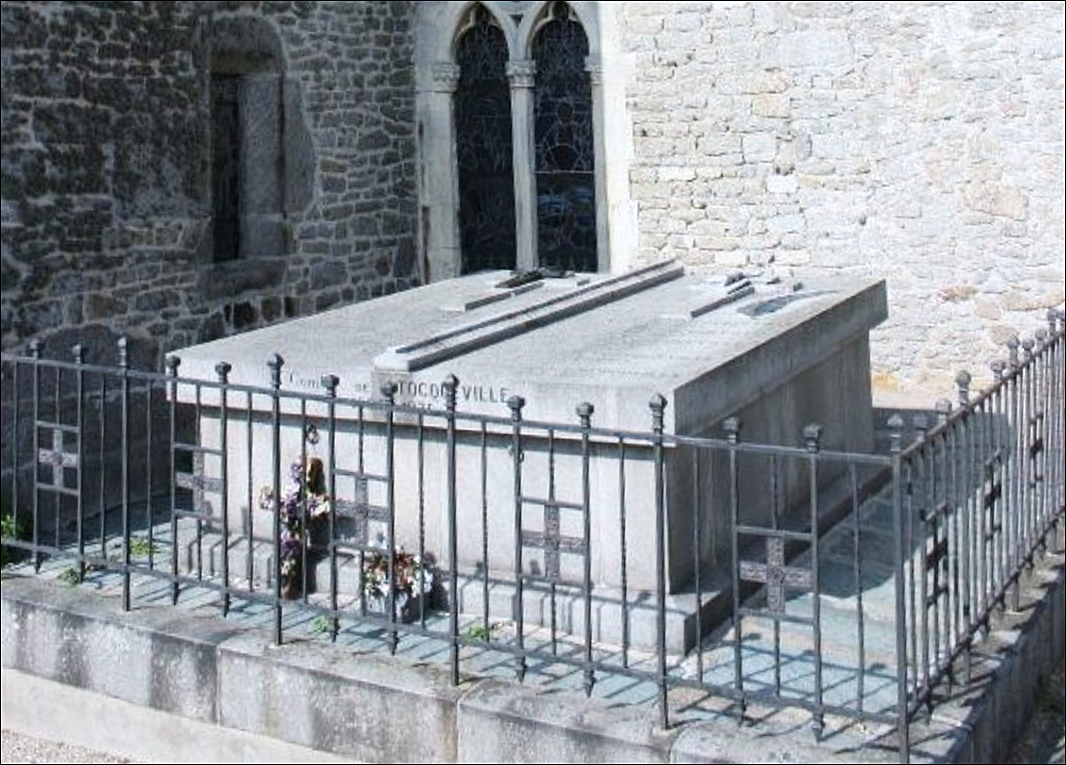
Tocqueville’s professed religion was Roman Catholicism. A longtime sufferer of tuberculosis, Tocqueville would eventually succumb to the disease on April 16, 1859. He is buried in the Tocqueville Cemetery in Normandy. ✪












COUNTDOWN TO INAUGURATION DAY 2025





▶️ CLICK HERE TO VIEW


▶️ CLICK HERE TO VIEW
▶️ 25 Minutes 29 Seconds
▶️ 3 Hour 17 Minutes 21 Seconds
▶️ 9 Minutes 51 Seconds
▶️ 16 Minutes 30 Seconds
▶️ 16 Minutes 34 Seconds
▶️ 1 Hour 6 Minutes 47 Seconds
▶️ 6 Minutes 47 Seconds
▶️ 1 Minute 47 Seconds
▶️ 2 Minutes 26 Seconds
