


George Herman “Babe” Ruth Jr. (February 6, 1895 – August 16, 1948)
✪ George Herman “Babe” Ruth Jr. was an American professional baseball player whose career in Major League Baseball (MLB) spanned 22 seasons from 1914 through 1935. Nicknamed “the Bambino, the Babe” and “the Sultan of Swat,” he began his MLB career as a star left-handed pitcher for the Boston Red Sox, but achieved his greatest fame as a slugging outfielder for the New York Yankees. Ruth is regarded as one of the greatest sports heroes in American culture and is considered by many to be the greatest baseball player of all time. In 1936, Ruth was elected into the Baseball Hall of Fame as one of its “first five” inaugural members.
George Herman Ruth Jr. was born on February 6, 1895, at 216 Emory Street in the Pigtown section of Baltimore, Maryland. Ruth’s parents, Katherine (née Schamberger) and George Herman Ruth Sr., were both of German ancestry.
Many details of Ruth’s childhood remain unknown. As a child, Ruth spoke German in the home. When Ruth was a toddler, the family moved to 339 South Woodyear Street, not far from the rail yards; and by the time he was six years old, his father opened a saloon with an upstairs apartment at 426 West Camden Street. Details are equally scanty about why Ruth was sent at the age of seven to St. Mary’s Industrial School for Boys, a reformatory school and orphanage. However, according to Julia Ruth Stevens’ recount in 1999, it was because George Sr. was a saloon owner in Baltimore and was unable to give Ruth little supervision growing up & he became a delinquent. As an adult, Ruth admitted as a youth he often ran the streets, rarely attended school, and drank beer when his father was not looking. Some accounts say that following a violent incident at his father’s saloon, the city authorities decided that that environment was unsuitable for a small child. Ruth entered St. Mary’s on June 13, 1902. Ruth’s nickname there was “Niggerlips,” as he had large facial features and was darker than most boys at the all-white reformatory. He was recorded as being “incorrigible” and spent much of the next 12 years there.
How Ruth first came to play baseball at St. Mary’s is also unknown: according to one account, his placement on the team at St. Mary’s was due largely in part to repeatedly breaking Baltimore windows with long hits while playing street ball. By another account, he was told to join a team on his first day at St. Mary’s by the school’s athletic director, Brother Herman, becoming a catcher even though left-handers rarely play that position. During his time there he also played third base and shortstop. Again, unusual for a left-hander. He was forced to wear mitts and gloves made for right-handers.
Ruth was encouraged in his athletic pursuits by the school’s Prefect of Discipline, Brother Matthias Boutlier, a native of Nova Scotia. A large man, Brother Matthias was greatly respected by the boys both for his strength and for his fairness. For the rest of his life, Ruth would praise Brother Matthias. Ruth stated, “I think I was born as a hitter the first day I ever saw him hit a baseball.”
The school’s influence remained with Ruth in other ways. He was a lifelong Catholic who would sometimes attend Mass after carousing all night, and he became a well-known member of the Knights of Columbus. He would visit orphanages, schools, and hospitals throughout his life, often avoiding publicity.He was extremely generous to St. Mary’s after he became famous and rich, donating money and his presence at fundraisers; and spending $5,000 to buy Brother Matthias a Cadillac in 1926—subsequently replacing it when it was destroyed in an accident. Nevertheless, his biographer Leigh Montville suggests that many of the off-the-field excesses of Ruth’s career were driven by the deprivations of his time at St. Mary’s.
Professional Baseball
In early 1914, Ruth signed a professional baseball contract with Jack Dunn, who owned and managed the minor-league Baltimore Orioles, an International League team. The details & circumstances of Ruth’s signing with the Orioles are not known. Some versions have Ruth running away before the eagerly awaited game, to return in time to be punished, and then pitching St. Mary’s to victory as Dunn watched in the stands.
The train journey to spring training in Fayetteville, North Carolina, in early March was likely Ruth’s first outside the Baltimore area. The rookie ballplayer was often the subject of various pranks by the veterans, who were probably also the source of his famous nickname. There are various accounts of how Ruth came to be called “Babe,” but most center on his being referred to as “Dunnie’s babe” or a variant.
SportsCentury reported that his nickname was gained because he was the new “darling” or “project” of Dunn, not only because of Ruth’s raw talent, but also because of his lack of knowledge of the proper etiquette of eating out in a restaurant, being in a hotel, or being on a train. “Babe” was at that time, a common nickname used in baseball, with perhaps the most famous to that point being Pittsburgh Pirates pitcher and 1909 World Series hero Babe Adams, who appeared younger than his actual age.
Ruth made his first appearance as a professional ballplayer in an inter-squad game on March 7, 1914. He played shortstop and pitched the last two innings of a 15–9 victory. In his second at-bat, Ruth hit a long home run to right field; the blast was locally reported to be longer than a legendary shot hit by Jim Thorpe in Fayetteville. Once the regular season began, Ruth was a star pitcher who was also dangerous at the plate. The team performed well, yet received almost no attention from the Baltimore press. A third major league, the Federal League, had begun play, and the local franchise, the Baltimore Terrapins, restored that city to the major leagues for the first time since 1902. Few fans visited Oriole Park, where Ruth and his teammates labored in relative obscurity. Although by late June the Orioles were in first place, having won over two-thirds of their games, the paid attendance dropped as low as 150. Dunn explored a possible move by the Orioles to Richmond, Virginia, as well as the sale of a minority interest in the club. However, these possibilities all fell through leaving Dunn with little choice other than to sell his best players to major league teams to raise money. The Cincinnati Reds and New York Giants expressed interest in Ruth, but Dunn sold his contract, along with those of pitchers Ernie Shore and Ben Egan, to the Boston Red Sox of the American League (AL) on July 4.
Boston Red Sox (1914–1919)
Ruth arrived in Boston with Egan and Shore on July 11, 1914. Ruth’s new teammates considered him brash and would have preferred him as a rookie to remain quiet and inconspicuous. When Ruth insisted on taking batting practice despite being both a rookie who did not play regularly and a pitcher, he arrived to find his bats sawed in half. His teammates nicknamed him “the Big Baboon,” a name the swarthy Ruth, who had disliked the nickname “Niggerlips” at St. Mary’s, fiercely detested.
Ruth had received a raise on promotion to the major leagues and quickly acquired tastes for fine food, liquor, and women, among other temptations. Ruth later told the story of how one morning he had met Helen Woodford, who would become his first wife. She was a 16-year-old waitress at Landers Coffee Shop, and Ruth related that she served him when he had breakfast there.
In 1917, Ruth was used little as a batter, other than for his plate appearances while pitching, and hit .325 with two home runs. The United States’ entry into World War I occurred at the start of the season and overshadowed baseball. Conscription was introduced in September 1917, and most baseball players in the big leagues were of draft age. In 1918, the Red Sox won their third pennant in four years and faced the Chicago Cubs in the World Series, which began on September 5, the earliest date in history. The season had been shortened because the government had ruled that baseball players who were eligible for the military would have to be inducted or work in critical war industries, such as armaments plants. Ruth pitched and won Game One for the Red Sox, a 1–0 shutout. Before Game Four, Ruth injured his left hand in a fight but pitched anyway. Ruth’s effort gave his team a three-games-to-one lead, and two days later the Red Sox won their third Series in four years, four-games-to-two. Before allowing the Cubs to score in Game Four, Ruth pitched 29+2⁄3 consecutive scoreless innings, a record for the World Series that stood for more than 40 years until 1961 and was only broken by Whitey Ford after Ruth’s death. With the World Series over, Ruth gained exemption from the war draft by accepting a nominal position with a Pennsylvania steel mill. Many industrial establishments took pride in their baseball teams and sought to hire major leaguers. The end of the war in November set Ruth free to play baseball without such contrivances.
Sale To New York
Not all the circumstances surrounding the sale of Ruth to the Yankees are known, but Brewer and former congressman Jacob Ruppert, the New York team’s principal owner, reportedly asked Yankee manager Miller Huggins what the team needed to be successful. “Get Ruth from Boston,” Huggins supposedly replied, noting that Red Sox owner Frazee was perennially in need of money to finance his theatrical productions. There were other financial pressures on Frazee, despite his team’s success. Ruth, fully aware of baseball’s popularity and his role in it, wanted to renegotiate his contract, signed before the 1919 season for $10,000 per year through 1921. He demanded that his salary be doubled, or he would sit out the season and cash in on his popularity through other ventures. Frazee sold the rights to Babe Ruth for $100,000, the largest sum ever paid for a baseball player.
The deal was announced on January 6, 1920. Reaction in Boston was mixed: some fans were embittered at the loss of Ruth; others conceded that Ruth had become too difficult to deal with. According to Marty Appel in his history of the Yankees, the transaction, “changed the fortunes of two high-profile franchises for decades“ The Red Sox, winners of five of the first 16 World Series, those played between 1903 and 1919, would not win another pennant until 1946, or another World Series until 2004, a drought attributed in baseball superstition to Frazee’s sale of Ruth and infamously known as the “Curse of the Bambino.” Conversely, the Yankees had not won the AL championship prior to their acquisition of Ruth. They won seven AL pennants and four World Series with him, and lead baseball with 40 pennants and 27 World Series titles in their history.
New York Yankees (1920–1934)
When Ruth signed with the Yankees, he completed his transition from a pitcher to a power-hitting outfielder. His fifteen-season Yankee career consisted of over 2,000 games, and Ruth broke many batting records while making only five widely scattered appearances on the mound, winning all of them. At the end of April 1920, the Yankees were 4–7, with the Red Sox leading the league with a 10–2 mark. Ruth had done little, having injured himself swinging the bat. Both situations began to change on May 1, when Ruth hit a tape measure home run that sent the ball completely out of the Polo Grounds, a feat believed to have been previously accomplished only by Shoeless Joe Jackson. Fans responded with record attendance figures. On May 16, Ruth and the Yankees drew 38,600 to the Polo Grounds, a record for the ballpark, and 15,000 fans were turned away. Large crowds jammed stadiums to see Ruth play when the Yankees were on the road.
In 1920 and afterwards, Ruth was aided in his power hitting by the fact that A.J. Reach Company—the maker of baseballs used in the major leagues—was using a more efficient machine to wind the yarn found within the baseball. The new baseballs went into play in 1920 and ushered the start of the live-ball era; the number of home runs across the major leagues increased by 184 over the previous year. Baseball statistician Bill James pointed out that while Ruth was likely aided by the change in the baseball, there were other factors at work including the gradual abolition of the spitball. In the offseason, Ruth spent some time in Havana, Cuba, where he was said to have lost $35,000 (equivalent to $530,000 in 2021) betting on horse races.
On March 4, 1922, Ruth signed a new contract for three years at $52,000 a year (equivalent to $840,000 in 2021). This was more than two times the largest sum ever paid to a ballplayer up to that point and it represented 40% of the team’s player payroll. On May 25, he was thrown out of the game for throwing dust in umpire George Hildebrand’s face, then climbed into the stands to confront a heckler. Ban Johnson ordered him fined, suspended, and stripped of position as team captain.
After the season, Ruth was a guest at an Elks Club banquet, set up by Ruth’s agent with Yankee team support. There, each speaker, concluding with future New York mayor Jimmy Walker, censured him for his poor behavior. An emotional Ruth promised reform, and, to the surprise of many, followed through. When he reported to spring training, he was in his best shape as a Yankee, weighing only 210 pounds
The Bellyache Heard Around The World
Ruth usually did not look very athletic; he was described as “toothpicks attached to a piano,” with a big upper body but thin wrists and legs. Ruth had kept up his efforts to stay in shape in 1923 and 1924, but by early 1925 weighed nearly 260 pounds (120 kg) again. His annual visit to Hot Springs, Arkansas, where he exercised and took saunas early in the year, did him no good as he spent much of the time carousing in the resort town. Ruth collapsed in Asheville, North Carolina, as the team journeyed north. He was put on a train for New York, where he was briefly hospitalized. A rumor circulated that he had died, prompting British newspapers to print a premature obituary. In New York, Ruth collapsed again and was found unconscious in his hotel bathroom. He was taken to a hospital where he had multiple convulsions. After sportswriter W. O. McGeehan wrote that Ruth’s illness was due to binging on hot dogs and soda pop before a game, it became known as “the bellyache heard ’round the world.” However, the exact cause of his ailment has never been confirmed and remains a mystery.
The “Called Shot” & Ruth’s Final Yankee Years (1926–1934)
Ruth spent part of the offseason of 1925–26 working out at Artie McGovern’s Gym, where he got back into shape, but the Yankees were not expected to win the pennant. The 1926 World Series was also known for Ruth’s promise to Johnny Sylvester, a hospitalized 11-year-old boy. Ruth promised the child that he would hit a home run on his behalf. Sylvester had been injured in a fall from a horse, and a friend of Sylvester’s father gave the boy two autographed baseballs signed by Yankees and Cardinals. The friend relayed a promise from Ruth (who did not know the boy) that he would hit a home run for him. After the Series, Ruth visited the boy in the hospital. When the matter became public, the press greatly inflated it, and by some accounts, Ruth allegedly saved the boy’s life by visiting him, emotionally promising to hit a home run, and doing so. Ruth’s 1926 salary of $52,000 was far more than any other baseball player, but he made at least twice as much in other income, including $100,000 from 12 weeks of appearances in Vaudeville.
The Yankees faced the Cubs, McCarthy’s former team, in the 1932 World Series. There was bad blood between the two teams as the Yankees resented the Cubs only awarding half a World Series share to Mark Koenig, a former Yankee. The games at Yankee Stadium had not been sellouts; both were won by the home team, with Ruth collecting two singles, but scoring four runs as he was walked four times by the Cubs pitchers. In Chicago, Ruth was resentful at the hostile crowds that met the Yankees’ train and jeered them at the hotel. The crowd for Game Three included New York Governor Franklin D. Roosevelt, the Democrat candidate for president, who sat with Chicago Mayor Anton Cermak. Many in the crowd threw lemons at Ruth, a sign of derision, and others (as well as the Cubs themselves) shouted abuse at Ruth and other Yankees. They were briefly silenced when Ruth hit a three-run home run off Charlie Root in the first inning, but soon revived, and the Cubs tied the score at 4–4 in the fourth inning, partly due to Ruth’s fielding error in the outfield. When Ruth came to the plate in the top of the fifth, the Chicago crowd and players, led by pitcher Guy Bush, were screaming insults at Ruth. With the count at two balls and one strike, Ruth gestured, possibly in the direction of center field, and after the next pitch (a strike), may have pointed there with one hand. Ruth hit the fifth pitch over the center field fence; estimates were that it traveled nearly 500 feet (150 m). Whether or not Ruth intended to indicate where he planned to (and did) hit the ball, the incident has gone down in legend as Babe Ruth’s called shot. The Yankees won Game Three, and the following day clinched the Series with another victory.
In 1934, Ruth played in his last full season with the Yankees. By this time, years of high living were starting to catch up with him. His conditioning had deteriorated to the point that he could no longer field or run. He could still handle a bat & recorded a .288 batting average with 22 home runs.
Boston Braves (1935)
By this time, Ruth knew he was nearly finished as a player. He desired to remain in baseball as a manager. Early in the 1934 season, Ruth openly campaigned to become the Yankees manager. However, the Yankee job was never a serious possibility. Ruppert always supported McCarthy, who would remain in his position for another 12 seasons. By the end of the season, Ruth hinted that he would retire unless Ruppert named him manager of the Yankees. When the time came, Ruppert wanted Ruth to leave the team without drama or hard feelings.
Retirement:
During the 1934–35 offseason, Ruth circled the world with his wife; the trip included a barnstorming tour of the Far East. At his final stop in the United Kingdom before returning home, Ruth was introduced to cricket by Australian player Alan Fairfax, and after having little luck in a cricketer’s stance, he stood as a baseball batter and launched some massive shots around the field, destroying the bat in the process.
While the barnstorming tour was underway, Ruppert began negotiating with Boston Braves owner Judge Emil Fuchs, who wanted Ruth as a gate attraction. The Braves had enjoyed modest recent success, finishing fourth in the National League in both 1933 and 1934, but the team drew poorly at the box office. After a series of phone calls, letters, and meetings, the Yankees traded Ruth to the Braves on February 26, 1935. Ruppert had stated that he would not release Ruth to go to another team as a full-time player. For this reason, it was announced that Ruth would become a team vice president and would be consulted on all club transactions, in addition to playing.
Ruth still hoped to be hired as a manager somewhere even if he could no longer play, but only one managerial position, Cleveland, became available between Ruth’s retirement and the end of the 1937 season. Asked if he had considered Ruth for the job, Indians owner Alva Bradley replied negatively. Team owners and general managers assessed Ruth’s flamboyant personal habits as a reason to exclude him from a managerial job;. Barrow said of him, “How can he manage other men when he can’t even manage himself?” Of the 5 members in the inaugural class of Baseball Hall of Fame in 1936 (Ty Cobb, Honus Wagner, Christy Mathewson, Walter Johnson and Ruth himself), only Ruth was not given an offer to manage a baseball team.
On July 4, 1939, Ruth spoke on Lou Gehrig Appreciation Day at Yankee Stadium as members of the 1927 Yankees and a sellout crowd turned out to honor the first baseman, who was forced into premature retirement by ALS, which would kill him two years later. The next week, Ruth went to Cooperstown, New York, for the formal opening of the Baseball Hall of Fame. Three years earlier, he was one of the first five players elected to the hall. As radio broadcasts of baseball games became popular, Ruth sought a job in that field, arguing that his celebrity and knowledge of baseball would assure large audiences, but he received no offers. During World War II, he made many personal appearances to advance the war effort, including his last appearance as a player at Yankee Stadium, in a 1943 exhibition for the Army-Navy Relief Fund. He hit a long fly ball off Walter Johnson; the blast left the field, curving foul, but Ruth went ahead & circled the bases anyway. In 1946, he made a final effort to gain a management job in baseball when he contacted new Yankees boss MacPhail, but he was sent a rejection letter.
Personal Life:
Ruth met Helen Woodford (1897–1929), by some accounts, in a coffee shop in Boston, where she was a waitress. They married as teenagers on October 17, 1914. Although Ruth later claimed to have been married in Elkton, Maryland, records show that they were married at St. Paul’s Catholic Church in Ellicott City. They adopted a daughter, Dorothy (1921–1989) in 1921. Ruth and Helen separated around 1925 reportedly because of Ruth’s repeated infidelities and neglect. They appeared in public as a couple for the last time during the 1926 World Series. Helen died in January 1929 at age 31 in a house fire in Watertown, Massachusetts in a house owned by Edward Kinder, a dentist with whom she had been living as “Mrs. Kinder.”
On April 17, 1929, three months after the death of his first wife, Ruth married actress and model Claire Merritt Hodgson (1897–1976) and adopted her daughter Julia (1916–2019). It was the second and final marriage for both parties. Claire, much unlike Helen, was well-travelled and educated, and went on to put structure into Ruth’s life.
Although Ruth was married throughout most of his baseball career, when team co-owner Tillinghast ‘Cap’ Huston asked him to tone down his lifestyle, Ruth said, “I’ll promise to go easier on drinking and to get to bed earlier, but not for you, fifty thousand dollars, or two-hundred and fifty thousand dollars will I give up women. They’re too much fun.” A detective that the Yankees hired to follow him one night in Chicago reported that Ruth had been with six women. Ping Bodie said that he was not Ruth’s roommate while traveling; “I room with his suitcase.”
His performance during the 1922 season had been disappointing, attributed in part to his drinking and late-night hours. After the end of the 1922 season, he was asked to sign a contract addendum with a morals clause. Ruth and Ruppert signed it on November 11, 1922. It called for Ruth to abstain entirely from the use of intoxicating liquors, and to not stay up later than 1:00 a.m. during the training and playing season without permission of the manager. Ruth was also enjoined from any action or misbehavior that would compromise his ability to play baseball.
Cancer & Death (1946–1948)
As early as the war years, doctors had cautioned Ruth to take better care of his health, and he grudgingly followed their advice, limiting his drinking and not going on a proposed trip to support the troops in the South Pacific In 1946, Ruth began experiencing severe pain over his left eye and had difficulty swallowing. In November 1946, Ruth entered French Hospital in New York for tests, which revealed that he had an inoperable malignant tumor at the base of his skull and in his neck.
His name and fame gave him access to experimental treatments, and he was one of the first cancer patients to receive both drugs and radiation treatment simultaneously. Having lost 80 pounds (36 kg), he was discharged from the hospital in February and went to Florida to recuperate. He returned to New York and Yankee Stadium after the season started. The new commissioner, Happy Chandler (Judge Landis had died in 1944), proclaimed April 27, 1947, Babe Ruth Day around the major leagues, with the most significant observance to be at Yankee Stadium. A number of teammates and others spoke in honor of Ruth, who briefly addressed the crowd of almost 60,000. By then, his voice was a soft whisper with a very low, raspy tone.
Around this time, developments in chemotherapy offered some hope for Ruth. The doctors had not told Ruth he had cancer because of his family’s fear that he might do himself harm. Ruth showed dramatic improvement during the summer of 1947, so much so that his case was presented by his doctors at a scientific meeting, without using his name. He was able to travel around the country, doing promotional work for the Ford Motor Company on American Legion Baseball. He appeared again at another day in his honor at Yankee Stadium in September, but was not well enough to pitch in an old-timers game as he had hoped. The improvement was only a temporary remission, and by late 1947, Ruth was unable to help with the writing of his autobiography, The Babe Ruth Story, which was almost entirely ghostwritten. In and out of the hospital in Manhattan, he left for Florida in February 1948, doing what activities he could. After six weeks he returned to New York to appear at a book-signing party.
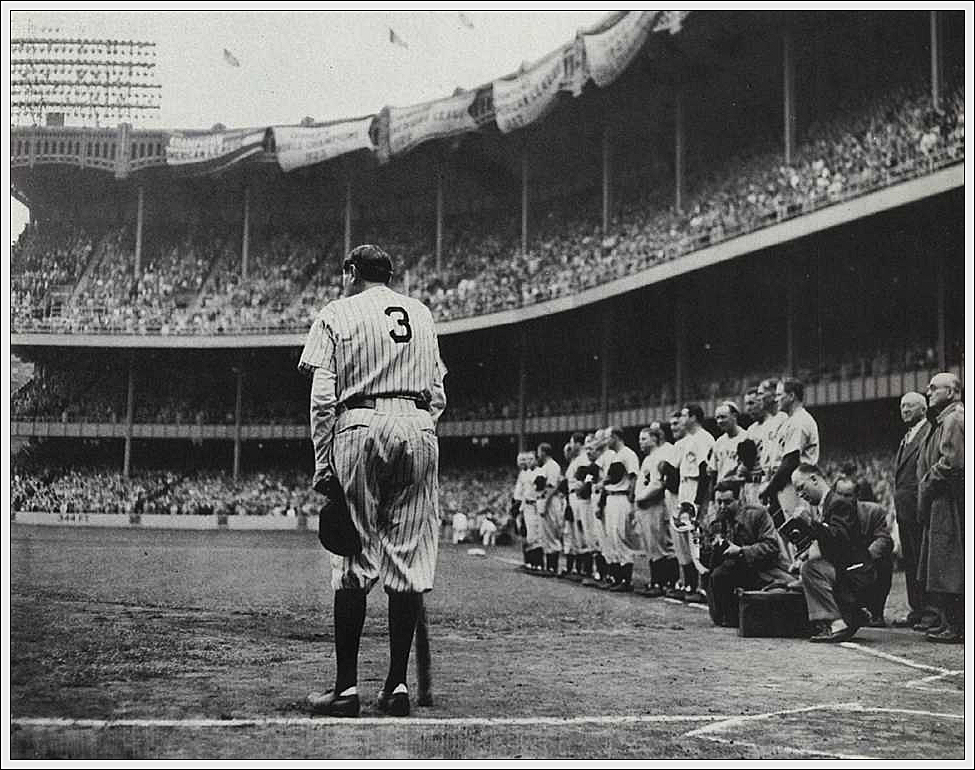
On June 5, 1948, a “gaunt and hollowed out” Ruth visited Yale University to donate a manuscript of The Babe Ruth Story to its library. On June 13, Ruth visited Yankee Stadium for the final time in his life, appearing at the 25th-anniversary celebrations of “The House that Ruth Built.” By this time he had lost much weight and had difficulty walking. Introduced along with his surviving teammates from 1923, Ruth used a bat as a cane. Nat Fein’s photo of Ruth taken from behind, standing near home plate and facing “Ruthville” (right field) became one of baseball’s most famous and widely circulated photographs, and won the Pulitzer Prize.
Ruth made one final trip on behalf of American Legion Baseball, then entered Memorial Hospital, where he would die. He was never told he had cancer. But before his death, he surmised it. Ruth’s condition gradually grew worse, and only a few visitors were permitted to see him, one of whom was National League president and future Commissioner of Baseball Ford Frick. “Ruth was so thin it was unbelievable. He had been such a big man and his arms were just skinny little bones, and his face was so haggard,” Frick said years later.Thousands of New Yorkers, including many children, stood vigil outside the hospital during Ruth’s final days.
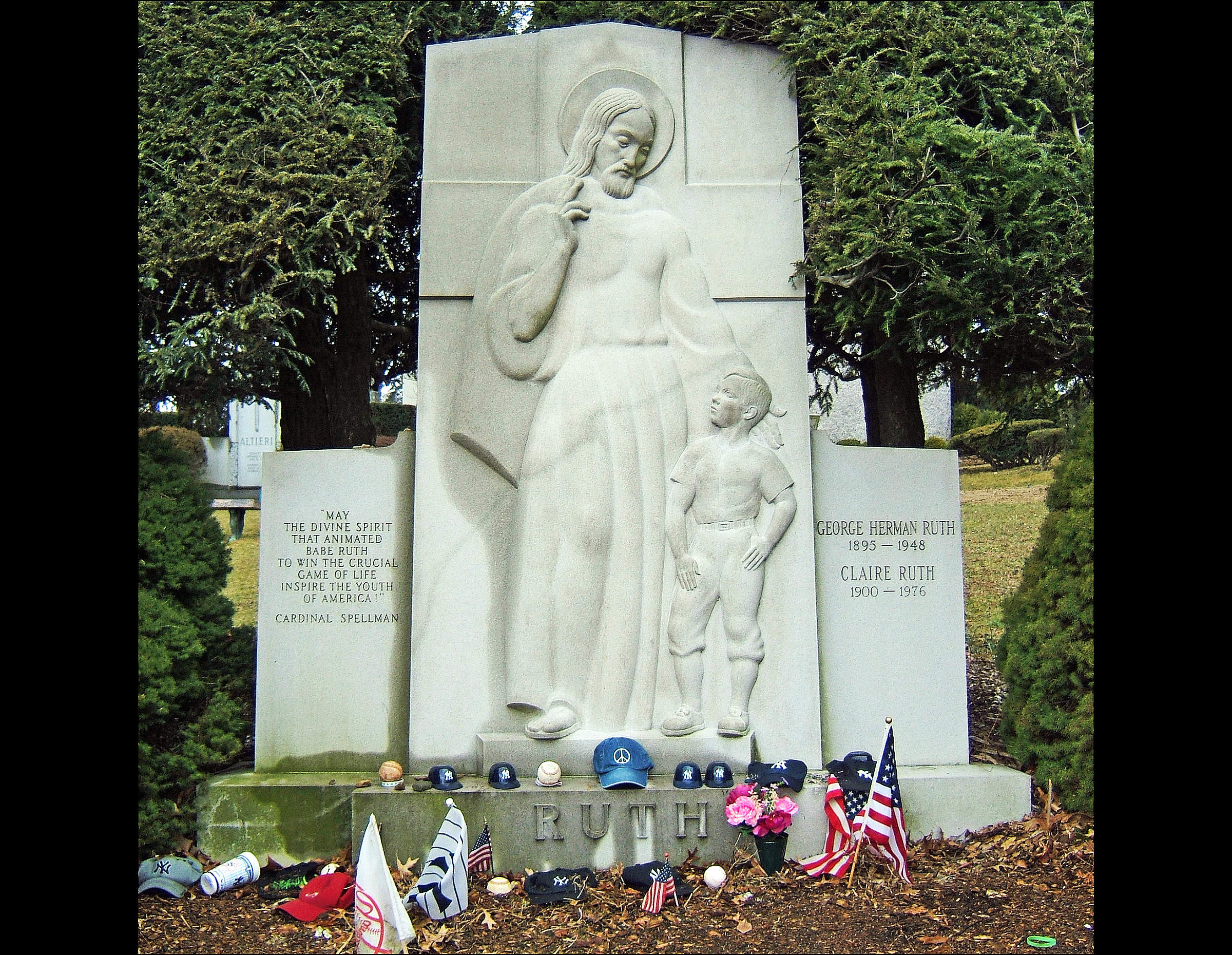
On August 16, 1948, at 8:01 p.m., Ruth died in his sleep at the age of 53. His open casket was placed on display in the rotunda of Yankee Stadium, where it remained for two days; 77,000 people filed past to pay him tribute. His Requiem Mass was celebrated by Francis Cardinal Spellman at St. Patrick’s Cathedral; a crowd estimated at 75,000 waited outside. Ruth rests with his second wife, Claire, on a hillside in Section 25 at the Gate of Heaven Cemetery in Hawthorne, New York.
Legacy & Impact:
Ruth was the first baseball star to be the subject of overwhelming public adulation. Baseball had been known for star players such as Ty Cobb and “Shoeless Joe” Jackson, but both men had uneasy relations with fans. In Cobb’s case, the incidents were sometimes marked by violence. In his history of the Yankees, Glenn Stout writes that “Ruth was New York incarnate—uncouth and raw, flamboyant and flashy, oversized, out of scale, and absolutely unstoppable.”
During his lifetime, Ruth became a symbol of the United States. During World War II Japanese soldiers yelled in English, “To hell with Babe Ruth,” to anger American soldiers. Ruth replied that he hoped “every Jap that mentioned my name gets shot.” According to biographer Glenn Stout, “He appealed to a deeply rooted American yearning for the definitive climax: clean, quick, unarguable. Ruth’s home runs were an exalted, uplifting experience that meant more to fans than any runs they were responsible for. A Babe Ruth home run was an event unto itself, one that meant anything was possible.” Ruth appeared to exemplify the American success story, that even an uneducated, unsophisticated youth, without any family wealth or connections, could do something better than anyone else in the world.
More books have been written about Ruth than any other member of the Baseball Hall of Fame. Montville suggested that Ruth is probably even more popular today than he was when his career home run record was broken by Hank Aaron on April 8, 1974. In numerous surveys and rankings, Ruth has repeatedly been named the greatest baseball player of all time. n 1983, the United States Postal Service honored Ruth with the issuance of a twenty-cent stamp. Several of the most expensive items of sports memorabilia and baseball memorabilia ever sold at auction are associated with Ruth. As of May 2022, Ruth’s 1920 Yankee’s jersey, which sold for $4,415,658 in 2012 (equivalent to $5.22 million in 2021), is the third most expensive piece of sports memorabilia ever auctioned. The bat with which he hit the first home run at Yankee Stadium is in The Guinness Book of World Records as the most expensive baseball bat sold at auction, having fetched $1.265 million on December 2, 2004 (equivalent to $1.8148 million in 2021).
One long-term survivor of the craze over Ruth may be the Baby Ruth candy bar. The original company to market the confectionery, the Curtis Candy Company, maintained that the bar was named after Ruth Cleveland, daughter of former president Grover Cleveland. However, she died in 1904 and the bar was first marketed in 1921, at the height of the craze over Ruth. The Ruth estate licensed his likeness for use in an advertising campaign for Baby Ruth in 1995. In 2005, the Baby Ruth bar became the official candy bar of Major League Baseball in a marketing arrangement.
In 2018, President Donald Trump announced that Ruth, along with Elvis Presley and Antonin Scalia, would posthumously receive the Presidential Medal of Freedom.Montville describes the continuing relevance of Babe Ruth in American culture, more than three-quarters of a century after he last swung a bat in a major league game:
“The fascination with his life and career continues. He is a bombastic, sloppy hero from our bombastic, sloppy history, origins undetermined, a folk tale of American success. His moon face is as recognizable today as it was when he stared out at Tom Zachary on a certain September afternoon in 1927. If sport has become the national religion, Babe Ruth is the patron saint. He stands at the heart of the game he played, the promise of a warm summer night, a bag of peanuts, and a beer. And just maybe, the longest ball hit out of the park.” ✪


▶️ CLICK HERE TO VIEW
▶️ 8 minutes 33 Seconds
▶️ 47 Minutes 37 Seconds
▶️ 9 Minutes 20 Second ⭐️ Michael Brower
