


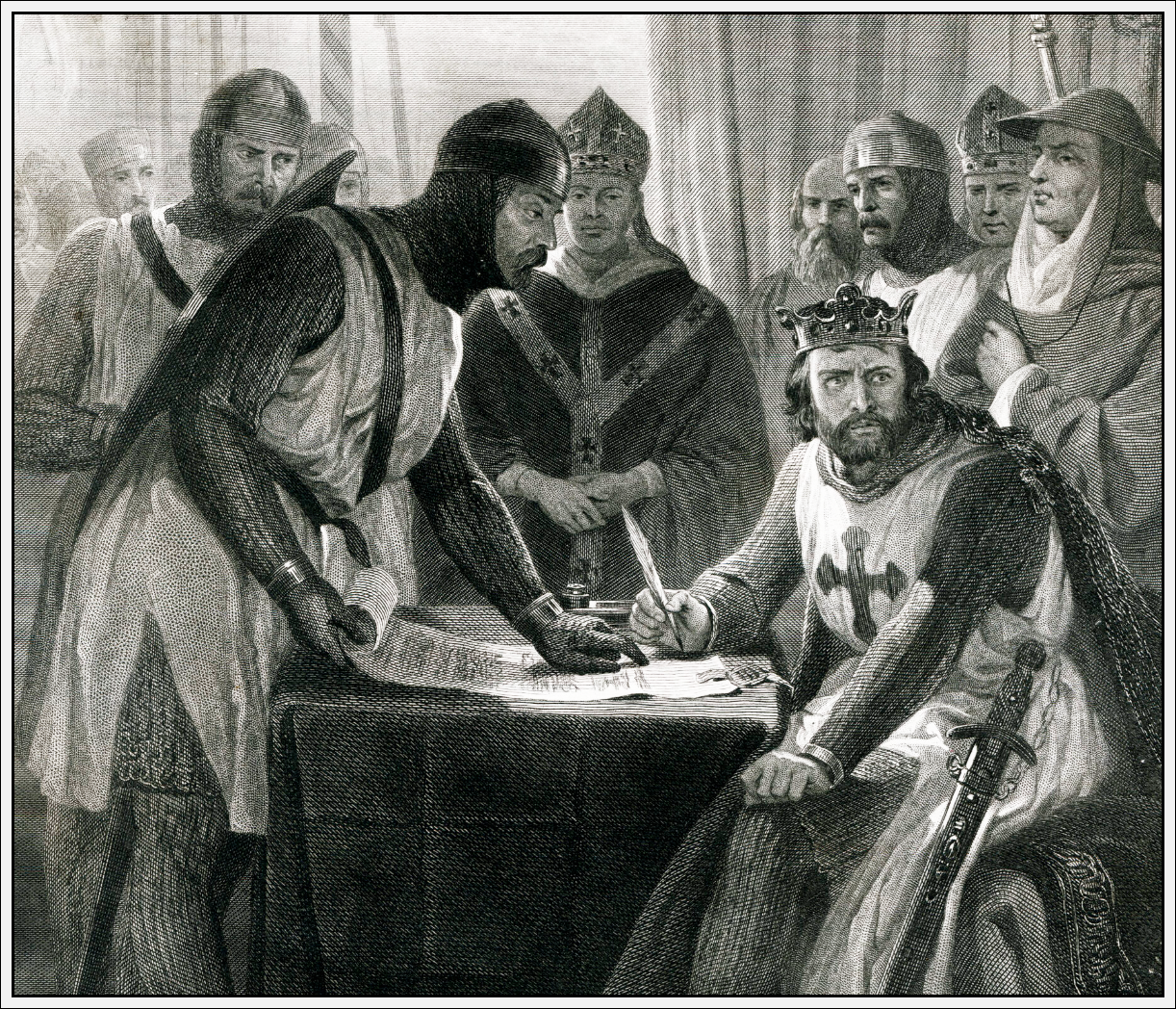

✪ Within the Magna Carta, we find the seeds of all our constitutional protections: the Rule of Law, due process, trial by jury, and the principle that even kings are not above the law. Though born in the soil of medieval England, it is a document which has long since taken root in the hearts of American patriots...
▶️ FEATURED ARTICLE: CLICK HERE TO READ

xxx
very June 15th, we commemorate one of the most important milestones in the unending struggle of free men against tyranny: the signing of the Magna Carta on June 15, 1215. Though sealed by a reluctant King John under the shadow of rebellion, this ancient document lit the first embers of liberty that would one day blaze into the conflagration of the American Revolution; and, ultimately, into the drafting of the United States Constitution.
✪ A Charter Of Liberties Against Royal Tyranny
Let us recall the significance of that great charter, its influence on our Founding Fathers, and its role as a bulwark against the arbitrary hand of government.
The Magna Carta, or “Great Charter,” emerged from the fields of Runnymede in the summer of 1215 after the barons of England rose against King John’s despotic rule. Heavy taxation, arbitrary imprisonment, and the denial of basic rights provoked their ire. Armed with swords and the just cause of liberty, they forced the monarch’s hand, compelling him to sign a document that would, for the first time in history, place limits on royal power.
Anecdotes from that time bring the drama to life. Chroniclers record King John, desperate and cornered, attempted to stall negotiations with the barons by feigning compliance and then secretly writing to the Pope, seeking the charter’s annulment. One can imagine the tense atmosphere at Runnymede that day— a marshy meadow along the Thames — where armed knights and weary clerks gathered as the king’s trembling hand pressed his seal onto parchment under the watchful eyes of his armed barons. It was not the act of a willing king, but the submission of a tyrant to the righteous demands of his own people.
The barons declared that even the King was subject to the law of the land. Clause 39 stands out as the wellspring of our modern concept of due process:
“No free man shall be seized or imprisoned or stripped of his rights or possessions … except by the lawful judgment of his equals or by the law of the land.”
From this clause flowed the tradition of English common law, which would be carried across the Atlantic by the settlers going to the New World.
✪ The Magna Carta’s Effect On The American Mind
When our Founding Fathers waged their righteous cause against the British Crown, they drew deeply from the well of the Magna Carta’s promises. James Madison, Thomas Jefferson and John Adams all cited its legacy in their defense of American rights. The revolutionary generation regarded themselves as the true heirs of that ancient charter; not as rebels, but as Englishmen defending the liberties guaranteed to them since 1215.
A stirring anecdote from the period of the American Revolution illustrates this perfectly. In 1765, amid uproar over the Stamp Act, the Sons of Liberty gathered in New York City’s Fraunces Tavern. They raised their glasses not only to the repeal of the hated tax but also in solemn remembrance of “the immortal memory of the barons of Runnymede.” They saw themselves as the spiritual descendants of those noblemen who had compelled their king to honor the rights of the people some 550 years earlier.
Principles of the Magna Carta’s are invoked in the Declaration of Independence. In Jefferson’s words; “The king has refused his Assent to Laws, the most wholesome and necessary for the public good,” echo the grievances of the barons against King John. The colonists believed they were merely asserting the rights that the Crown had long promised but repeatedly denied.
When the Founders gathered in Philadelphia in 1787, the Magna Carta’s influence was omnipresent. Madison, known as the “Father of the Constitution,” recognized that a government of laws required the same protections the barons had demanded: No man may be imprisoned without trial, no property may be seized without due process, and no taxes may be levied without the consent of the governed. These are the guarantees enshrined in the Fifth Amendment’s Due Process Clause, in the prohibition against bills of attainder and ex post facto laws, and in the guarantee of habeas corpus in Article I, Section 9.
✪ The Magna Carta & The Revolutionary War
The cry of “No taxation without representation” is, at its core, a reaffirmation of the Magna Carta’s fundamental tenet that the King could not exact taxes without the consent of his subjects; originally the barons However, later it is understood to be the people’s representatives in Parliament. In the colonies, the lack of representation in Parliament was seen as a direct violation of this ancient right, and the colonists responded with the same spirit of defiance that moved the barons at Runnymede.
One of the most poignant episodes of the Revolution came during the siege of Boston in 1775. George Washington, upon assuming command of the Continental Army, ordered that every soldier be provided with a copy of the “Rights of Englishmen” and the guarantees of the Magna Carta, so that every patriot might understand that their cause was not only rebellion but also the defense of ancient liberties. Washington’s directive demonstrates the reverence our Founders held for the Great Charter, seeing in it the shield of the common man against tyranny.
Moreover, the Quartering Act, the Intolerable Acts, and the suspension of Colonial legislatures were all viewed as echoes of the arbitrary rule the Magna Carta had sought to restrain. The colonists, steeped in the common law and the principles of English liberty, believed themselves to be vindicating their rights by resisting the King’s tyranny.
✪ The Magna Carta & The Constitution
When the Constitution was written, the framers consciously wove the Magna Carta’s principles into the very fabric of our supreme law. The concept of limited government; the idea rulers derive their power from the consent of the governed, finds its earliest expression in the Magna Carta. The guarantees of trial by jury, protection of private property, and due process of law were not novel inventions of 1787 but reaffirmations of a struggle that had begun centuries earlier.
In The Federalist, No. 84, Alexander Hamilton dismissed the notion that the Constitution required a Bill of Rights. He argued that the very structure of the Constitution provided those protections. Yet even he acknowledged the Magna Carta’s legacy made it essential to enumerate certain rights explicitly. This debate culminated in the adoption of the Bill of Rights in 1791; a direct descendant of the demands made by the barons in 1215.
✪ The Magna Carta & American Liberty Today
The struggle for liberty did not end at Runnymede or in Philadelphia. It continues on today in every generation which loves liberty and loathes tyranny. Each time the government seeks to expand its powers beyond constitutional limits, it is the spirit of the Magna Carta which reminds us no ruler is above the law. Each time an American is denied due process, imprisoned without trial, or taxed without representation, it is the Magna Carta which stands as a silent witness. It calls us back to the ancient promise that Law is king and liberty belongs to every freeborn man.
The Magna Carta teaches us that liberty is not given freely by those in power; rather, demanded by those with the courage to assert their God-given rights. It asserts rights are not privileges to be dispensed at the pleasure of princes but divine birthrights endowed to us by our Creator and secured by the blood of patriots. It asserts even the mightiest government is only a servant of the people.
✪ Conclusion
As we mark another anniversary of the Magna Carta, let us remember that liberty was not born fully formed in 1776 or 1787. It is the product of an ever ongoing, centuries-long struggle against tyranny. A struggle which began with the barons’ rebellion against King John and eventually found its greatest expression in the American Revolution and Constitution. Let us honor this heritage by recommitting ourselves to the principles for which so many have fought: the Rule of Law, due process, and the inviolable rights of every man.
As we reflect on the Great Charter, let it not ever become a relic of a bygone age but a living reminder that the cause of liberty is eternal; and each of us bears the responsibility to defend it in our own time. If the Magna Carta taught us anything, it is freedom is never completely secure unless we stand ready to defend it — against kings, tyrants and any who would usurp the rights of the people.
Let this anniversary be a clarion call to all who love liberty: to study & know their rights, understand their history, and to defend those rights and liberties with the same resolute spirit which inspired & motivated the barons at Runnymede. The patriots at Lexington and Concord. For in such vigilance & defense lie the hopes and promise of every yet unborn generation; the hope & promise that liberty shall never perish from the Earth. ✪














▶️ DONATE VIA PAYPAL (DEBIT & CREDIT CARD)
ALL PayPal Transactions Are Encrypted For Card Holder Privacy & Security
▶️ DONATE VIA ZELLE (DIRECT BANK CASH TRANSFER)
ZELLE is the perfect online alternative to PayPal. It’s an incredibly simple, secure, easy, fast and FREE way to send or receive money to recipients directly from your online banking account without a middleman. Best of all, there’s NO fees.
ZELLE is a service provided by your bank and is already built in to your online banking account. You only need to activate it first before using. If you’ve already activated ZELLE in your online bank or credit union account, you can donate to The New Americanist by using our ZELLE address:
vip@thenewamericanist.com
To activate your ZELLE, follow these easy instructions (a simple two minute process):

▶️ DONATE VIA SNAIL MAIL








▶️ CLICK HERE TO VIEW
▶️ 3 Hours 27 Minutes 15 Seconds
▶️ 19 Minutes 57 Seconds
▶️ 7 Minutes 36 Seconds
▶️ 6 Minutes 47 Seconds
▶️ 8 Minutes 25 Seconds
▶️ 8 Minutes 17 Seconds
▶️ 6 Minute 40 Seconds
▶️ 19 Minutes 39 Seconds
▶️ 10 Minutes 4 Seconds
▶️ 1 Hour 40 Minutes 36 Seconds
▶️ 17 Minutes 21 Seconds
▶️ 8 Minutes 36 Seconds ⭐️ Gary Brown
▶️ 15 Minutes 34 Seconds ⭐️ Bosun Higgs
▶️ 33 Minutes 35 Seconds
▶️ 13 Minutes 44 Seconds
▶️ 29 Minutes 22 Seconds
▶️ 6 Minutes 29 Seconds
▶️ 8 Minutes 41 Seconds
▶️ 5 Minutes 48 Seconds
▶️ Premiere
▶️ 33 Minutes 18 Seconds
⭐️ The NEW LOGICAL SHOW featuring The New Americanist’s very own bet1125
PLEASE be certain to LIKE & SUBSCRIBE: Let’s support NEW Conservative media.
