




✪ On its way out the door, the Biden Administration has proposed a rule that would effectively ban cigarettes by requiring a drastic reduction in nicotine content. The Food and Drug Administration (FDA), which unveiled the proposed rule on Wednesday, says the aim is to make cigarettes unappealing by eliminating their “psychoactive and reinforcing effects…”
▶️ CLICK HERE TO READ

nnnn
n addition to cigarettes, the FDA’s proposed rule covers cigarette tobacco, pipe tobacco (except shisha for waterpipes), and cigars (except for “premium” cigars). All of those products would be limited to 0.7 milligrams of nicotine per gram of tobacco. That cap technically complies with a federal law that bars the FDA from banning tobacco products or “requiring the reduction of nicotine yields of a tobacco product to zero.” But the negligible amount of nicotine allowed under the rule would amount to both in practice.
Mandatory government oversight and management of negligible nicotine levels in tobacco products would instead create a huge black market and criminalize currently legal transactions.
The FDA, which first considered this policy under Scott Gottlieb during the first Trump Administration, has abandoned the idea of gradually phasing in the nicotine reduction because that would initially result in “compensatory smoking.” That is, current smokers would be apt to inhale more deeply, take more or bigger puffs, or consume more cigarettes to get the nicotine dose to which they are accustomed, which would increase their exposure to the toxins and carcinogens in tobacco smoke. But avoiding that pitfall by mandating an immediate cut to a negligible nicotine level would magnify the black-market effects of de facto cigarette prohibition.
Given the disastrous results of the war on drugs, it is hard to fathom why a government agency in 2025 would think it is a good idea to expand that crusade to include products that are regularly consumed by nearly 30 million American adults. The proposed nicotine cap “would effectively outlaw almost all cigarettes currently being sold,” which would “benefit organized crime by igniting a robust illicit market for cigarettes and other tobacco products,” the Law Enforcement Action Partnership (LEAP) notes in an emailed press release.
“We know from any number of historical examples that prohibition doesn’t end the demand for these products,” says Neill Franklin, LEAP’s former executive director. “Smokers will just go to the underground market to find what they need.” The upshot, Franklin says, will be “an illicit tobacco market with no product safety standards, regulations, or taxable revenue,” which “will mean huge new business opportunities for organized crime and an increased strain on law enforcement.”
The FDA seems unfazed by such concerns. The agency says it is “considering whether illicit trade could occur as a result of a nicotine product standard and whether such activity could significantly undermine the public health benefits of the product standard.” But there is no question that “illicit trade” will “occur,” as it always does whenever the government decides to ban psychoactive substances, and the consequences will go beyond undermining the FDA’s goals.
Law enforcement agencies “are too often tasked with the unpleasantness that results when we turn public health issues into police matters,” Franklin notes. That “unpleasantness” includes diversion of police resources and criminalization of conduct—in this case, supplying what the FDA calls “normal nicotine content (NNC) cigarettes”—that violates no one’s rights. Criminalization entails arresting and incarcerating people, including low-level dealers as well as major traffickers, for engaging in peaceful transactions with consenting adults.
“Even as the country finally begins to acknowledge the disastrous consequences of the war on drugs, government officials are increasingly taking a prohibitive approach to nicotine,” Jacob Grier noted in a prescient 2022 Reason story that opened with the 2014 death of Eric Garner during an arrest for selling “loosies” (untaxed cigarettes) in New York City. Grier also noted arrests in Massachusetts for violating that state’s ban on flavored tobacco and nicotine products. The defendants could face up to five years in prison for supplying previously legal products.
If “NNC cigarettes” are added to the list of proscribed drugs, we can expect many more examples of people entangled in the criminal justice system because they tried to satisfy a demand for products that the government deems intolerable. Even without new state laws, cigarette peddlers will be committing crimes by selling untaxed tobacco products.
The FDA is too focused on the benefits of a cigarette ban to worry about such costs. “Multiple administrations have acknowledged the immense opportunity that a proposal of this kind offers to address the burden of tobacco-related disease,” FDA Commissioner Robert M. Califf said on Wednesday;
“Today’s proposal envisions a future where it would be less likely for young people to use cigarettes and more individuals who currently smoke could quit or switch to less harmful products. This action, if finalized, could save many lives and dramatically reduce the burden of severe illness and disability, while also saving huge amounts of money. I hope we can all agree that significantly reducing the leading cause of preventable death and disease in the U.S. is an admirable goal we should all work toward.”
By 2100, the FDA projects, its plan will prevent some 48 million Americans from starting to smoke. It also hopes that current smokers, instead of buying cigarettes from the inevitable black market, will either quit or switch to less hazardous nicotine products such as e-cigarettes. The agency says it “recognizes that tobacco products exist on a continuum of risk, with combusted cigarettes being the deadliest, and that certain non-combusted cigarettes pose less risk to individuals who use cigarettes or certain other combusted tobacco products or to population health than other products meeting the definition of a cigarette.”
Gottlieb, the former FDA commissioner, was more explicit and enthusiastic in recognizing and welcoming the harm-reducing potential of nicotine vaping products, which he described as “a tremendous public health opportunity.” But that view is hard to reconcile with the FDA’s refusal to approve vaping products in any flavors other than tobacco or menthol, which excludes the products that former smokers overwhelmingly prefer. The FDA is simultaneously striving to eliminate cigarettes and to make the most promising alternative less appealing, a perverse combination that undermines its avowed goal of reducing smoking-related morbidity and mortality.
President-elect Donald Trump has signaled that his administration will be friendlier to vape manufacturers and consumers, saying he “saved flavored vaping” during his first term and promising that he will “save vaping again.” But it is unclear whether Trump’s pick to run the FDA, Marty Makary, is on board with that agenda or what he thinks about the nicotine cap.
Mitch Zeller, who directed the FDA’s Center for Tobacco Products from 2013 to 2022, says the plan to restrict nicotine in cigarettes was nixed after Gottlieb left office in 2019. At that point, “we had no champion,” Zeller told CBS News. “The day came when I was told by political appointees at FDA to stop talking about menthol [cigarettes] and nicotine in my speeches. And we were basically told to stop working on them.”
The same thing could happen again after Trump takes office, especially in light of opposition from Republican legislators. In 2023, The New York Times notes, “members of an influential House subcommittee passed a measure that would have prevented the F.D.A. from spending any money to advance limits on nicotine, with nearly all of the supporting votes by Republicans.” Then again, the Times says, “Mr. Trump himself has said that he is personally opposed to cigarette smoking,” and “supporters of the plan point to signs that incoming public health officials may be receptive to it,” including “the popularity of Robert F. Kennedy Jr.’s pledge to tackle chronic diseases and improve the health of Americans if he is confirmed to lead the nation’s top health agency.” ✪






















▶️ JANUARY 2025 SUPPORT CHALLENGE

✪ ANNUAL TNA OPERATING EXPENSES
$1200 WordPress Hosting: 50GB package
$ 700 Comprehensive Site Security & Support
$ 400 Corporate License Annual Renewal
$ 150 Annual Disqus Licensing
$ 50 Name & URL Registration Annual Renewal
$2500 TOTAL FOR 2025
✪ NEW TNA ANNUAL PATRON STATUS
If you’d like to help support the site by making a donation of $500 or more during the month of January, we’ll honor you as a TNA Annual Patron with your own personal listing appearing in the bottom page footer every day for the rest of 2025.
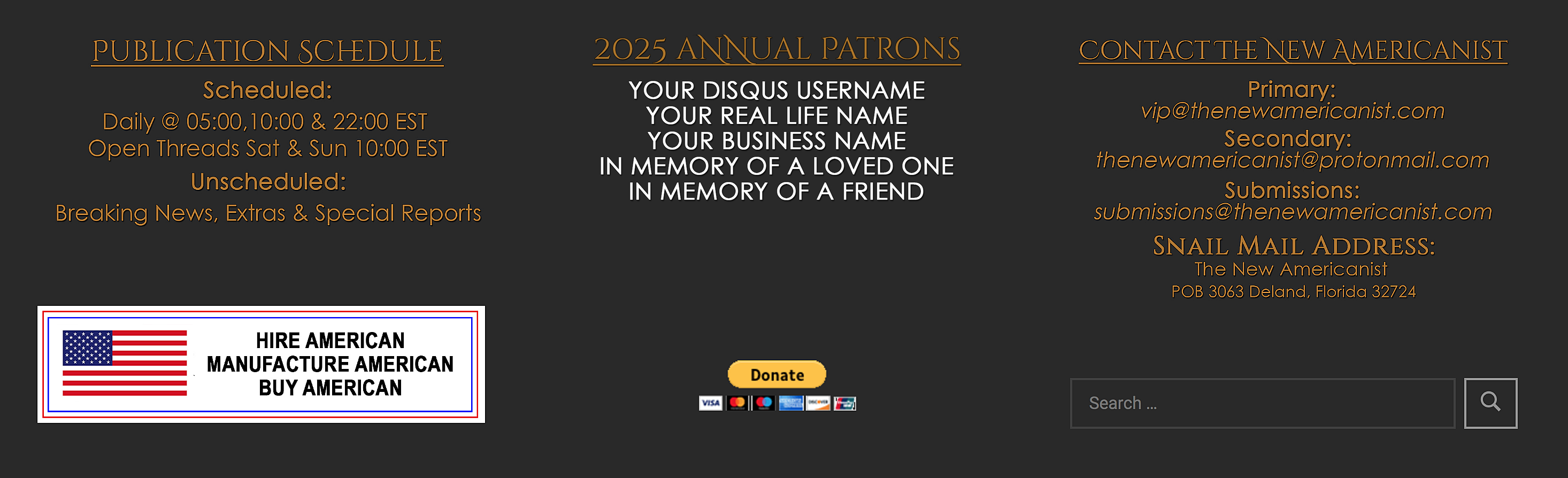
As an Annual Patron you can list either your real life or online username, business name including web address (sorry no phone numbers) or a tribute to a living or deceased love one. If you have questions, please contact me via email.
✪ NEW MONTHLY CHALLENGE AMOUNT FOR FEB – DEC 2025
I am requesting a new monthly challenge goal amount in 2025 of $2500 beginning in February. Creating and maintaining TNA each day is a full time job position which requires between 60-80 hours per week researching, rewriting, editing, graphics, formatting and publishing. Final challenge totals for 2024 consistently averaged between $2100-2300 each month. This new monthly amount will allow me to continue to make quality the top priority.
✪ NEW NON PAYPAL DONATION OPTION
If you don’t care for PayPal’s woke business culture & attitude; or their fees, you can now use ZELLE to easily make online purchases or donations. ZELLE is already installed inside your online banking. There’s no need to register, create an account or enter any debit or credit card information. ZELLE provides safe, secure and immediate electronic transfers directly between your bank and your recipients. It’s also completely FREE and already built into your bank or credit union’s online banking account page. If you haven’t used ZELLE before, you only need to activate it. A simple, two minute process which can be found at this link:

THANK YOU FOR YOUR CONTINUING SUPPORT
YOUR DONATIONS KEEP US GOING STRONG!
▶️ DONATE VIA PAYPAL (DEBIT OR CREDIT CARD)
ALL PayPal Transactions Are Encrypted For Card Holder Privacy & Security
▶️ DONATE VIA ZELLE (DIRECT DIGITAL CASH TRANSFER)
ZELLE is a simple, secure, easy, fast and FREE way to send money directly to recipients directly from your online banking page or app without a middleman.
If you’ve already activated ZELLE in your bank or credit union account, you may make a donation by using The New Americanist ZELLE Address:
vip@thenewamericanist.com
If you haven’t yet activated ZELLE in your bank or credit union account, easy to follow instructions (a simple two minute process) may be found here:
▶️ DONATE VIA SNAIL MAIL

COUNTDOWN TO INAUGURATION DAY 2025



▶️ CLICK HERE TO VIEW
▶️ 2 Hours 9 Minute 8 Seconds
▶️ 17 Minutes 36 Seconds
▶️ 18 Minutes
▶️ 14 Minutes 53 Seconds
▶️ 12 Minutes 31 Seconds


