


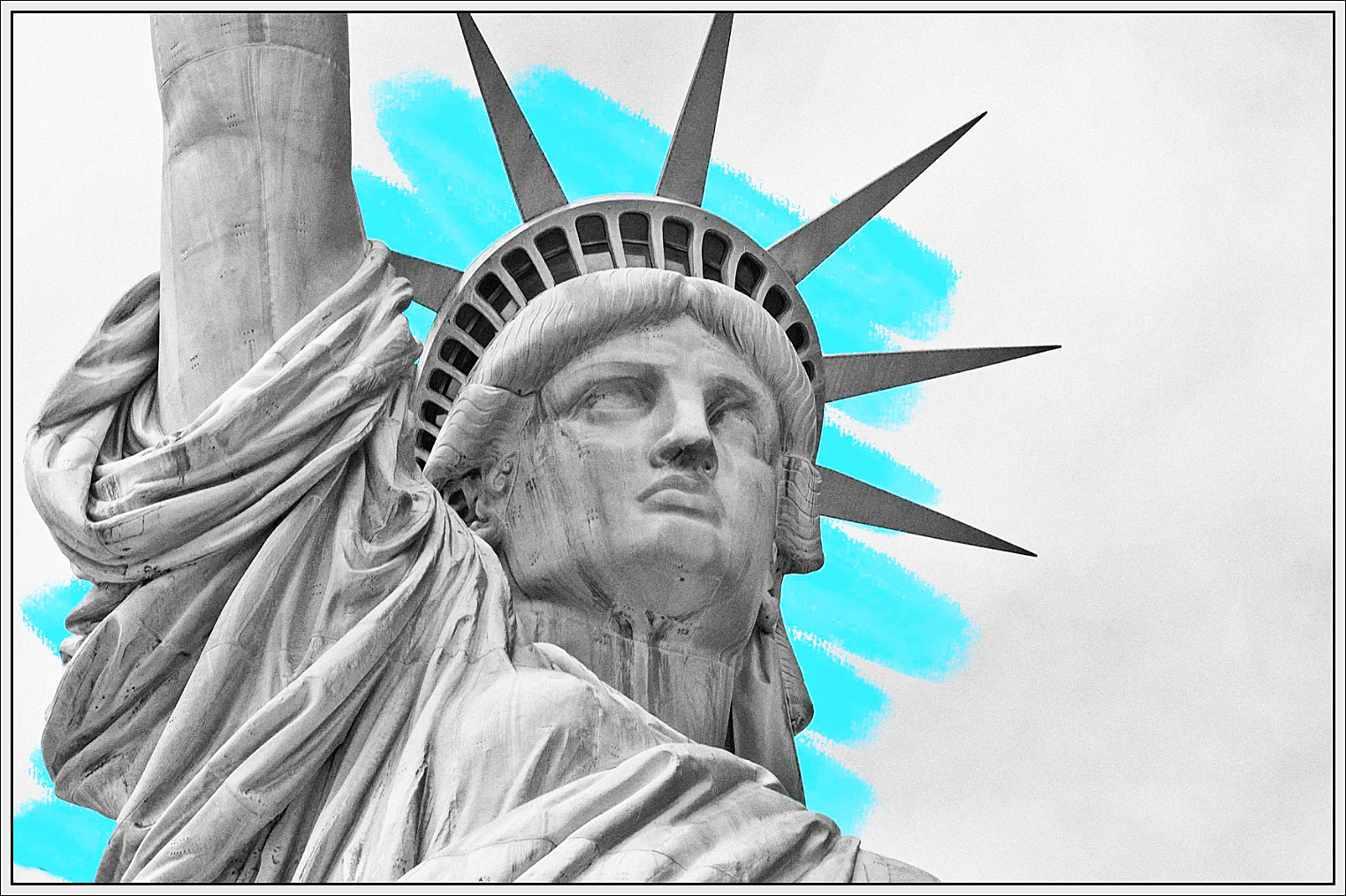

✪ Expecting everyone to speak English is merely recognition of cultural reality & a signpost for new Americans seeking to assimilate and prosper…
▶️ FEATURED ARTICLE: CLICK HERE TO READ

mmm
ast Friday, Donald Trump signed an executive order making English the official language of the United States, ending a time period of 249 years in which the country did not have an official language. A designation the United States has shared only with Mexico and the Pacific archipelago nation of Palau. The order also rescinds a 2000 Bill Clinton mandate requiring aid-dispensing agencies to provide language assistance to non-English speakers, while leaving the door open to agencies to do so if they choose. While the Left will undoubtedly cry “nativism” and “xenophobia” over this development during the coming days, the order’s wording, historical perspective and common sense show this is a necessary step towards strengthening the “melting pot” by uniting as “a citizenry that can freely exchange ideas in one shared language.”
First, it’s necessary to understand why America has never had an official language. From its colonial beginnings, America had an Anglophone supermajority but also a smattering of other languages. At the nation’s founding in 1776, New York, Pennsylvania, and sections of the Appalachian backcountry harbored large minorities of German and Dutch speakers. Establishing a state language went no more with the libertarian character of the Revolutionary generation than establishing a state religion, which the First Amendment expressly forbids. But America’s political economy assured voluntary assimilation anyway; and America’s great Founding documents and debates, from the Federalist Papers to Common Sense, were written and published in English, a shared language that brought the Union together and made its ideals legible to citizens in South Carolina just as easily as in Massachusetts.
For the next century and a half, the absence of a welfare state incentivized almost all Americans to learn English and preserve our linguistic commonality even if they remained bilingual or spoke a different language at home. In a world with no public safety net, learning the language that 90 percent of your potential employers, customers, employees, and clients speak was a no-brainer. Thus, by 1800, almost all Germans living in Philadelphia (one-third of the city) spoke English. A century later, most Germans who had settled in the Midwest were at least bilingual, and some knew only English. By the mid-20th century, most of the Poles, Italians, Hungarians, and other Eastern Europeans who arrived in the great immigration wave of 1880-1914 spoke English. The number of Italian-Americans who speak the old country’s language today is 550,000, well under 5 percent of all Americans of Italian heritage. That’s no mystery because those groups arrived in the U.S. overwhelmingly before the New Deal and Great Society welfare programs existed and thus assimilated faster than more recent waves of immigrants.
Today, while many immigrants strive for the American dream and learn English on their way to assimilation. However, the existence of a vast state and federal welfare system has slowed the process for some and completely halted it for others. According to the U.S. Census Bureau, 8.3 percent of Americans do not speak English “very well” (admittedly an amorphous line). That is one in twelve Americans for whom our common debates are inaccessible, or accessible only through imperfect translations, for whom the Preamble or the Gettysburg Address do not have the cadence and clarity they possess only in English. Where America’s traditional impetus to assimilation is enervated by government meddling in the economy, an executive order like Trump’s, which explicitly seeks to “help newcomers engage in their communities, participate in national traditions, and give back to our society,” makes perfect sense.
Common languages unite people with other differences, ease communication, reduce confusion (which is particularly helpful in business), and widen the sphere of people from whom we can learn and with whom we can converse, reason, and understand. In short, common languages are wonderful things for nations and individuals to have. Recall that the confusion of man’s languages in Genesis 11:1-9 was God’s punishment.
In The Jakarta Method, historian Vincent Bevins relates how Indonesia, a nation comprising over 900 inhabited islands with a breathtaking array of regional and island-specific languages, forged a national culture after winning independence from the Dutch. The Indonesians formed a new state, in part, by rallying around a formerly barely-used national language, Bahasa Indonesia.
Bevins writes in the endnotes, “In the 1930 census, only 2% of Dutch East Indies residents spoke Malay as a first language. By 1980, [Bahasa] Indonesian was used at home by …. 36 percent of city dwellers and a large proportion of age groups. Now in Indonesia, almost everyone in Indonesia can speak Bahasa Indonesia to some degree, though they may speak other languages at home.” Indonesia’s independence leader, Sukarno, recognized early on that in a land teeming with Christians, Muslims, Buddhists, Hindus, and a bazillion ethnicities, common values and a common language in which to discuss them could keep the nation together. Our country can learn from the Indonesian example.
Today’s America is dizzyingly diverse. America houses speakers of at least 350 languages, and one in five Americans speak a language other than English at home (although many of these speak English in public or in the workplace). This diversity makes a shared national language imperative.
Trump’s order recognizing English as our national language is not a xenophobic knee-jerk reaction to other tongues. It does not preclude agencies from offering help in other languages if they so choose but removes the stupendous legal requirement to help in any language someone might speak, no matter how rare or exotic.
It does not look down on immigrants or discourage recent immigrants from speaking their native languages as well as English. It is a recognition of reality and a signpost for new Americans seeking to assimilate and prosper. It is a reasoned reflection of our foundational national desire to take the talented and ambitious of the world who wish to share in our heritage of liberty and unite them in a common culture and cause. There is a phrase for that: E pluribus unum. ✪














▶️ DONATE VIA PAYPAL (DEBIT & CREDIT CARD)
ALL PayPal Transactions Are Encrypted For Card Holder Privacy & Security
▶️ DONATE VIA ZELLE (DIRECT BANK CASH TRANSFER)
ZELLE is the perfect online alternative to PayPal. It’s an incredibly simple, secure, easy, fast and FREE way to send or receive money to recipients directly from your online banking account without a middleman. Best of all, there’s NO fees.
ZELLE is a service provided by your bank and is already built in to your online banking account. You only need to activate it first before using. If you’ve already activated ZELLE in your online bank or credit union account, you can donate to The New Americanist by using our ZELLE address:
vip@thenewamericanist.com
To activate your ZELLE, follow these easy instructions (a simple two minute process):

▶️ DONATE VIA SNAIL MAIL




▶️ CLICK HERE TO VIEW
▶️ 1 Hour 39 Minutes 10 Seconds
▶️ 1 Hour 16 Minutes 42 Seconds
▶️ 6 Minutes 23 Seconds
▶️ 6 Minutes 50 Seconds
▶️ 9 Minutes 27 Seconds
▶️ 1 Hour 2 Minutes 17 Seconds
▶️ 6 Minutes 13 Seconds
▶️ 8 Minutes 1 Second ⭐️ Gary Brown
▶️ 18 Minutes 59 Seconds
▶️ 13 Minutes 49 Seconds
▶️ 13 Minutes 54 Seconds
▶️ 15 Minutes 10 Seconds
▶️ 3 Minutes 29 Seconds
▶️ 5 Minutes 31 Seconds
▶️ 4 Minutes 19 Seconds
▶️ 15 Minutes 40 Seconds ⭐️ Deplorables Know Libs Suck
▶️ 9 Minutes 43 Second
▶️ 5 Minutes 50 Seconds
▶️ 5 Minutes 56 Seconds
▶️ 2 Minutes 2 Seconds ⭐️ Louisiana Mom
▶️ 11 Minutes 44 Seconds ⭐️ The New Logical Show
A NEW video podcast produced by TNA’s very own bet125. Make certain you SUBSCRIBE & LIKE.
Let’s all support new Conservative Media. 😎
