


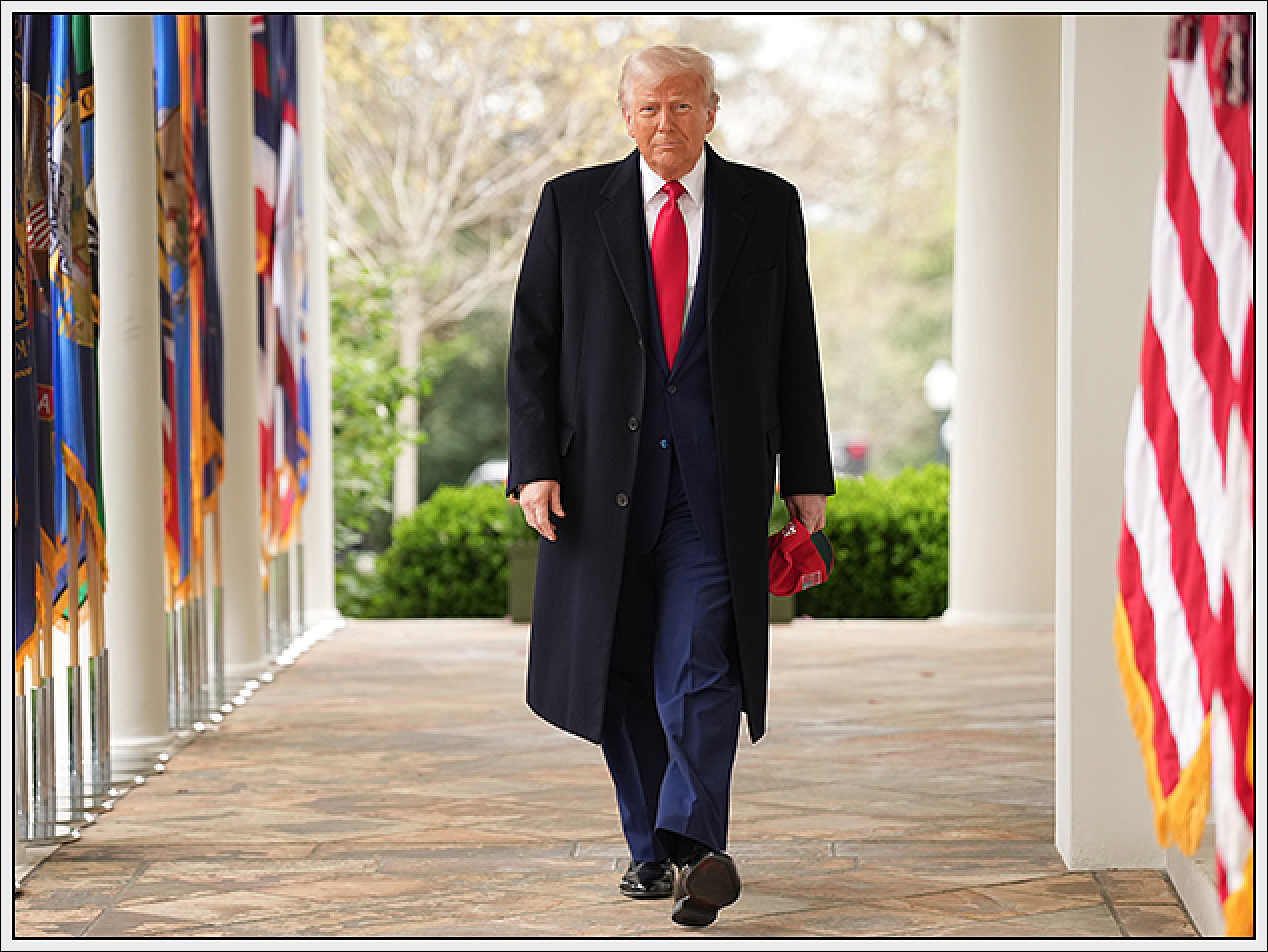

✪ For decades, American elites have spoken of free trade as though it were a moral commandment engraved in stone—unquestionable, sacred, eternal. Tariffs, they say, are relics of the past. Economic heresy. An automatic road to higher prices, shrinking output, and worldwide retaliation…
▶️ FEATURED ARTICLE: CLICK HERE TO READ

ooo
hat they won’t tell you; and what most of them don’t know, is that some of the most brilliant economists in history developed a working theory which proved exactly the opposite: under the right conditions & application, tariffs can make a country richer.
This economic idea has a formal name; Optimum Tariff Theory, and it has been around since long before modern economists started pretending free trade was a universal standard. Long before Donald Trump ever uttered the word “tariff,” British and classical economists were working out the details of exactly how, when, and why a powerful country could use tariffs to tilt global trade and economic power in its favor.
If that sounds familiar, it should because Trump’s trade policy—especially his 10 percent baseline tariff on all imports—is the near perfect real world application of this theory. However before we go any further,, it’s worth pausing to understand what Optimum Tariff Theory actually says.
✪ Optimum Tariff: The Idea Behind Trump’s Trade Strategy
The core mechanism within Optimum Tariff Theory is this: when a country and its economy is big enough, it can influence world prices. Correspondingly, the United States is not a small, open economy. We are the world’s largest buyer of goods. Whenever we buy less of something, the world notices & prices move.
Next, imagine we place a tariff on imports. That’s just the equivalent of a tax at the border which raises the domestic price of a foreign product. As a result, we buy less of it. However, if we represent a major share of the overall global demand for that product—such as steel, semiconductors, autos, solar panels, whatever—the global price will start to fall. The country selling it can’t easily find other buyers and supply then outstrips demand. So, the price drops.
In such scenarios, the tariff doesn’t only just make the product more expensive at home. It exerts pressure and pushes down its world price; so in the end, we wind up paying less for it than we would have without the tariff. Yes, we give up some volume of trade, however what we do trade, we trade on better terms. This principle is what economists call a terms-of-trade gain.
Here’s where the Optimum Tariff Theory gets its name. If you raise tariffs too high on imports, then you’ll lose too much volume and any potential gains vanish. If you don’t raise them at all, you leave bargaining power on the table. However, there’s a sweet spot of a “just right” rate—a point at which the terms-of-trade improvement outweighs the lost trade volume. That’s the Optimum Tariff.
For example, if your local supermarket doubled all its prices tomorrow, you’d probably shop somewhere else. However, if there’s only one store in town, and it raises its prices only slightly, most people will continue to shop there and pay the price. That store has market power and so do we.
Of course, there’s always a catch. If every country did this—if every nation tried to raise tariffs to extract better deals—then overall global trade could shrink. Worse, other countries could retaliate with tariffs of their own. That was the primary concern of many of the classical economists who developed this theory. And for decades, it became the reason to ignore it. Free trade was treated not just as policy, but as an economic ideal and virtue.
Yet the Optimal Tariff Theory never completely disappeared.
✪ The Forgotten History of Strategic Tariffs
In the mid-19th century, a British economist named Robert Torrens showed how tariffs could improve a country’s trading position by shifting the balance of demand between nations. John Stuart Mill followed him with a more rigorous treatment; introducing the idea how much a country gains from a tariff depends on the elasticity of its trading partner’s supply. In other words, how easily they could or could not sell their products elsewhere.
Later in the century, Alfred Marshall and Henry Sidgwick constructed graphic models demonstrating how countries could adjust trade volumes to improve their outcomes. Francis Edgeworth introduced the idea of trade indifference curves—economic maps of national welfare—and demonstrated precisely where the maximum gain from tariffs could be extracted. The Optimum Tariff Theory grew more precise, more elegant, and harder to ignore.
Then in 1906, C.F. Bickerdike finally delivered the mathematical knockout. He proved, with equations, that a modest tariff imposed by a country with market power—one that imported goods whose world supply was not perfectly elastic—could raise national income. He even derived the formula still cited today by economists who admit, if only in footnotes, that yes, tariffs can indeed work.
By the time Nicholas Kaldor published his now-famous 1940 essay, “A Note on Tariffs and the Terms of Trade,” the heavy lifting had already been done. However, Kaldor did provide something very essential: he clarified and consolidated the entire theory into a framework which could be taught, diagrammed, and easily replicated. He took the complex interplay of reciprocal demand and indifference curves and presented it in a clean, two country, two good model. In Kaldor’s version, tariffs shift a country’s offer curve outward—meaning they demand more favorable terms for the same level of trade—and the point of tangency with their trading partner’s offer curve moves to a higher indifference curve, representing a net welfare gain.
Kaldor walked the reader through each step of the logic:
If a country is large enough to affect world prices, then a tariff reduces the quantity imported, drives down the global price of that good, and allows the country to re-import it at a discount. The result? The country keeps more value from each trade—a net improvement in national welfare.
He was careful in cautioning against too large tariffs and his work assumed there would be no retaliation. He even prefaced his argument by reaffirming his own general support for free trade. But the effect of his paper was clear even among the strongest proponents of free traders. The logic and benefits behind the Optimum Tariff was now undeniable.
Economists would later go on to enshrine Kaldor’s diagram in textbooks, but often stripped it of context. It was often presented as more of a curiosity, a theoretical aside, instead of what it truly was: a powerful rebuttal to the idea that free trade is always the best policy.
So why was the Optimum Tariff Theory ultimately buried? Because it undermined the happy, feel good talk of mutual gain. Because it suggested that trade was not always a win-win proposition, but often win-lose. Because it demonstrated how powerful nations could become richer by shifting the burden of demand and supply to weaker ones.
Trump didn’t cite these economists & he doesn’t need to. His instincts have told him what has already been proved in theory: America has economic power and leverage. We are the buyer everyone wants to sell to. When we put a modest price on the access to our market, we get better deals in return. That’s the logic behind Trump’s 10 percent baseline tariff. That’s the logic behind reciprocal tariffs.
The textbooks may have forgotten, but Trump remembered. ✪



















▶️ DONATE VIA PAYPAL (DEBIT & CREDIT CARD)
ALL PayPal Transactions Are Encrypted For Card Holder Privacy & Security
▶️ DONATE VIA ZELLE (DIRECT BANK CASH TRANSFER)
ZELLE is the perfect online alternative to PayPal. It’s an incredibly simple, secure, easy, fast and FREE way to send or receive money to recipients directly from your online banking account without a middleman. Best of all, there’s NO fees.
ZELLE is a service provided by your bank and is already built in to your online banking account. You only need to activate it first before using. If you’ve already activated ZELLE in your online bank or credit union account, you can donate to The New Americanist by using our ZELLE address:
vip@thenewamericanist.com
To activate your ZELLE, follow these easy instructions (a simple two minute process):

▶️ DONATE VIA SNAIL MAIL




▶️ CLICK HERE TO VIEW
▶️ 1 Hour 02 Minutes 55 Seconds ⭐️ Cued @1 Hour 2 Minutes 55 Seconds
▶️ 24 Minutes 53 Seconds
▶️ 11 Minutes 09 Seconds
▶️ 17 Minutes 27 Seconds
▶️ 20 Minutes 28 Seconds
▶️ 12 Minutes 43 Seconds
▶️ 27 Minutes 2 Seconds
▶️ 17 Minutes 48 Seconds
▶️ 20 Minutes 16 Seconds
▶️ 15 Minutes 07 Seconds
▶️ 5 Minutes 49 Seconds
▶️ 7 Minutes
▶️ 17 Minutes 29 Seconds ⭐️ The New Logical Show
A NEW video podcast produced by TNA’s very own bet125. Make certain you SUBSCRIBE & LIKE.
Let’s all support new Conservative Media. 😎
▶️ RSBN LIVESTREAM LINK: Trump Visit to Walter Reed
⭐️ TokaiseBlessedPatriot
