


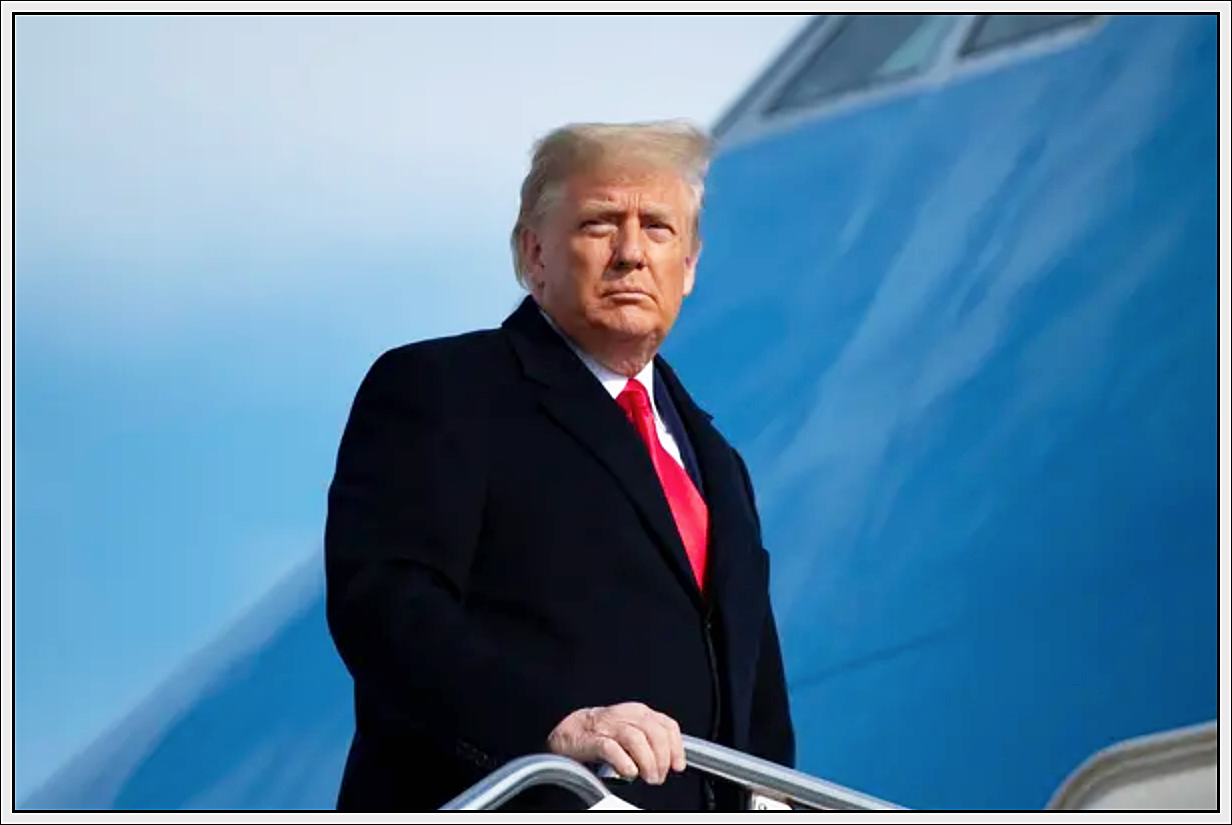

✪ Lower courts don’t have any authority to usurp the powers of the Executive Branch through restraining orders & injunctions, no matter what the SCOTUS says...
▶️ FEATURED ARTICLE: CLICK HERE TO READ

bbb
he Supreme Court’s shocking decision on Wednesday to allow a D.C. district court judge to order the Trump Administration to disburse $2 billion in federal grant money is a major blow to the separation of powers undergirding our constitutional system of government.
However, the thing about separation of powers is that they either stand or fall together. All three branches of our government — Legislative, Executive and Judicial — must respect the Constitution’s clear separation of powers. If one of them doesn’t, there’s no binding reason the others should either.
Put another way, if the Supreme Court can simply disregard the Executive Branch’s constitutional authority and allow it to be usurped by an inferior Federal court, which is what happened, then there’s no reason the Executive Branch under Trump should pay any attention to what the Supreme Court says in this case, because it’s trying to assert an authority it simply doesn’t have.
Here’s what happened. As part of an administration-wide effort to crack down on fraudulent and wasteful federal spending, President Trump ordered a review of all federal grants, and also ordered that payments on all grants should be paused while the review is ongoing. Some of those grant recipients sued, and in a 5-4 decision handed down Wednesday, the Supreme Court denied a request by the Trump Administration to vacate a recent ruling by D.C. District Court Judge Amir Ali (a Biden appointee) that ordered the State Department and United States Agency for International Development (USAID) to disburse about $2 billion in federal grants to nongovernmental groups for “work already completed.”
In mid-February, Ali had issued a temporary restraining order that prohibited the Trump Administration from pausing the disbursement of funds, arguing that the respondents were likely to succeed in showing the government violated the Administrative Procedures Act. After issuing this restraining order, Ali apparently grew frustrated by the slow pace of the disbursement of funds and on Feb. 25 issued a second order requiring the government to pay out about $2 billion in grant funds within 36 hours.
The Trump Administration responded by filing an application to the SCOTUS asking it to vacate Ali’s order and issue a stay on his ruling. Chief Justice John Roberts granted an administrative stay and referred the administration’s petition to the full court for review.
The high court’s decision came down Wednesday, 5-4, with Roberts and Associate Justice Amy Coney Barrett joining the court’s Democrat appointees to deny the Trump Administration’s request. The majority didn’t give a reason for this denial, which is too bad, because the ruling should trigger a constitutional crisis.
In a blistering dissent, Associate Justice Samuel Alito slammed the majority for giving a green light to the lower court’s judicial overreach. “Does a single district-court judge who likely lacks jurisdiction have the unchecked power to compel the Government of the United States to pay out (and probably lose forever) 2 billion taxpayer dollars?” Alito wrote. “The answer to that question should be an emphatic ‘No,’ but a majority of this Court apparently thinks otherwise. I am stunned.”
Alito is completely right to be stunned. Here is a case in which a district judge, Ali, is explicitly claiming for himself executive authority to disburse federal funds and determine the time and manner in which the funds will be disbursed — powers clearly vested not in the judiciary but in the Executive Branch; that is, with President Trump. Ali simply brushed aside the Trump Administration’s argument that sovereign immunity barred the enforcement order and arrogated to himself the right to exercise executive powers.
This on its own should be reason enough for the Trump Administration to ignore the Supreme Court’s decision to let the lower court’s order stand. But there’s other problems too, like the fact that the lower federal court in this case lacks jurisdiction. Contract disputes with the Federal Government are only supposed to be heard by the Court of Federal Claims, not a D.C. district judge. Among other things, this means Ali’s order requires President Trump to violate existing federal law.
Another problem is that Ali labeled his order a temporary restraining order to make it impossible to appeal, even though it’s obviously not a temporary restraint of actions but a proactive order that requires the government to take specific and immediate actions — in 36 hours no less, leaving the administration almost no time to appeal or even review the legality of the order. As Alito wrote in his dissent:
“The order here, which commanded the payment of a vast sum that in all likelihood can never be fully recovered, is in no sense ‘temporary.’ Nor did the order merely ‘restrain’ the Government’s challenged action in order to ‘preserve the status quo.’”
The most serious problem, though, is this pernicious notion that any district judge, anywhere in the country, can dictate to the Executive Branch what it must or must not do, under the guise of issuing a temporary restraining order or a universal injunction in a pending case. In the first Trump Administration, anti-Trump plaintiffs simply venue-shopped for the most radical anti-Trump judges they could find to ask for universal injunctions and temporary restraining orders against nearly everything the Trump White House tried to do. It was easy to find judges willing to comply with this abuse of judicial power, just as it is this time around.
But it’s almost certainly a violation of the U.S. Constitution. In 2018, Associate Justice Clarence Thomas suggested as much in a concurring opinion in Trump v. Hawaii, which reversed a lower court’s decision to uphold a nationwide injunction on Trump’s travel ban. Thomas wrote:
“District courts, including the one here, have begun imposing universal injunctions without considering their authority to grant such sweeping relief. These injunctions are beginning to take a toll on the federal court system — preventing legal questions from percolating through the federal courts, encouraging forum shopping, and making every case a national emergency for the courts and for the Executive Branch.”
Thomas continued, writing he was “skeptical that district courts have the authority to enter universal injunctions,” noting that such injunctions didn’t emerge until a century and a half after the Founding, and “appear to be inconsistent with longstanding limits on equitable relief and the power of Article III courts. If their popularity continues, this Court must address their legality.”
The Supreme Court had an opportunity here to address the legality of the lower court’s use of a temporary restraining order to commandeer the executive branch’s constitutional authority, but it didn’t. That’s a shame, because if this kind of judicial overreach continues, the Trump administration might conclude, correctly, that it has little choice but to ignore the decrees coming from activist lower court judges — no matter what façade of legitimacy the Supreme Court might choose to give them. ✪



















▶️ DONATE VIA PAYPAL (DEBIT & CREDIT CARD)
ALL PayPal Transactions Are Encrypted For Card Holder Privacy & Security
▶️ DONATE VIA ZELLE (DIRECT BANK CASH TRANSFER)
ZELLE is the perfect online alternative to PayPal. It’s an incredibly simple, secure, easy, fast and FREE way to send or receive money to recipients directly from your online banking account without a middleman. Best of all, there’s NO fees.
ZELLE is a service provided by your bank and is already built in to your online banking account. You only need to activate it first before using. If you’ve already activated ZELLE in your online bank or credit union account, you can donate to The New Americanist by using our ZELLE address:
vip@thenewamericanist.com
To activate your ZELLE, follow these easy instructions (a simple two minute process):

▶️ DONATE VIA SNAIL MAIL







▶️ CLICK HERE TO VIEW
▶️ 1 Hour 16 Minutes 44 Seconds
▶️ 33 Minutes 31 Seconds
▶️ 11 Minutes 1 Seconds
▶️ 23 Minutes 3 Seconds
▶️ 16 Minutes57 Seconds
▶️ 11 Minutes 54 Seconds
▶️ 9 Minutes 44 Seconds
▶️ 15 Minutes 10 Seconds
▶️ 13 Minutes 36 Seconds ⭐️ Gary Brown
▶️ 3 Hours 11 Minutes 08 Seconds
▶️ 6 Minutes 30 Seconds
▶️ 20 Minutes 51 Seconds
▶️ 13 Minutes 44 Seconds
▶️ 11 Minutes 15 Seconds
▶️ 8 Minutes 35 Seconds
▶️ 6 Minutes 20 Seconds
▶️ 8 Minutes 1 Second
▶️ 15 Minutes 29 Seconds
▶️ 23 Minutes 23 Seconds
▶️ 2 Minutes 2 Seconds ⭐️ Louisiana Mom
▶️ 11 Minutes 44 Seconds ⭐️ The New Logical Show
A NEW video podcast produced by TNA’s very own bet125. Make certain you SUBSCRIBE & LIKE.
Let’s all support new Conservative Media. 😎
